

An international research team has created a system based on laser lights and small telescopes that is able to read millimeter letters at an impressive distance.
Image that illustrates the operation of the laser device. Credit: Physics / Physical Review Letters / Liu
The researchers created a super device based on an advance laser technology and two little ones telescopes able to view letters of a few millimeters well 1.36 kilometers away. This is an exceptional result that will have a significant impact in physics experiments, as well as in the development of innovative Imaging technologies And sensors Equipped with great resolution And precision. Just think that this system has made it possible to improve the spatial resolution of Ben 14 times with respect to the use of a single telescope. The device is based onintensity interferometrya technology widely used in the field astronomical And astrophysical To view the objects of the deep sky distant.
As explained by NASA, interferometry “is a imaging technique in which the waves are superimposed in order to cause interference”. Generally we talk about electromagnetic waves Like those of light. Thanks to interferometry it is possible to obtain extremely precise measures in numerous scientific, industrial and communications sectors. There are various types of interferometers; those in intensity have the characteristic of “dribblare” the effects of the atmospheric turbulence he is optical defectsFor this reason it is particularly precious in the space sciences. The operating principle lies in the fact not to directly measure the bright waves, but in collecting data by analyzing the way the light interacts and reflects. For this reason it is based on multiple bright sources and more optical devices to process an accurate image.
The new experimental device capable of reading millimetric letters at 1.36 kilometers away was developed by an international research team led by Chinese scientists from the National Research Center of Hefei for the physical sciences on Microscala and the School of Physical Sciences of the University of Science and Technology of China, who collaborated in close contact with colleagues from various institutes. Among those involved, the institute of optics and precision mechanics of Xi’an, the theoretical physics center of the Massachusetts Institute of Technology (MIT), the TD Lee Institute of the Jiao Tong University of Shanghai and the physics departments of the University of Stockholm and Arizona. The researchers, coordinated by the professors Lu-Chuan Liu and Qiang Zhang, prepared the new device by equipping it with eight laser rays designed to hit tiny targets over 1 kilometer away; The interference of their light and reflection can be resolved thanks to two telescopes positioned strategically.
A colossal “hole” of 1 million kilometers opened on the sun and is facing the earth
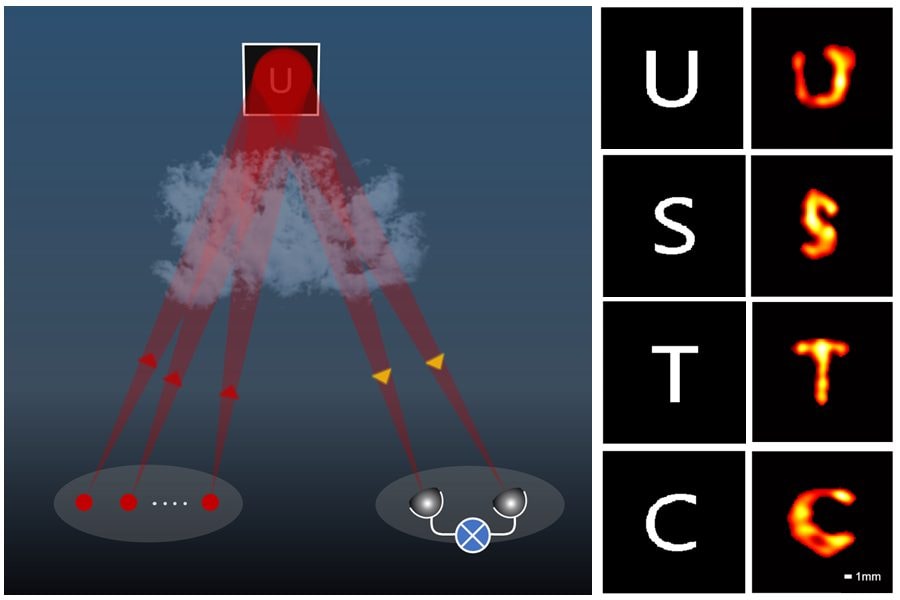
The operation of the device. Credit: Physics / Physical Review Letters / Liu
The system was installed in a building and the target was located inside another almost 1.4 kilometers away. These were tiny squares of 8 millimeters with some letters of the alphabet inside, as shown in the image above. During the experiment the two telescopes were removed from 7 to 87 centimeters, while the target was rotated up to 360 °. With the right settings, after having “shot” the eight laser rays against the objectives they managed to obtain a resolution of Ben 3 millimeterscompared to 42 millimeters which would have obtained using a single telescope (therefore insufficient to correctly view the text). This means an improvement of 14 times thanks to the intensity interferometry. The result can be even better by integrating artificial intelligence algorithms ad hoc.
“The new work represents a significant technical progress in the humaging of distant objects that do not emit their own light,” Dr. Shaurya Aarav, a scholar of quantum optics at the University of the Sorbonne in Paris, said in a press release. “The fact that they can resume objects of millimetric dimensions with mileage is truly impressive,” Eco Eco His colleague Ilya Starshynov of the University of Glasgow was echoed. The details of the “Active Optical Intensity Interferometry” research were published on Physical Review Letters.