
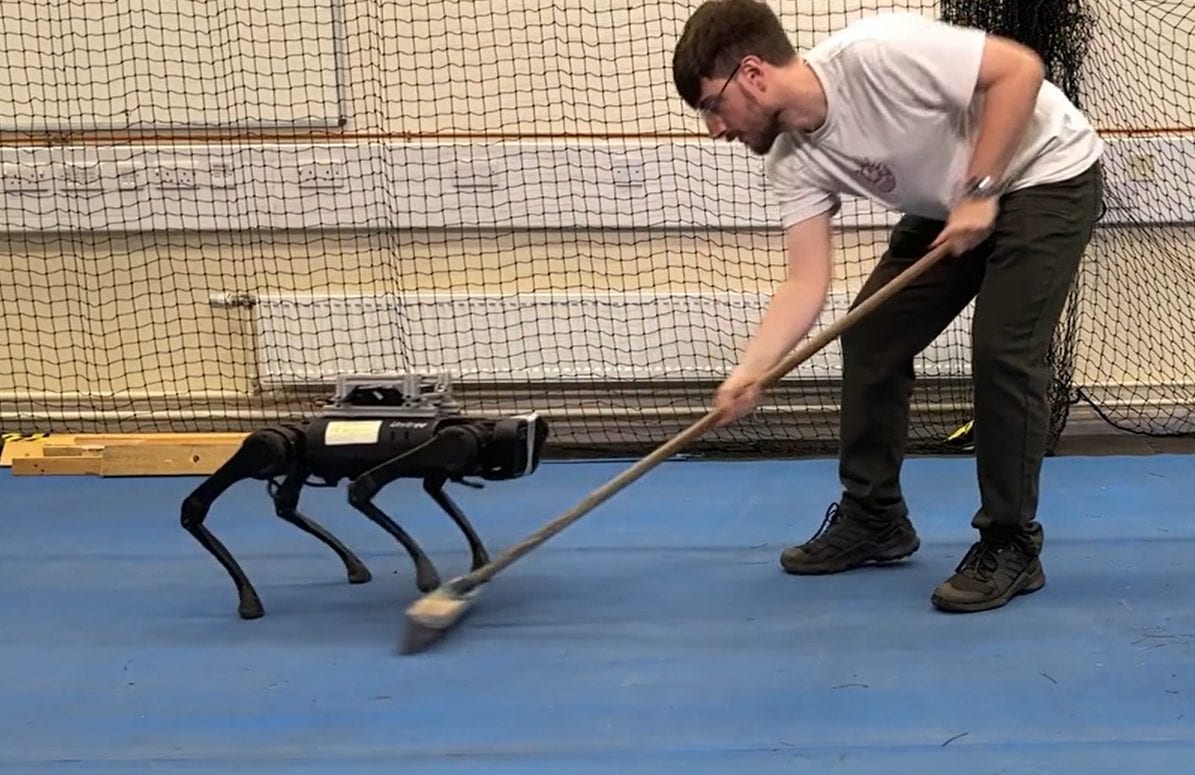
The robot dog hit with the legs with a broom. Credit: Joseph Humphreys, University of Leeds
The researchers developed aartificial intelligence (Ia) revolutionary for i Robot dogsable to make them travel any type of land rough – also never crossed before – as a real animal. The new model is the first framework which allows these robots to adapt to disconnected land in real timeadapting gait and movements on the basis of roughness and what they have previously learned. It is a substantial difference with the IAs for robot dogs of the previous generation, which allowed to face rough paths, but only on the basis of preset programs. In this case the robot responds independently and in the most effective way possible to the surrounding environment. This, in certain contexts, can also make the difference between life and death. Just think of a robot dog of rescue sent among the rubble of a collapsed palace; Only by dynamically adapting to the unknown path that has in front of it would be able to complete its mission, reaching and identifying any survivors. It is therefore an evolution substantial.
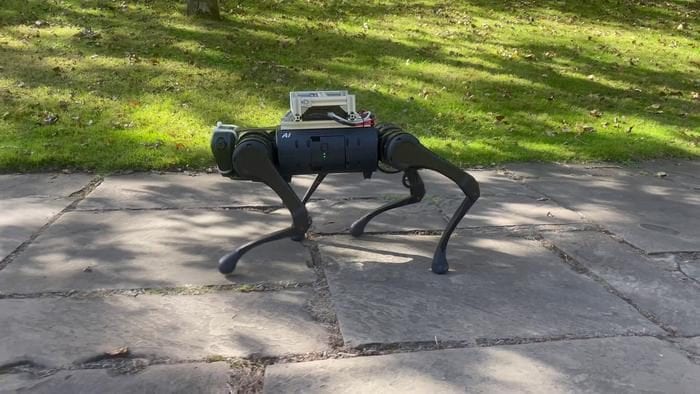
The two scientists Joseph Humphreys and Chengxu Zhou, respectively of the mechanical engineering faculty of the University of Leeds and the information department of the University College London, were the innovative IA for robot dogs. The two researchers prepared the new IA by developing a framework of learning with deep reinforcement on a computer; In simple words, it is a set of software that allows you to learn through interactions with complex environments. The source of inspiration for the two researchers was that of reality animal behaviorwith three sales points: energy saving, adaptability of movements based on the roughness of the soil and the memory of the pace. By combining these three things it is possible to obtain increasingly fluid and natural movements, which also improve by virtue of theexperience acquired.
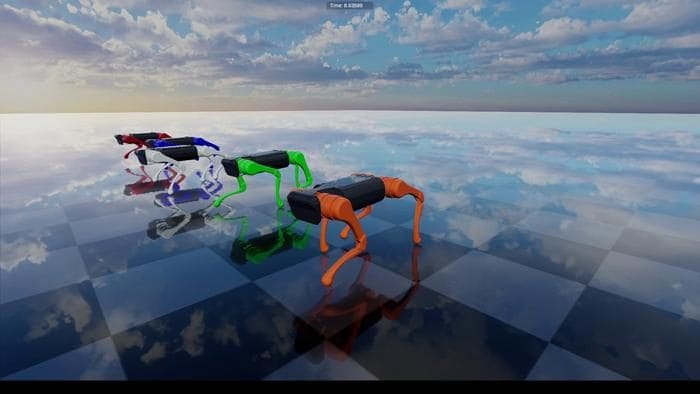
The simulation for training. Credit: Joseph Humphreys, University of Leeds
A particularly fascinating detail of this work lies in the fact that the IA was trained on a computer and then was downloaded in the robot dog, called Clarence; It was not the robot that learned how to walk on accidental land, but his “brain” was loaded with the data to perform this operation, immediately obtaining success once he tried. “It is similar to Matrix, when neo’s ability in martial arts is discharged into its brain, but does not undergo any physical training in the real world,” he explained in a press release with a convincing parallelism Dr. Humphreys.
How is it possible that Grok Lodi Hitler and after two days Musk already present his new model
The robot, as the video above shows, has been put to the test on multiple surfaces, by floors full of wooden boards with turf with mud, passing through gravel, chips, unstable platforms and other rough conditions. In the most extreme test it was soon to Fucking shots on legs To verify if it was able to adapt even in emergency situations (imagine the rubble that can collapse under the weight of the robot). In all cases, thanks to the innovative IA, Clarence managed to successfully overcome the paths, responding and adapting to the unexpected events how a real mammal would have made in such a situation. All this can lead to enormous benefits not only in the case of rescue operations after a disaster, but also in many other contexts, from spatial exploration to outdoor work. “Our long -term vision is to develop artificial intelligence systems embodied, including humanoid robots, which move, adapt and interact with the same fluidity and resilience of animals and human beings,” said Professor Zhou.
The first robot dog shop has recently opened in Italy, whose prices range from 2,000 to 10,000 euros, for specimens with specialized services. The Boston Dynamics robot spot dog is the guard around the White housethanks to the multiple “anti -intrusion” sensors with which it is equipped. The details of the new research “Learning to adapt Through Bio-Inspired Gait Strategies for Versatile Quadruped Locomotion” were published in Nature Machine Intelligence.