
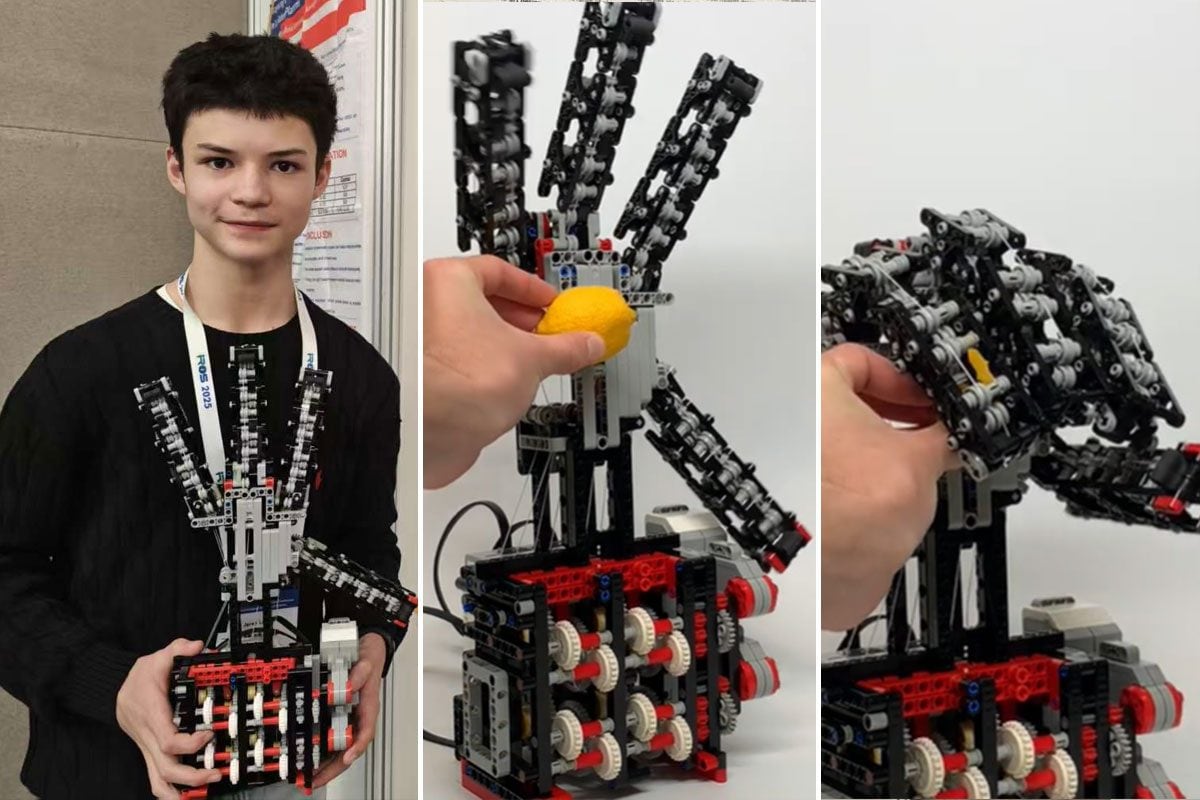
Jared Lepora, 16, presented his robotic hand made entirely of Lego at IROS 2025
At just 16 years old, Jared Lepora, built a robotic hand using only Lego pieces, capable of grasping objects and grasping objects of different shapes and sizes in an adaptive way. The device, named Educational SoftHand-Aimitates the natural movement of human fingers, allowing a stable but delicate grip.
The project was recently described in a study published in pre-print on ArXivin which Jared explains, with the help of his father, Professor Nathan Lepora of the University of Bristol, how the hand works and its potential applications in learning robotics. “I wanted to create something accessible and replicable, which could aid in understanding the principles of adaptive grasping, without the need for expensive laboratory instruments” explained the boy.
The hand has four fingers and is based on SoftHand of Pisa/IITa world-leading robotics project, which uses a tendon system to synchronize the movement of the fingers. Jared adapted this concept, replacing the 3D printed components and metal pads with standard Lego pieces (Lego Mindstorm) and replicating the tendon system for each finger.
Bouncing heads, fists of steel and subliminal messages: what’s happening at the Robot Olympics
Jared presented his hand at IROS 2025, the International Conference on Robots and Intelligent Systems which was held from 19 to 25 October 2025 in Hangzhou, Chinawhere he illustrated the results of his work and distinguished himself as the youngest speaker. His intervention received widespread acclaim for the combination of creativity, technical rigor and informative spirit.
According to experts, Lepora’s hand represents a concrete example of how innovation can arise even from simple tools. “It is a model that works and can be studied as a reference for more complex robotic gripping systems” reads the reviewers’ comment. The modular design and economical materials make it a potential teaching tool for students and soft-robotics enthusiasts.
The robotic hand made entirely of Lego
the tests conducted by Jared Lepora have demonstrated surprising results: the robotic hand built entirely with Lego pieces is able to grasp with approximately 90% of the strength of a professional 3D printed SoftHandcompleting an opening and closing cycle in about one second.
The fingers, thanks to a soft synergy mechanism, adapt automatically to the shape of the objects — from balls to cups — evenly distributing force through a network of replicating Lego gears the behavior of human tendons.
Educational SoftHand-A is not just an ingenious experiment: it represents a bridge between research robotics and the training of new generations of engineers, demonstrating that simple tools and accessible materials can be the basis for high-impact innovations. Experts point out that projects of this type could make advanced robotics more inclusive, facilitating the understanding of the principles of mechatronics and adaptive control.