
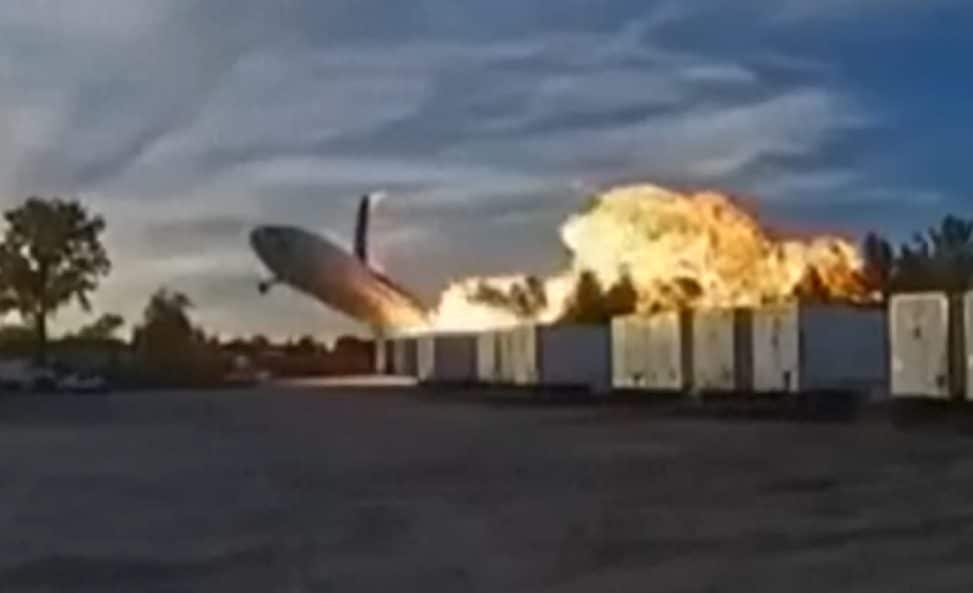
The frame of a video that captures the dramatic plane crash in Louisville. Credit: YouTube
As the days pass, new dramatic videos continue to arrive of the plane crash in Louisville (United States) involving the flight UPS 2976which crashed immediately after takeoff into the buildings of a recycling company (Kentucky Petroleum Recycling) and one that deals with auto parts (Grade A Auto Parts). The crash occurred at exactly 5.13pm (local time) on November 5, in front of Louisville International Airport (SDF). Give her Images you can clearly see that the aircraft, a McDonnell Douglas MD-11 (F) cargo headed to the “Daniel K. Inouye” international airport in Honololu (Hawaii), had its left wing on fire, before taking off and crashing into the buildings a few seconds later. The pilot took off despite being well aware of the aircraft failure, due to exceeding the so-called “speed of no return”, a speed – technically known as V1 or speed of decision – beyond which the flight of a plane on the runway can no longer be safely stopped, which therefore forces it to take off despite everything. We will be back soon.
The impact of the plane resulted in the death of at least 14 peopleincluding the three pilots on board: Commander Richard Wartenberg, First Officer Lee Truitt and Captain Dana Diamond. There would still be missing and some dead to be identified, due to the gigantic fireball released by the collision of the aircraft, loaded with fuel ahead of the 8 hour flight. It is unclear whether it was carrying toxic substances.
As far as dynamics are concerned, the MD-11’s 34 years old (not a high age for freighters) has lost the left engine as it took off – it is not clear whether due to structural failure or some explosive event – and the pieces hit the second, causing the disaster. UPS and FedEx grounded their MD-11s as a precaution (they have several in the fleet), while the following day the Federal Aviation Administration (FAA) has extended the initiative to all these models for thorough inspection, in order to avoid potential similar accidents.
Boeing 737 Max hit in flight by an unidentified object: hypothesis of space debris, damage and injured pilot
The speeds of an airplane at takeoff: V1, Vr and V2
What is certain is that there was an alarm in the cabin for several seconds, but the pilot, despite being well aware of the fault, still took off, in the hope of being able to control the aircraft and bring it back to the runway with an emergency landing. Everything revolves around the take-off speed of a plane, which is not unique but is based on three fundamental stages: V1 or Decision Speed (decision speed); Vr or Rotate Speed (rotation speed); And V2 or Takeoff Safety Speed (safe take-off speed). The cargo pilot Joseph Diebolderknown on YouTube as “Captain Joe,” detailed the differences between these speeds, which indicate why the MD-11 pilots were forced to take off despite a burning wing and warnings. It should be underlined that, as highlighted by the specialized pilot training portal baatraining.com, these speeds “they’re not just numbersbut they are the result “of accurate calculations based on weight of the aircrafton the length of the runway, on the weather conditions and more”, therefore it is essential to understand them “to appreciate the delicate balance that makes a successful take-off possible”.
The V1, explains Captain Joe (over 1.7 million followers on YouTube), is the decision speed, that is, the speed beyond which take-off can no longer be interrupted, even in the presence of a problem or failure. Within V1, the pilot can still abort the takeoff by braking the aircraft; beyond it the plane can no longer be stopped safely and you are forced to take off. This critical and “no return” speed is calculated before each flight and, as specified, is based on multiple parameters, from the weight of the aircraft to the weather. The UPS’s MD-11 had evidently overtaken V1 and was therefore forced to take off, in the hope that the pilot could control it and bring it back to the ground immediately with an emergency landing.
The Vr, the rotation speed, is the one at which the pilot pulls the control stick back and the front landing gear it detaches from the runway, because at that point sufficient lift is generated to allow take-off (it is called rotation speed because the aircraft begins to rotate on the transverse axis). The V2, the German pilot finally explains, is the “safe takeoff speed“, i.e. the minimum level at which the plane can continue to climb safely even if one of the engines is not working (remember that the MD-11 has three, two on the wing and one on the tail).”This is critical because it ensures that the aircraft has enough lift and control to maintain the climb trajectory” also in critical conditionshighlights the expert in the video. In the case of the Louisville crash, unfortunately, both main engines were lost and the plane hit power cable pylons before crashing into buildings.