
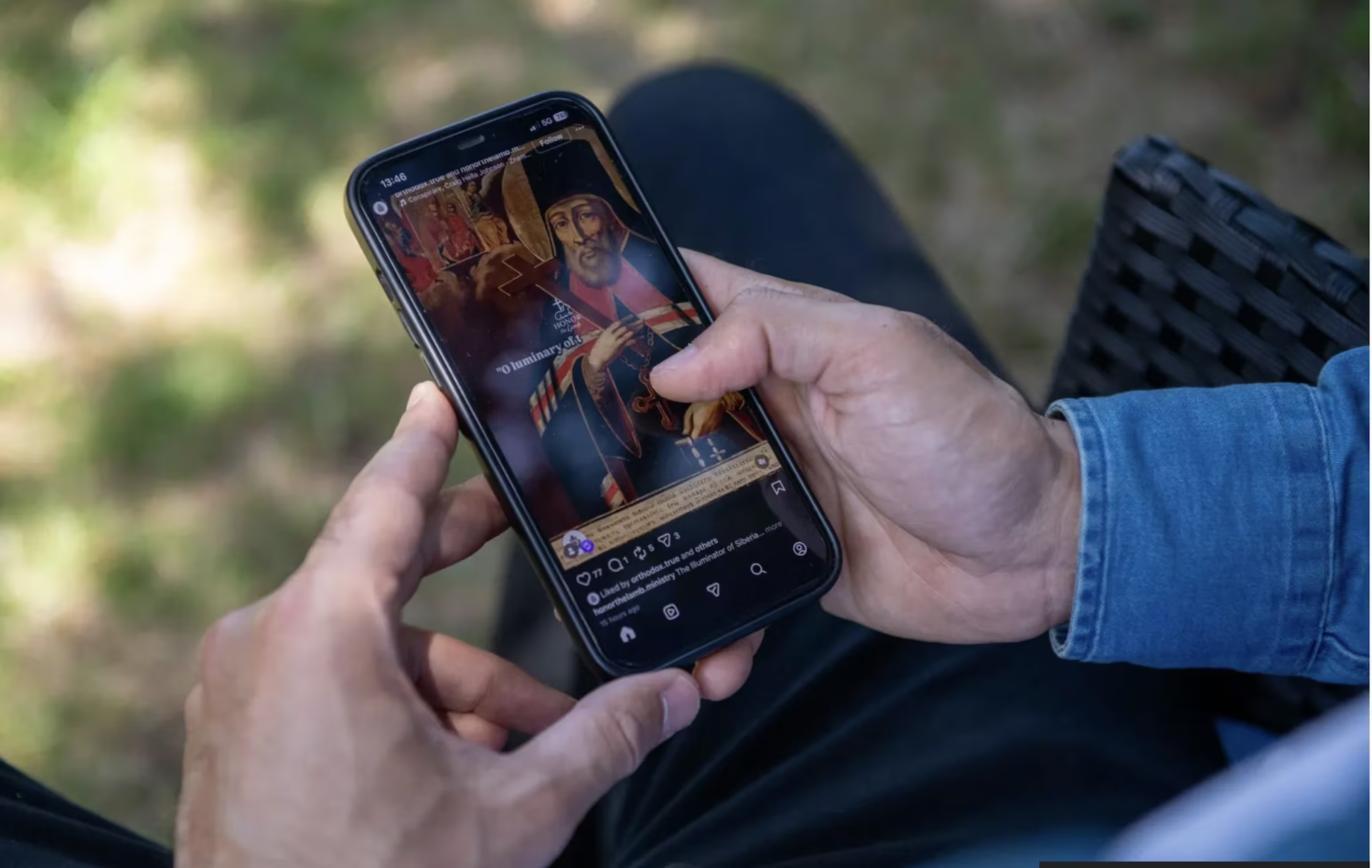
Marios is a personal trainer, works in London. After realizing that he was spending too much time in front of his smartphone, he decided to follow a 12-session therapy program dedicated specifically to smartphone addiction. We are talking about a topic that has been much discussed in recent months, on which there are already several legislative proposals.
There is an expression that is often coming back when it comes to social networks: “Big Tobacco Moment”. Historically, the Big Tobacco Moment is the phase in which consumers understood the health consequences of tobacco. Now we’re talking about the “Big Tobacco Moment” for i social networks every time something more emerges about their effects, as happened in the trial held in Los Angeles courthouse this spring. On the one hand Big Tech were deployed which represent social media and platforms, on the other approximately 1,600 users who wanted to demonstrate the effects of social network addiction. The case reported by the BBC is a little more complex. Marios is a man, around 40 years. He works as a personal trainer in London. He explained to journalist Ruth Clegg that for some time he has understood have a problem with your smartphoneso much so that I decided to start a cycle of 12 therapy sessions. The beginning of the interview is quite explanatory: “It’s a feeling I’ve had for many years: this uncontrollable need to be on the phone. It’s like having your own personal drug dealer with you.”
In fact the screenshots confirm it. The problem starts from Instagram: Marios says it’s ‘his downfall’. And then it falls on the other apps. “My medicine is always in my pocket, flashing, beeping and reminding me to take a dose.” During the trial in Los Angeles, KGM, one of the plaintiffs, also raised the same problem. In his case the addiction was even more accentuated: we are talking about 16 hours a day spent only on Instagram. A use that Adam Mosseri, head of Instagram, had defined as “problematic” but not an addiction.
The problem of social network addiction
Of course, it is very difficult for social networks to be able to provoke lung or mouth cancers. What remains to be understood are the cognitive effectshow they can change the way we perceive ourselves and others, our relationships and even the management of dopamine flows. It is difficult to do scientific studies on long term: think about the age of the social networks we use now. Facebook was born in 2004, Instagram In the 2010 And TikTok In the 2016. And they all changed a lot when they integrated recommendation mechanisms.
In Italy we need a law to disconnect the elderly from social media, not just teenagers
If they were before spaces in which to talk and peek at what others were doing, over time they have become platforms for vertical contents defined by the algorithm. Every time we swipe down it’s a bit like pulling the lever of a slot machine. We can find the content more in line with our expectations or the most disappointing one of the day. In the last year the topic has arrived on the bench of governments, especially in the West.
Some countries have banned the use of social networks for younger users, starting with Australia. Others, however, are discussing legislative proposals. In Italy there are open discussions on the ban on social media for younger users and also a bill on algorithmic addiction, signed by Lorenzo Bass And Anthony Nicita. Among the points of this proposal there is also the blocking of infinite scrolling, that system whereby after each video on social media we can always find another one.