
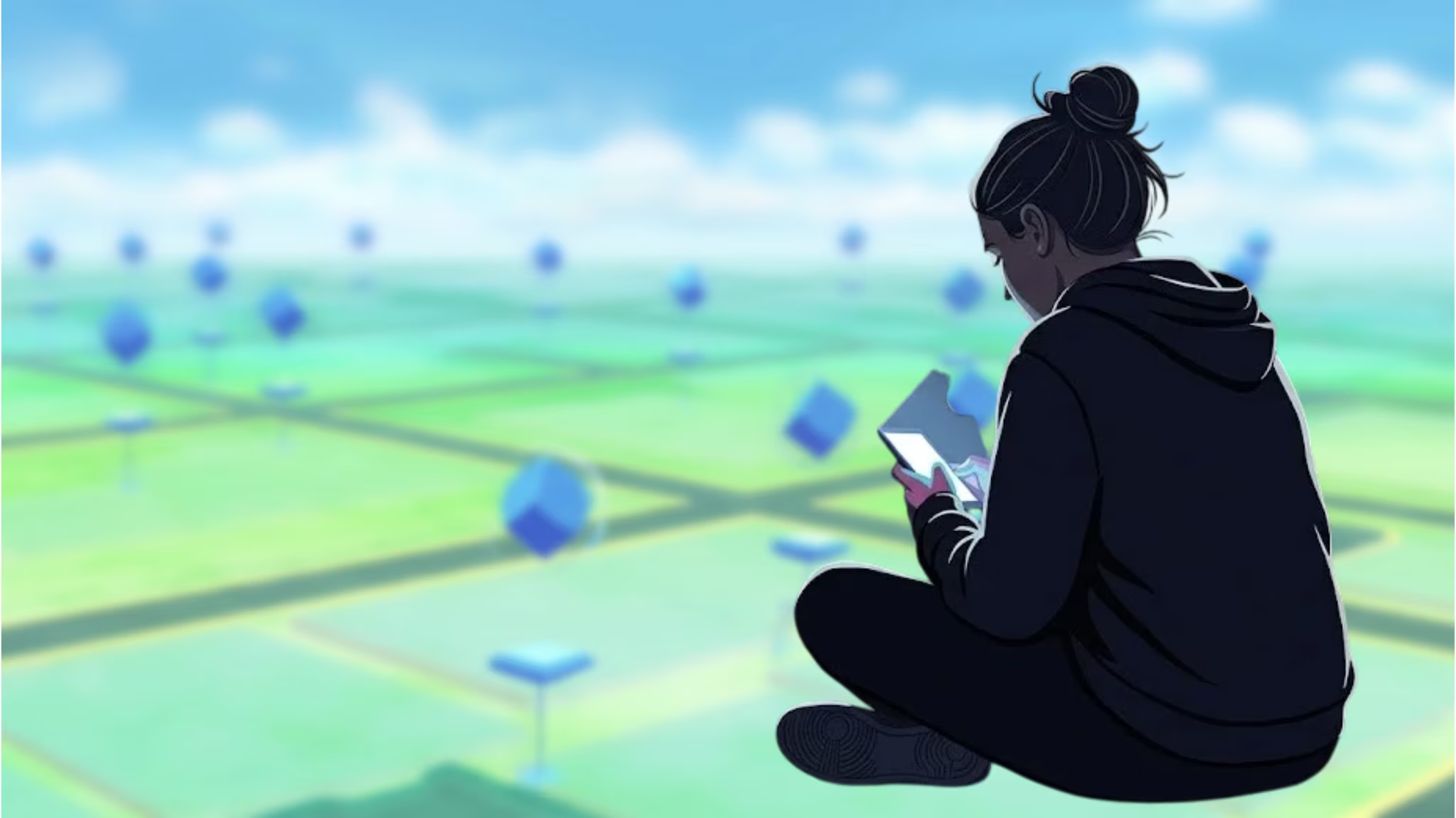
New possibilities, even more monsters to catch. Pokémon Go offers an experience that is different in its components but unchanged in its essence. I downloaded the app 10 years after the summer the whole world started playing it.
July 2016. I’m back home, in Sicily, for the summer holidays. However, what awaits me is not the usual routine of the sea and evening outings in Catania, because all my friends have downloaded Pokemon Go. It is a free augmented reality video game for smartphones that invites players to explore the real world to catch Pokémon. All this using the device’s geolocation. So I decide to join the club, a bit out of FOMOpartly because, as a millennial, Pokémon are Pokémon. Hence a completely different summer from what I was used to, made up of walks in the Etna villages to do the raids on gymshatch eggs and, of course, try to capture the 151 little monsters required by the Pokédex. I saw my country of origin with different eyes. It truly seemed like a magical place populated by adorable creatures I had grown up with. Not only that: with Pokémon Go, I discovered evocative places close to where I was born and raised, such as the salt pans of Paternò and the Saracen Bridge in Adrano.
Meanwhile, in those days, the press was talking about the impact of Pokémon Go on a global level: beyond 50 million downloads worldwide three days after launchgrowth of domestic tourism, up to the most absurd stories related to capture. Like that of the Australian policemen, forced to invite players not to enter the police stations to capture the pokémon that appeared nearby. Or the one he involved New York City: A wild Vaporeon that appeared in Central Park at night had attracted hundreds of people, many of whom left their cars in the middle of the street, blocking city traffic. In other words, Pokémon GO had become a mass phenomenon.
How Pokémon Go has changed: the return after the explosion
Once I returned to everyday life in Rome, I continued to play Pokémon Go. But only for a few months. The bond was mainly due to that summer spent at home with lifelong friends. Ten years later I am still in Rome, with Pokémon Go installed on my phone again. A colleague convinced me, on the occasion of the anniversary. He’s been playing with it since 2016. I expected to find an app more or less the same as the one I left behind. Instead it is very different. Today the Pokédex has almost a thousand monsters, including alternate forms and Mega Evolutions. Then there are fights with other trainers, exchanges, research missions, events that change what appears on the map. It’s a much more layered video game, although it remains accessible even for those just starting out. Meanwhile, over the years, a collateral ecosystem made up of third-party apps. There are legal ones, such as PokeRaid, which allows you to obtain an invitation to participate remotely in raids, i.e. battles against legendary Pokemon. There are others that are frowned upon by the community and hindered by the manufacturer Scopely Explore, which alter geolocation to allow you to participate in raids far from your location.
Nostalgia for PES, a manga has been published in which the protagonist is reincarnated within the video game
The most obvious difference, however, concerns the atmosphere. In 2016, all you had to do was open the app to meet groups of strangers running to the same gym. Ten years later everything is calmer. Which is understandable, once the hype of the launch has passed. This doesn’t mean it’s unpopular, however. Today Pokémon Go matters 5 million daily users. The game’s users range from 18 to 50 years old, with the 30-40 year old group being the most widespread. The community itself appears more consolidated. Last July 11th and 12th the Pokemon Go Festthe annual global, digital gathering celebrating gaming. For the occasion, events are organized around the world and within the app. In the case of the 2026 Festival, it was possible to capture two Mewtwo Mega Evolutions. Tokyo, Chicago and Copenhagen are the cities involved. In general, Pokémon Go often welcomes initiatives, in-game and in cities, to keep the community active. And the answer is still positive. This participation also has an impact on tourism. In these ten years the Niantic app has contributed to spread of the staycationthat is, a holiday focused on exploring your own city, or nearby places, but with a Pokémon twist.
The company behind the game has also changed. In 2025, Niantic’s gaming division was acquired for $3.5 billion by Scopely, part of a Saudi Arabia-funded business group. The news alarmed the community about the transfer of data to a company supported by Public Investment Fund of Saudi Arabia. As for Niantic, today its name is Niantic Spatial and specializes in geospatial technology and artificial intelligence. The most recent project concerns Coco Roboticsa global home delivery service using robots trained using scans and geospatial data collected with Pokémon Go’s augmented reality. One thing about the game that has perhaps remained unchanged is its social power. During a raid, it still happens that you see people stop, say hello and collaborate without ever having seen each other before. Sharing a Pokémon or a battle can even be the spark for a friendship. In short, after ten years, Pokémon Go remains a less noisy but still relevant phenomenon for millions of players around the world. Me included.