
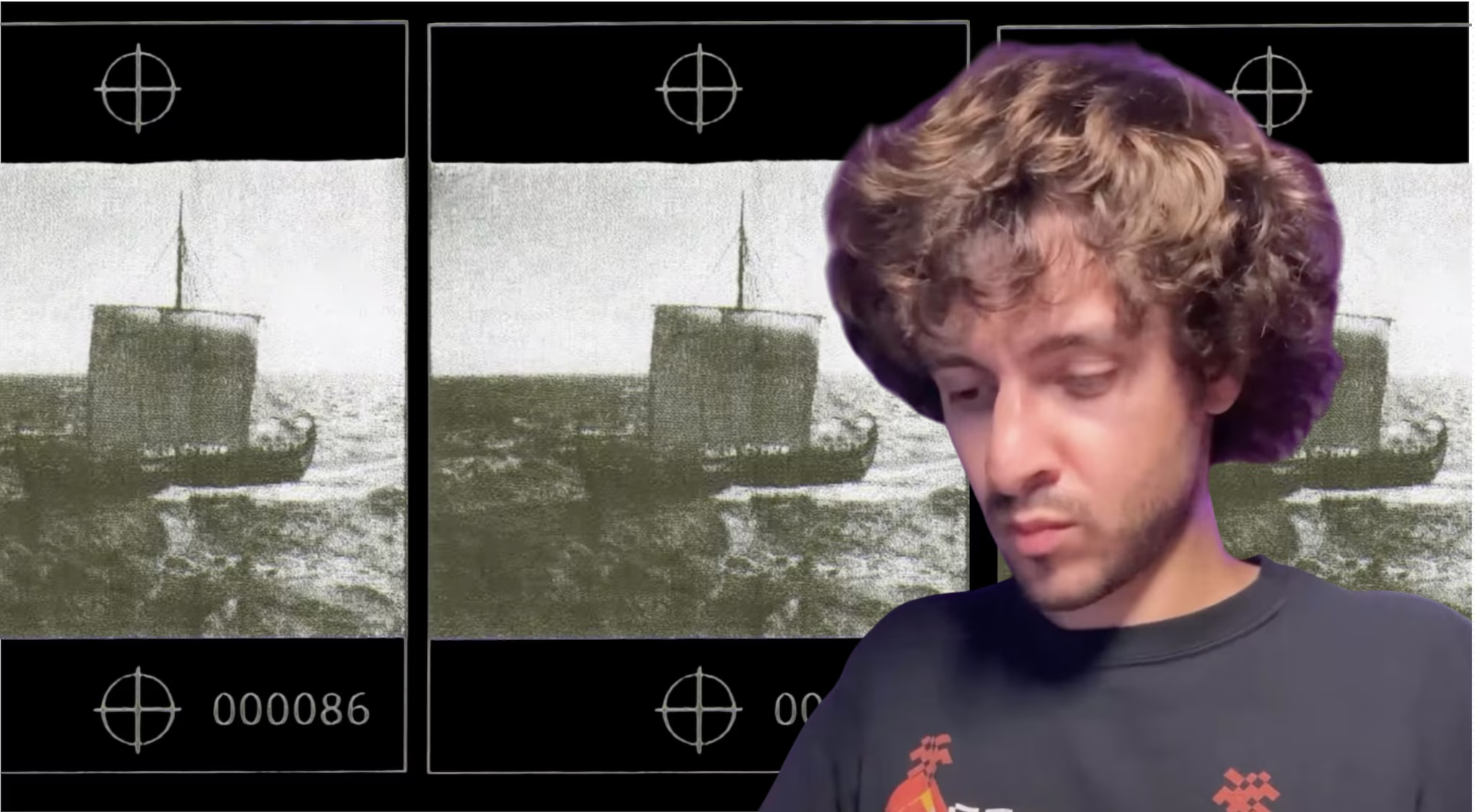
Filippo Cavallaro printed the scenes from The Odyssey on the thermal paper normally used for receipts. At this point he sequenced the images and created a version of the film in one of the worst possible quality.
Christopher Nolan has raised the bar, again. The director of Interstellar And Memento wanted to experiment with a new format for The Odysseyhis latest film which arrived in theaters on July 16th. Technically it’s called 70mm IMAX. All scenes from the story of Odysseus, played by Matt Damon they were shot with 70 mm analogue film, therefore wider than the normal one which is usually 35 mm. Not only that: the film uses a square format, namely IMAX. The result is a film that when compared to digital formats comes to a 18K resolution. However, we already know all this. Much of The Odyssey’s advertising campaign was based on his technical feats. What was perhaps difficult to imagine is that a movement of users would try to lower in any way the quality designed by Nolan to see his film. Furthermore, in Italy there are no theaters that distribute films in 70 mm IMAX format.
In recent days the meme has gained traction on social media As Nolan Intendedin Italian we can translate it with As Nolan intended. In short, thousands of users are sharing on social media how they managed to transform The Odyssey in the visual experience more as low as possible. Some people watch it on a smartwatch, some on an old TV with a cathode ray tube, some on a Tamagotchiwho on PS Vita and who can convey it in a grainy virtual reality mush. Often these are just images from the trailer, sometimes directly photomontages. Effectively photos of The Odyssey seen from the display of a pregnancy test they are a little suspicious. The user Filippo Cavallaro but he decided to go further.
Filippo has a profile on social media which has now reached 13,000 followers. His latest video racked up 1.4 million views in just over a day. Of the whole meme As Nolan Intended is perhaps the most creative video. Filippo took the trailer of The Odysseybroke it down into frames and then printed each individual frame onto the thermal paper that is used for receipts. At this point he scanned all the frames, recomposed and aligned them and then put them together to shoot an alternative trailer in which each scene only has shades between black and white. Nothing more lo-fi. Almost everything was done by hand. From what we see the only help came from a script on Pythona short code that was used to divide the printed frames and align them. Printers can also be easily found on the market: they are those from Glovo and Deliveroo. The scan was done with one of those home printers with a built-in scanner.
Styropyro’s latest experiment is “lightning in a bottle”: the creator dusts off a seventeenth-century discovery
The video clearly blew up. And perhaps for Filippo it could inaugurate a format. In his profile there are already several videos in which he plays with images generated by devices that are not exactly at the forefront of the sector: one Kodak DC 3200 from 2000 taken for 2 euros or one Fujifilm IX-30 from 2001 bought for 10 euros. There is also precedent for minifilms printed on thermal paper. On May 8th he published a video very similar to the one on The Odyssey in which he transformed the x-ray of his knee in a small film where every sequence was printed by a receipt machine. Now it has definitely improved the whole process.