
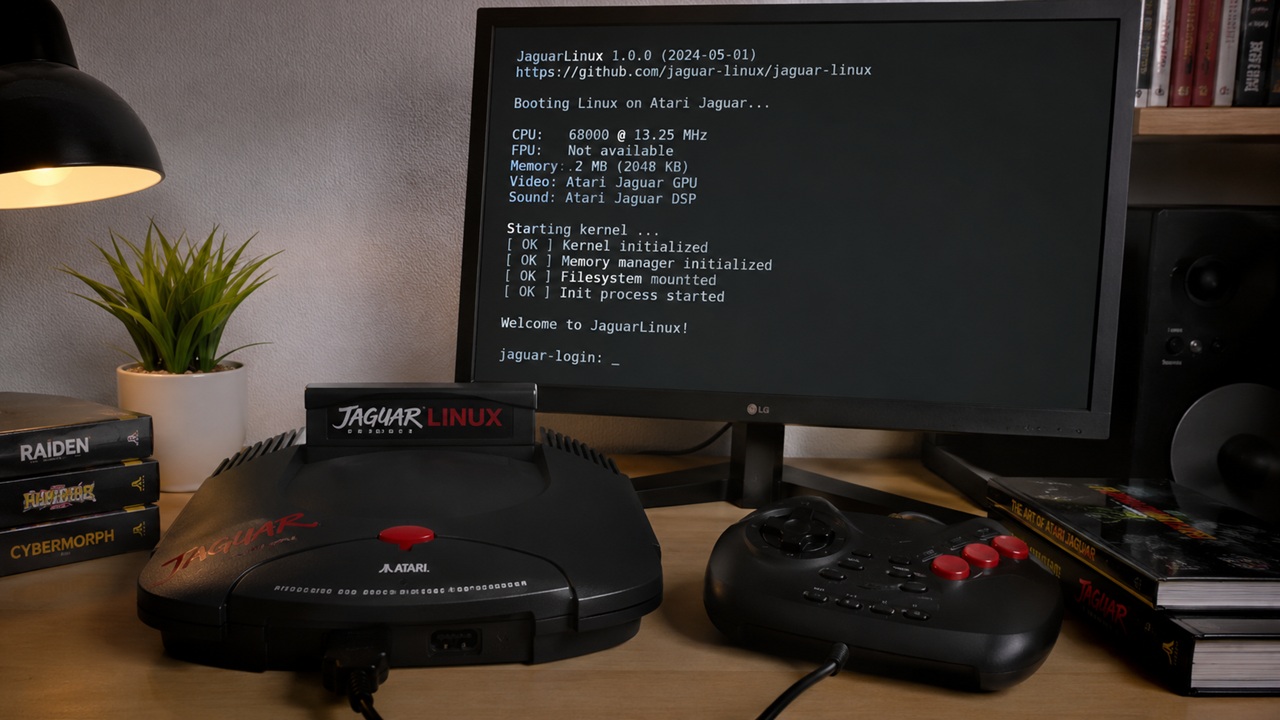
THE’Atari Jaguar demonstrated once again the extraordinary flexibility of Linux kernel through a project that seemed impossible. A Spanish software developer, known as cakehonolulu, has managed to complete a working port of the operating system on the historical one Atari console from 1993despite a platform characterized by extremely limited resources and a decidedly unusual architecture.
The objective of the project does not concern daily use of the console, but rather a technical demonstration of the possibilities offered by open source software even on hardware considered more than obsolete. In fact, the result allows you to start a Working Linux kernel along with the shell BusyBoxboth on one Atari Royal Jaguar via cartridge both within a dedicated emulator. The project has been extensively documented on GitHub.
The main difficulty comes precisely from the characteristics of the console. The Atari Jaguar uses a Motorola 68000 processor at 13.3 MHzsupported by coprocessors Tom And Jerrydedicated respectively to graphics and audio processing. Atari presented the system as a 64-bit console, but in practice most of the processing passed through the Motorola 68000, while Making full use of coprocessors was complex even for video game developers of the time.
Another particularly severe limit concerns the available memory. In fact, the console has only 2 MB of RAM and up to 6MB ROMextremely small values for a modern operating system. This further complicates the work the absence of one Memory Management Unit (MMU)a component normally used by Linux for memory management.
To overcome this obstacle, the project leveraged historical architectural support m68k present in the Linux kernel along with uClinuxan initiative created precisely to allow the operating system to run on processors without MMUs. This basis allowed Linux to be adapted to the Motorola 68000 from Jaguar, but required numerous specific interventions to make the software compatible with the console hardware.
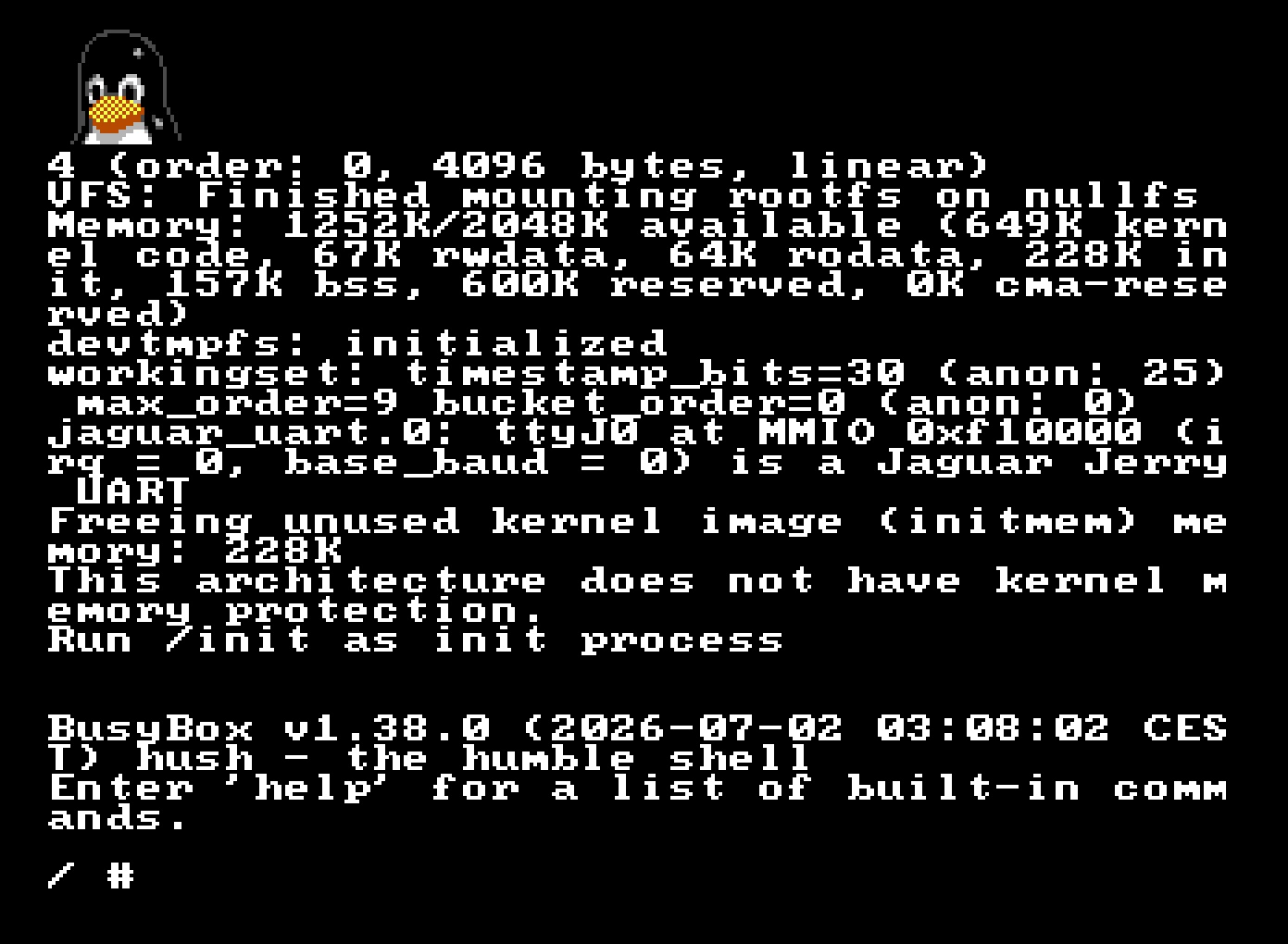
The work was not limited to compiling the kernel. The developer had to extremely optimize memory usageeliminate numerous modules and services normally present in Linux distributions and create a Dedicated driver for the Tom chipessential for the system to boot correctly even on the original hardware.
The final result represents above all a demonstration of adaptability of the Linux kernel. Experiments of this type in fact allow us to preserve the knowledge of historical architectures, as well as highlighting the modularity of an operating system capable of running on both embedded devices and much more powerful infrastructures.
The Atari Jaguar never managed to establish itself on the market despite its launch in 1993. The console was overshadowed by the arrival of subsequent platforms dedicated to 3D gaminghow Sega Saturnthe original PlayStation And Nintendo 64. Despite limited commercial success, the system hosted titles that later became cults for video game enthusiasts, including Alien vs. Predator, Tempest 2000 and conversions of Doom And Wolfenstein 3D. Over thirty years after its debut, this porting of Linux has perhaps turned a small spotlight back on one of the most controversial consoles in history.