
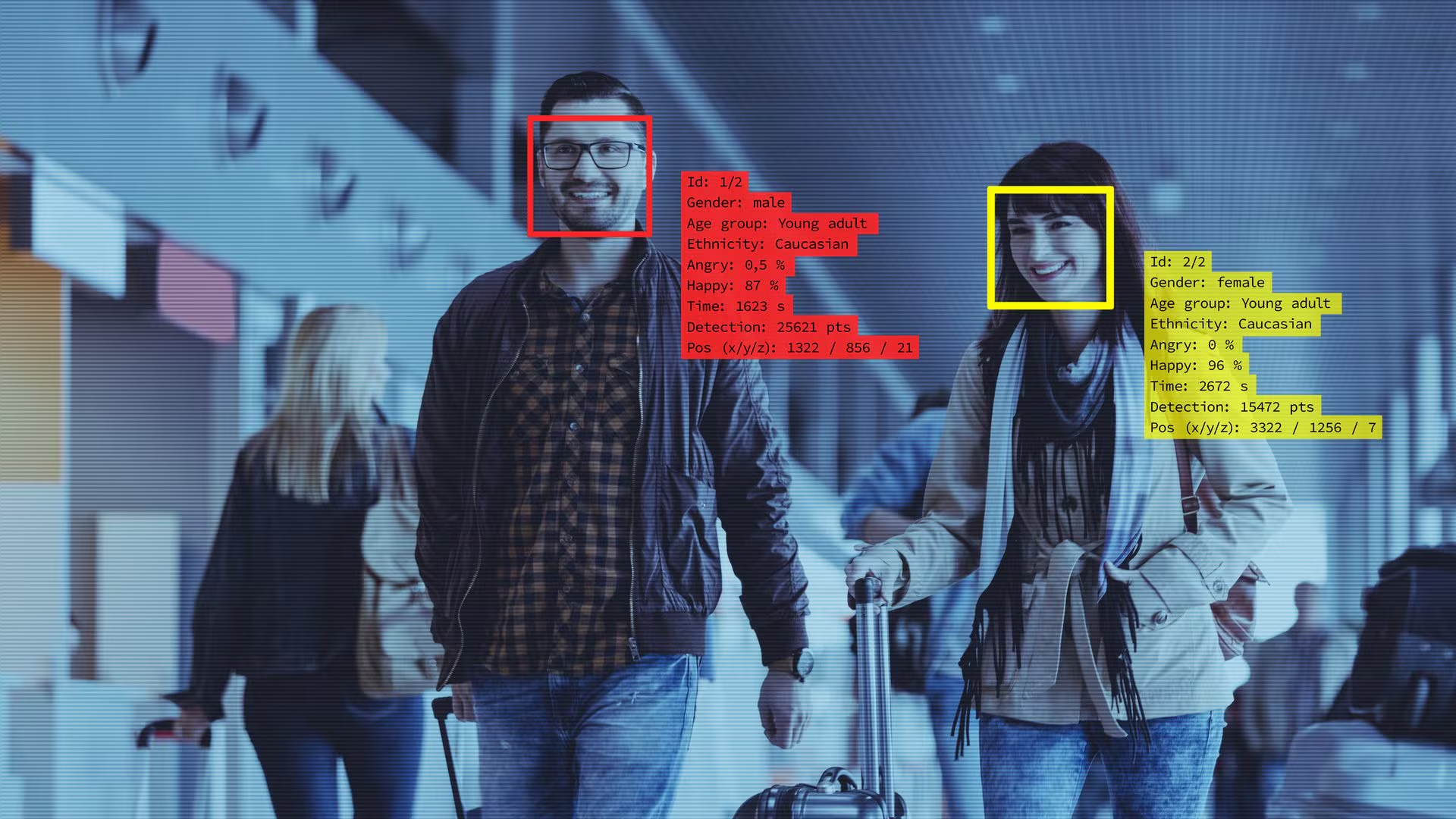
Artificial intelligence (AI)-based facial recognition is a powerful tool for identifying people, not without potential bias and privacy concerns. How it works and why people’s faces are transformed into a mathematical formula by algorithms.
At the Constitutional Affairs and Justice commissions of Room And Senate a is under discussion legislative decree on the use of facial recognition based onartificial intelligence (IA) by the police forces. The objective would be the adaptation to the provisions of the European Regulation 1689 of 2024, known as AI Actbut some points, which would also include identification in public places, are considered controversial by the oppositions – who talk about a “police state” – and from the organizations of civil society.
“With article 10, anyone who enters a station, takes part in a procession or attends a concert will be able to be biometrically registered without being suspected of any crime: And mass surveillance, not safety. Even real-time recognition is extended with insufficient guarantees, while complaints and the right to explanation remain without concrete tools. Parliament should stop these rules now, before our face becomes evidence to be preserved” she maintains Digital Human Rights Networkcoalition of ten civil society organizations including The Good Lobby Italia.
In this regard, although not entering into the merits of the Italian legislative decree, the spokesperson of the European Commission underlined that “Facial recognition in accessible public spaces is a practice prohibited by the AI Act.” Soon a note arrived from Palazzo Chigi reported by ANSA, which specifies that theItaly “will continue to respect the European legislationstarting from the AI Act, as done so far, in coherence with the constitutional guarantees and freedom rights, the verification of which is the responsibility of the judicial authority.” At the moment the work in the commissions is progressing, but there is no timetable for approval, despite the acceleration on 29 July in the European Policies Committee of the Senate. But what exactly is AI-based facial recognition?
Meta is testing an app that invents bedtime stories for parents: how StoryKit works
Facial recognition, as explained in the article The Cambridge Handbook of Facial Recognition in the Modern State published by Cambridge University Press, after detection “deals with evaluating theidentity of the person inimage extracted from face and it can be an identification or verification process.” In simple words, underlines the company specializing in cybersecurity Kaspersky, “it is a method that allows you to identify or confirm the identity of a person starting from their face.”
How facial recognition works
There camera captures a person’s face and various systems software elaborate and compare the data extracted with those present in specific ones databasesin order to associate the pixels to a name. It is to all intents and purposes a system of biometric securityexactly like them fingerprints – which we now routinely use to access “sensitive” applications on ours smartphones – or the iris recognition and of retinano longer the prerogative of film sagas like 007 And Mission: Impossible. Facial recognition is also increasingly entering our phones, as demonstrated by the application Apple’s Face ID for the iPhonethey algorithms of artificial intelligence are significantly enhancing the precision and effectiveness of these systems, net of potential bias always possible.
As highlighted in the article Advances in Face Recognition: A Comprehensive Review of Feature Extraction and Dataset Evaluation, conducted by scientists from the National Institute of Technology in Kumoh (Republic of Korea) and the Department of Business Development and Technology at Aarhus University (Denmark), facial recognition “has become a major research area” thanks to “the rapid growth of intelligent software applications.”
The role of AI in facial recognition
Kaspersky explains that most technologies are based on two-dimensional images and not 3D, “because it is easier to compare a 2D image with public photos or those in a database.” The face image is first detected through systems face detectionlike those present in the operating system of cameras and in the applications of photograph of cell phones, useful for focusing and exposure control. Once extrapolated from the video cameras, the image is “fed” to algorithms artificial vision And machine learning models which analyze different characteristics. They identify the key points as the distance between the eyes, nose, mouth And chin, shapes, contours, depthetc., then rotate the face to a standard position and correct light, contrast and other parameters to obtain auniform image for the database.
All “correct” facial features are transformed into a numeric vector through deep neural networks trained on millions of faces (such as FaceNet and DeepFace), effectively obtaining a mathematical formula: a sort of unique signature for each of us, like fingerprints. At this point the mathematical formula is compared with those present in the database and can indicate to the police the identity of the person, if present. In essence, with these systems it is possible to verify whether a person was actually in a given place (for example in association with a crime) or identify it.
It is clear that such systems are not infallible and significant biases can emerge (the most banal example is the confusion between similar people); they also pose problems privacy not indifferent. This is precisely why the EU’s AI Act prohibits the use of facial recognition in public places. “We don’t want AI to have public control over where we and you move in accessible public spaces on a daily basis, so this is a clear no”, said the spokesperson of the European Commission, commenting on the case of the Italian legislative decree, but without expressly referring to it (having no useful elements to judge it).