
SpaceX he is trying to get his up and running as soon as possible Starship reusable space rocket which promises to bring much larger payloads into orbit with greater overall mass at relatively low prices. The next test flight of the US carrier could be carried out within a few weeks and this will also allow it to be released into orbit i first Starlink V3 satellites (during Flight 12, the satellites were on suborbital trajectories). Starlink Mobile promises to further expand the possibilities and earnings of SpaceX.
In recent months the US company has renamed the Direct to Cell technology (DTC or D2C) in Starlink Mobile continuing to make agreements with traditional telephone operators. Currently this technology is not yet fully operational and can be used by operators to connect users in remote places, particularly in case of emergencies, but the future will be very different.
During the conference with shareholders and investors, Gwynne Shotwell (President and COO of SpaceX) made some statements regarding telephone operators and their future. According to the senior manager “roughly, between them (ed. Verizon, AT&T and T-Mobile)they have a market worth 600 billion dollars a year. I predict that we will be able to win over quite a few of their customers. Our service will be better. We will eliminate dead zones by taking advantage of orbiting satellites. It will be better during any natural disaster. I am very excited about Starlink Mobile”.
The potential of Starlink Mobile (but also similar technologies) are to be able to exploit the enormous present and future satellite constellation of Starlink satellites, even if currently not all of them are equipped with this technology. With the arrival of the Starlink V3 satellites, the potential will increase further, allowing not only greater browsing speeds through routers and antennas, but also making calls, sending text messages and surfing the Internet without the need for dedicated antennas.
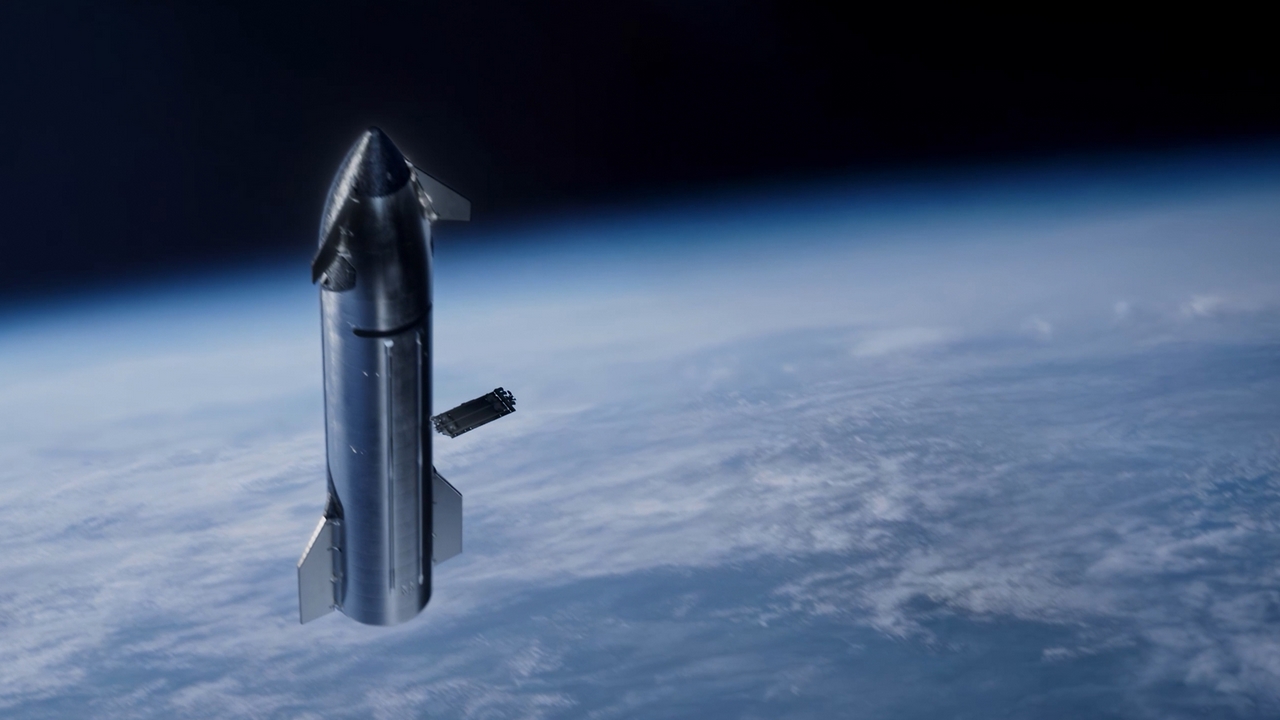
View of Starship in space from a Starlink V3 satellite on Flight 13.
This composite is made of imagery from four separate cameras on a single satellite. Six of the satellites were equipped with cameras to scan Starship’s heat shield and transmit imagery down to operators to…pic.twitter.com/sNTHHz5vLr— SpaceX (@SpaceX) July 31, 2026
Thanks to the use of frequencies common to telephone operators, Starlink Mobile It can work like a traditional telephone antenna with great advantages. For example, it is not necessary to have dedicated or very recent devices, there is no need to make software updates and it can work on different operating systems. This then allows us to cover areas where normal connectivity is not present (remote areas) and would be unprofitable for traditional operators.
To have full operation of Starlink Mobile you will have to wait for that Starship become operational considering the size and mass of the new ones Starlink V3 satellites. To deploy the same transmission capacity as the current constellation it should take a year (or less) and therefore by the end of 2027, if the plans are respected there could be a new chapter for the adventure of SpaceXwhich will become a telephone operator in all respects.