
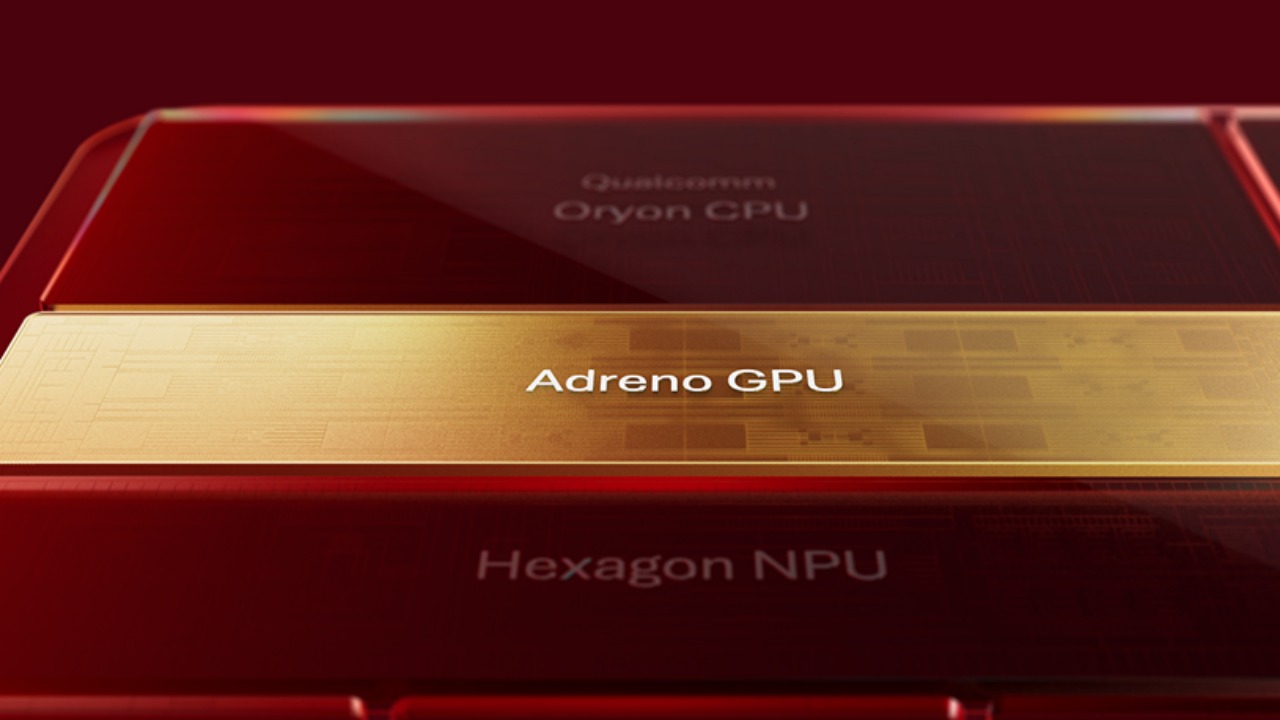
Qualcomm has revealed Adreno Neural Fusiona rendering pipeline that integrates neural processing, AI super resolution and frame generation into a single graphics flow. The technology will debut on the next generation of Adreno GPUs, expected on board the future flagship Snapdragon. The announcement precedes the Snapdragon Summit by a few weeks, scheduled for 22 to 24 September 2026, where Qualcomm promises to go into detail.
The most significant innovation lies in the architecture: instead of relying on the NPU for AI loads, Qualcomm has inserted the Adreno Matrix Cores directly inside each of the chip’s three GPU slices. These dedicated cores run AI rendering models in place, without having data travel to a separate block of silicon. To support them there is a cache 18MB High Performance Memory (HPM).designed to keep frame buffers, tile-based rendering data and compute loads locally, reducing system memory accesses.
Fewer artifacts, more stability: the Adreno Neural Fusion recipe
On the performance front, Qualcomm declares a reduction in consumption up to 40% when Neural Fusion is active, compared to the previous Snapdragon Game Super Resolution upscaling solution. The new Adreno GPUs also work at a frequency of 1.45GHzcompared to the 1.2 GHz of the previous generation, with a declared efficiency gain of 12%.
The promised visual benefits mainly concern the typical artifacts of AI upscaling: less shimmering on fine details, less ghosting on moving objects, more stable framerate. It is not the first time that a mobile chipmaker pursues these results: the real difference is having moved the AI work inside the graphics pipeline instead of treating it as an external operation managed by the NPU, as indicated by the first technical analyzes circulating online.
On the software front, Qualcomm ensures that Unreal Engine And Unity they already support Neural Fusion natively, without requiring developers to make specific engineering interventions on the respective graphics engines. A non-minor detail: the adoption of proprietary technology lives or dies based on the ease with which development studios manage to integrate it into their titles, and out-of-the-box support significantly lowers the entry threshold.
Qualcomm has not yet resolved two points: on which SKUs of the new Snapdragon family the technology will actually be available, and how many games will use it at launch. Promises on paper, moreover, are always measured in the field: the previous generation of AI upscaling solutions for mobile had shown mixed results depending on the title. The final judgment will only come with the first independent benchmarks on commercial devices, not before the new Snapdragon reaches real smartphones.