
SupraLabs he released Supra2-IMGan open source text-to-image engine that’s all in just 104.1 million parameters. The model, published on Hugging Face under the Apache 2.0 license, generates images starting from a text prompt using a Diffusion Transformer (DiT) architecture, the same family that gave rise to much heavier models such as Stable Diffusion 3 or Flux. At a time when the most well-known laboratories are chasing increasingly numerous parameters, the choice to publish such a small model almost sounds like a declaration of intent.
There are clearly major limitations: the images are born in the latent space of a VAE SD-VAE-FT-MSE (scale factor 0.18215), divided into 2-pixel patches, with a textual context window limited to 128 tokens. Output resolution stops at 256×256 pixelsfar from the 1024×1024 now standard on high-end models.
As for training, SupraLabs claims to have trained Supra2-IMG on 5.6 million images taken from the FLUX-Reason-6M dataset, selecting the captions according to a precise order of priority: first the composition of the scene, then the entities present, the text, the style and finally the more imaginative descriptions. The whole process just took 9 hours on a single 80GB Nvidia H100 SXM GPU rented on Runpod, for a total of 2.5 terabytes of storage used.
The same philosophy as the entire Supra2 family
Supra2-IMG was not born as a stand-alone project. It is part of the same model series that SupraLabs has already published with Supra2-100M-Instructa decoder-only language model based on the Qwen3 architecture, pre-trained from scratch on 30 billion tokens of English web text and then refined for chat on a single 16GB RTX 5060 Ti card. The common thread is the same as applied to the image generator: demonstrate that complete training, from random initialization to the working model, can run on consumer hardware or on a single rented cloud GPU, without the tens of millions of dollars clusters of the most famous laboratories.
The comparison with the production models, however, should be taken with a pinch of salt. A native resolution of 256×256 pixels remains a laboratory exercise more than a practical alternative to Stable Diffusion or Midjourney, and the sampling settings recommended by the developers themselves (guidance scale at 3.0, 50 diffusion steps, seed fixed at zero) betray a still immature model, designed to validate an architecture rather than for production use. The authors admit it in fact, presenting this release as an intermediate stage towards a future version, already called Supra2.5-IMG.
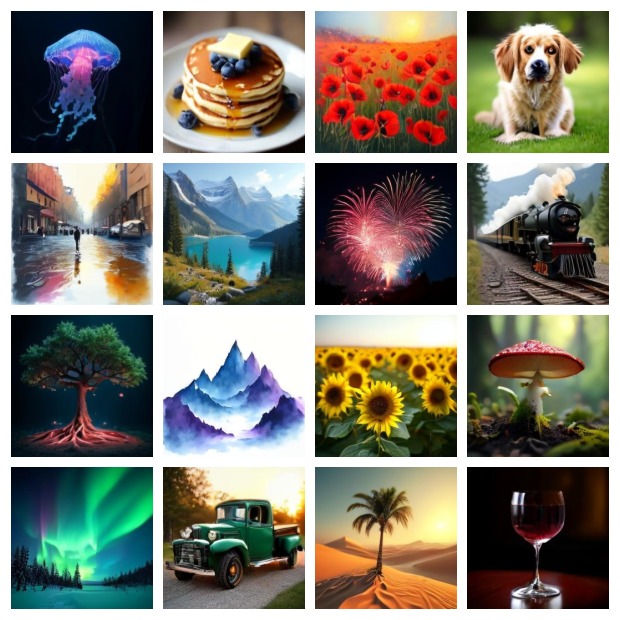
Anyone who wants to try it can do so right away: SupraLabs has put online two interactive demos on Hugging Face Spaces, as well as weights in safetensors format that can be freely downloaded under the Apache 2.0 license. It remains a niche project, but the direction, i.e. increasingly smaller generative models that can be trained in a few hours on a single video card, tells us well where a portion of open source research on generative artificial intelligence is moving.
