

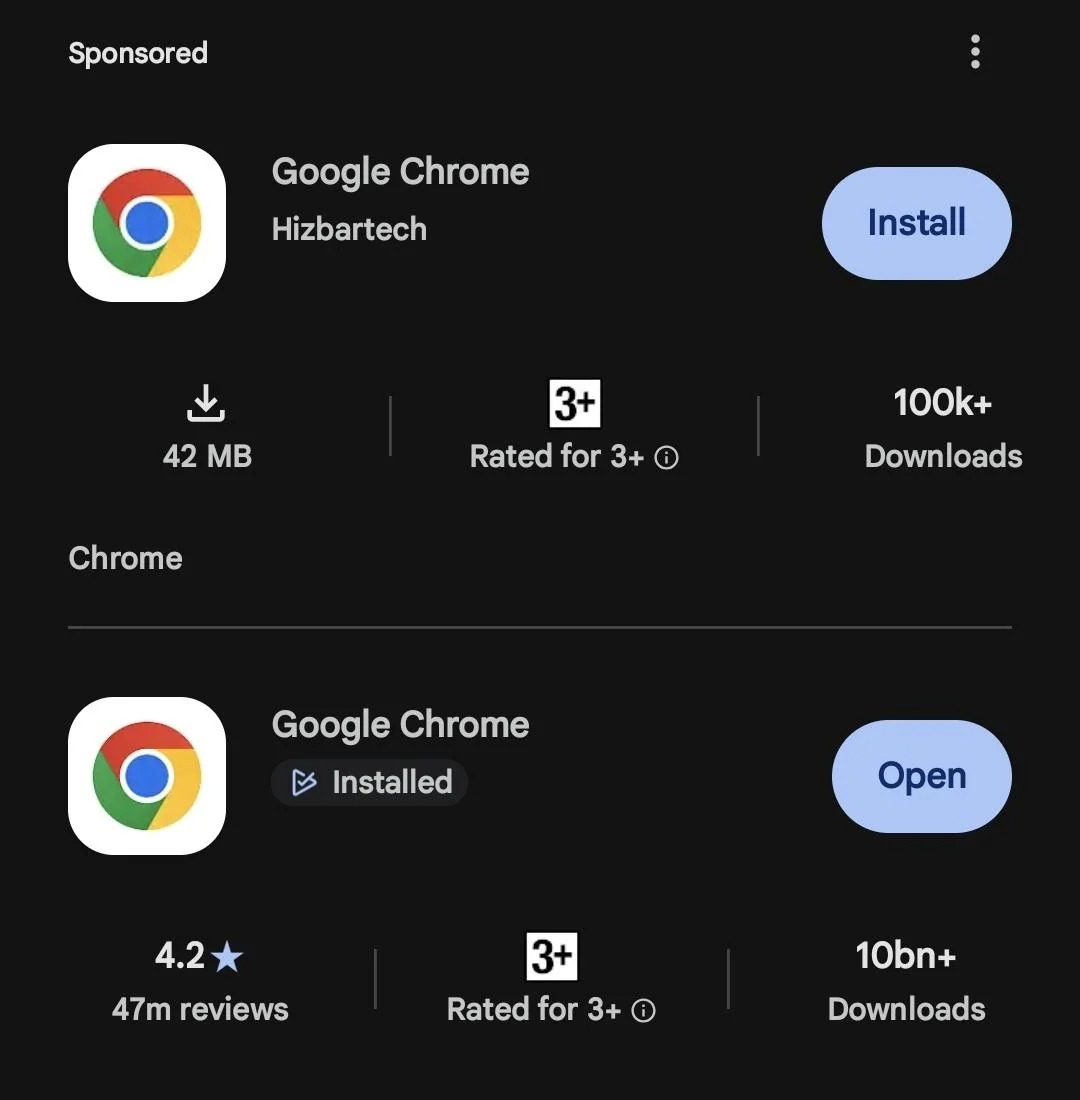
A counterfeit app from Google Chrome appeared on the Play Store with over 100,000 downloads and got an advertising space above the authentic browser. The card listed as developer Hizbartechinstead of Google. The app was later removed, but the case brings to light a problem that concerns both the distribution and promotion of software in the Android store.
The report came from Redditwhere a user posted a screenshot of Chrome search. The fake occupied a sponsored location, while the original browser appeared below. The image therefore documents a precise element: those looking for the Google product could first encounter an app that imitated its identity, thanks to an advertising insertion.
The available reconstruction also describes a change of name and icon. The app arrived on the store on August 22nd as a game, with the title Ball Bounce; on September 30th it took the name Google Chrome. This step also shifts attention to changes subsequent to publication: checking only the initial identity of a software is evidently not enough to describe its entire permanence in the catalogue.
The data of 100,000 downloads However, it requires caution. A breakdown of installations before and after the identity change is not available. We cannot therefore conclude that all the people counted downloaded the app believing they were getting Chrome, nor attribute the entire volume to the advertising campaign. The number describes the diffusion reported by the card, without clarifying when it occurred.
The problem also concerns advertising
The presence of a sponsored ad adds a second level to the story. The catalog made the app available, while the promotion gave it visibility in the imitated browser’s search. There are two distinct aspects to clarify: how the identity change occurred and how that presentation was able to obtain paid space. The available material does not reconstruct the checks carried out in the two steps.
The Google Play rules they expressly prohibit apps from tricking users into believing a non-existent affiliation. The official documentation on the deceptive imitation includes names, icons, descriptions and internal elements of the software. Examples include the use of another company’s logo and titles that are so similar to those of existing products that they create confusion: the ban on paper is already explicit.
As for how it actually works, one participant in the discussion said he had encountered one screen with avatar and chat functionsfollowed by seemingly random responses. It is an individual testimony which does not allow us to establish which data were processed, nor to certify the presence or absence of harmful behaviour. Even the malware label would require further proof.
The next one disappeared from the store it does not clarify on its own how the fake passed the checks. For the user, the immediately recognizable detail was the name Hizbartech in the card: information that should always be verified even when the title and icon seem familiar.
