
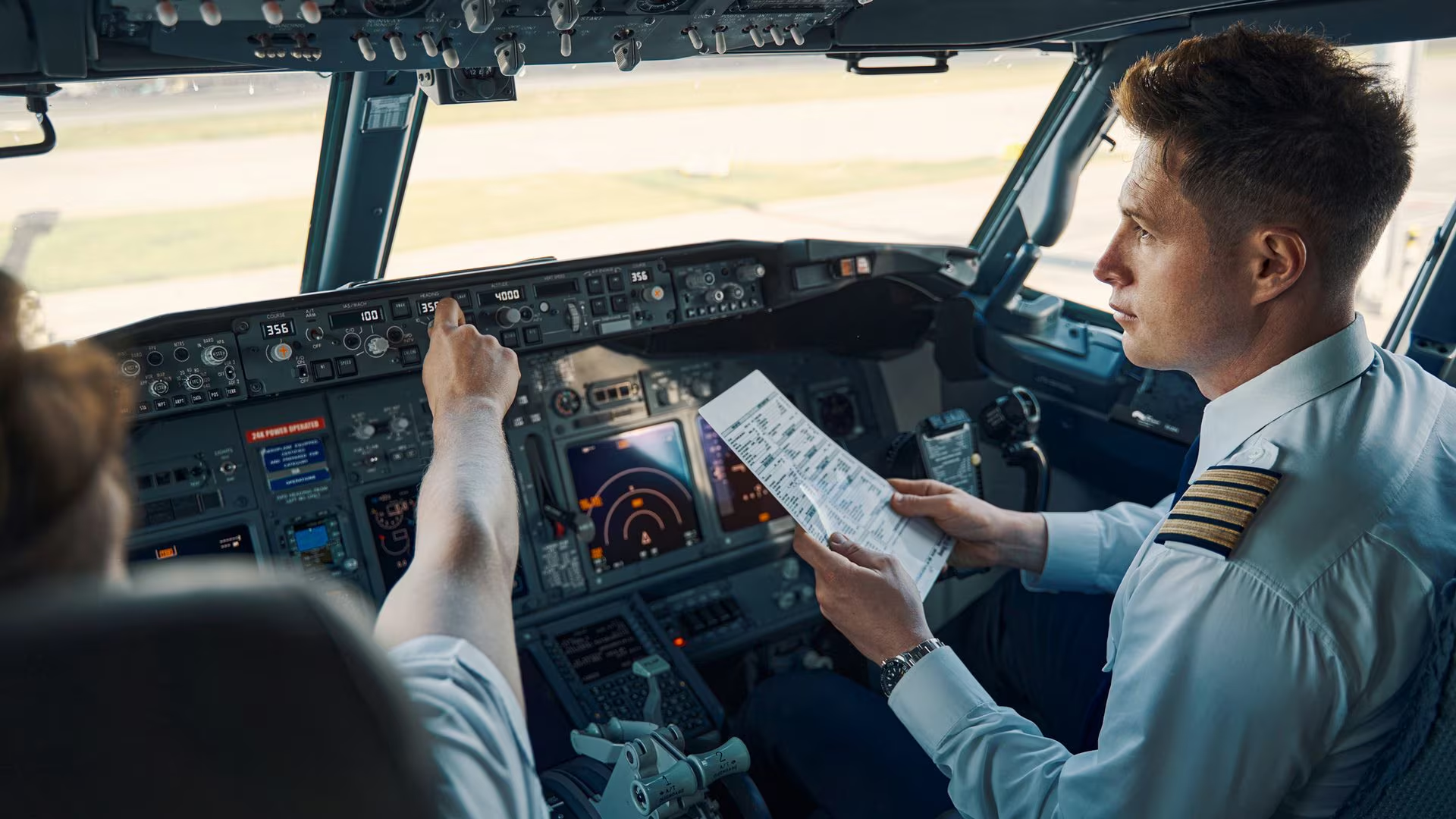
Commander Danilo Recine, vice president of ANPAC, explains to Fanpage.it what the squawk codes used on planes are. They can be changed in emergency situations, such as the bomb scares that affected at least 15 flights in the skies of Italy and Europe on 5 November 2026.
Thursday November 5, 2026 in the skies ofItaly and’Europe moments of tension were experienced due to multiple bomb scares which, at the time of writing, involved at least 15 planes. A real chaos that activated the required safety procedures and pushed the pilots to carry out emergency landings in airports different from those of destination. In some cases the planes were escorted by military fightersincluding ours Eurofighter. Six of the bomb alerts concerned aircraft arriving in Italy, two aimed at Rome and four to Milancoming from Finland, Ireland and other countries. For at least two flights the alarm was linked to the receipt of a threatening email signed by the “Male State Fighters”.
Net of the aforementioned claim, it is not clear what the organization behind these criminal acts is, however some analysts do not exclude that there may be a correlation with the cyberattacks which in recent days have affected the refrigeration systems of numerous sales outlets and large-scale retail trade centers in Europe, causing the destruction of tons of food and damages amounting to millions of euros. In France the cold storage rooms that house the blood bags were also hit. In essence, we could be faced with a real strategy of “hybrid warfare” against the countries of the Old Continent.
The only certainty, at the moment, is that all the bomb threats have fortunately been revealed unfounded and without consequences, despite the chaos and frenetic communications between air traffic and pilots to manage the alert. In some cases the four-digit codes transmitted by transponders (squawk tails) have been replaced with special ones emergency codeswhich help air traffic identify aircraft with certain problems. To better understand what squawk codes are and when they are used, Fanpage.it contacted the commander Danilo Recinevice president of ANPAC (National Commercial Aviation Pilots Association). Here’s what he told us.
Commander Recine, what is a squawk code?
The squawk code is a transponder code, it is synonymous. It is assigned by air traffic control before departure because it identifies that flight almost for the entire duration of the flight. A specific corresponds to that flight and that code aircraft. However, it can also be changed in flight, always by another control body. For example, if you fly from Italy and go to France, France has the right to change the code.
And in case of emergency?
It is a system which, if used by entering some particular codes relating to emergency or other situations, which are very few, allows the ground control body – which monitors us below radar control – to understand that we have that type of problem for which we insert that code. We have on board a device called a transponder where the codes are entered; in case of need, such as emergencies, we enter a code so that it is immediately, regardless of the radio communication or not, the radar controller sees this trace differently, in a different color, and therefore attracts his attention. It means that that plane needs attention and assistance. For example, in the case of aserious technical emergencywhere we need to land as soon as possible and have maximum priority and assistance, the code that is entered required by the procedures is the 7700.
So the plane has an identifying squawk code that can be changed if necessary
The plane uses the squawk code that is assigned to it, but if I have a problem in flight, where I have to declare that I am in emergency and I need to let the whole radar world, the air traffic controllers, know that I have had it, I enter that code 7700. During the clearance or “clearance” that I receive before leaving, for example from Rome to go to Paris, I must be authorized to set off, that is, to begin my operations. Together with this authorization I am given a route: the take-off runway at Fiumicino, what type of exit I will have to follow, an altitude and, at the end, also this squawk code, which can be of any number. It is the code of that flight.
Through this on-board device, however, if any flight that has its own code needs to tell the world: “I have an emergency problem, or a hijackingor they no longer work for me radio and I can’t speak anymore”, I enter a code on that same device that has a very specific meaning instead of the one I had before. This simply attracts the attention of those who control us from a radar point of view, because it says: “Ok, in that area there is a plane that has a problem”. If the code appears 7600it means there is a problem with radio communications. If there is a serious emergency that requires immediate return, the 7700 squawk is expected to be inserted in place of the one we had.
So can several planes have this 7700 on board at the same time, which is said to be in serious danger?
It almost never happens that multiple planes have it at the same time. It is something, let me tell you, almost impossible.
In this case there were several simultaneous bomb alerts on multiple aircraft
A bomb threat means that the news is given to the crew and, depending on the communications and information available, more or less reliable, a decision can be made to land as soon as possible or to continue towards the destination. Obviously, when you land, as a precaution you go to areas quite far from the airport operational areas and procedures are activated. In some cases the planes were escorted, but it was only an escort by military fighters to follow the flight. There is no specific code for the bomb threat. However, there is a code that I can use if I want to have it priority. I repeat, the situation can simply be communicated to flight control, or they inform us themselves. They can tell us: “There is a bomb threat concerning you, tell us your intentions.” We say, “Okay, we want to land as soon as possible at this airport,” and they give us top priority and let us land.
It is not obligatory enter a specific code. It is only done in the situations I told you. One is the actual emergency, which can be technical or medical. If I have a seriously ill person on board and a doctor tells me that there is an imminent danger to his life and that we need to land as soon as possible, I declare a medical emergency and at the same time enter squawk 7700. That way, if I land at Fiumicino, the Ciampino control tower also sees a plane with code 7700 and understands that this situation exists in its area. But there is no situation in which, because there have been bomb scares, these codes are automatically entered. They are codes that the pilot enters. If this situation, which I hope not, were to continue and whoever raises these alarms were to hit three incoming planes at the same time, for example in Milan, it is clear that if all three decide to enter that code, then we would see three of them. But the choice to include it or not in this situation it is not mandatory by the pilot, because there is already constant radio contact, the situation is known and the control body is already providing all the necessary priority, making all the other aircraft wait instead.
So the affected planes could keep their squawk code established at the beginning
Yes, yes, absolutely. It is a decision that is made by the commander. In some cases, however, we are obliged to enter certain codes according to the procedures. For example, if a plane has a problem with a motorwhich is one of the cases foreseen by the procedures, after having managed the situation you return to land at the closest possible airport, declaring an emergency by radio and entering that code. At that point that airport is, effectively, dedicated to that airplane, because a state of emergency has been declared. It happens very few times. There are failures that sometimes occur, but failures serious enough to require an emergency declaration are very few compared to the millions of flights we have around the world.
Fortunately, the plane remains one of the safest means of transport ever
Yes, because it has a lot of redundancies. This is the fundamental point. One of my radios may break, but I have two others. You may have a problem with one plumbing system, but there are others. And so on. The fuel tanks are also designed so that if there is a problem in one of them, they can be isolated so that they don’t interfere with the others. There are many technical precautions behind it and this ensures that, even with a rather serious failure, a plane not only continues to fly, but can return to land in complete safety.