
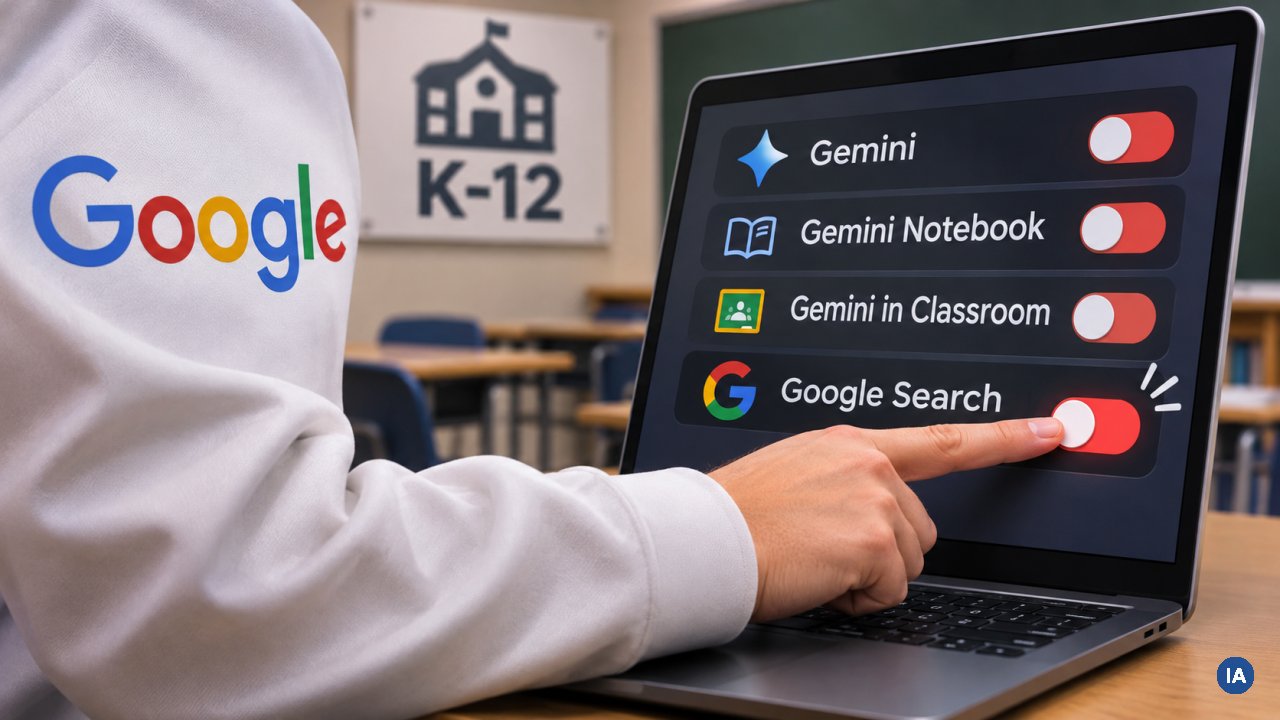
In the past few days Google announced that Gemini, Gemini Notebook, Gemini in Classroom And Google Search will be disabled for K-12 student accounts until school administrators explicitly enable them. The company presents the choice as the result of a discussion with schools, teachers, researchers and political decision makers. Along with the new door control scheme Guided Learning in Google Classroom and, in the testing phase, in Search: the mode accompanies the student with questions and intermediate steps instead of providing the answer.
For Search, deactivation has a direct consequence: the AI functions are now part of the engine, and for school accounts there is no variant that does not have them. “Search and AI are deeply integrated,” he said Chris PhillipsGoogle’s vice president for education, at the New York Times. If a school rejects AI, students “will not have access to Search and will see a message from the school that it is unavailable.” Since deactivation is the default setting, de facto Search remains turned off for students until the administrator enables it, and when enabled the AI functions also arrive.
We want to clarify what we announced today about our education services. Today’s announcements give schools more choice, not less. Here’s what we announced: – Gemini, Gemini Notebook, and Search will be OFF 🔴 by default. This is based on K-12 schools asking for more control over student use of AI services. – Schools are in control: They can choose to turn ON 🟢 one, two, or all of these services individually. – We are also updating Search for schools to make it better for learning. Specifically, AI Mode and AI Overviews will offer step-by-step guided learning through problems, so that students don’t get quick answers to schoolwork. We know there’s concern about students using AI to shortcut schoolwork, and schools have told us they want control. That’s exactly why we are making these changes today to address the feedback we’ve heard from educators in recent months. And we’ll continue to engage deeply with educators to ensure we are giving schools more choice, more controls, and improved Search for learning.
— News from Google (@NewsFromGoogle) November 3, 2026
After initial criticism, on the afternoon of November 3, Google published a clarification on A school can then enable Search while leaving the Gemini apps turned off. Some newspapers have read the clarification as a step backwards, but the disputed point remains the same. According to the post, the version of Search designed for schools includes AI Mode And AI Overviewswhich will offer step-by-step guided learning instead of immediate answers. Google does not indicate a version of Search without AI functions: anyone who wants to completely exclude AI still loses the search engine. The statement talks about details to be shared with schools in the coming months, before it comes into force. According to what Google explained to the New York Times, the new scheme will take effect at the beginning of 2027.
Guided Learning in Classroom and Search
In Google Classroom Guided Learning has been available globally since November 3. The mode was already present in the Gemini app. The student starts it from an activity assigned by the teacher and finds an individual study tool anchored to the course material, with open questions, step-by-step explanations and interactive functions such as quizzes. Teachers receive real-time guidance on where the class needs support and can consult transcripts of student conversations. Google claims its research shows measurable learning gains.
In Search Guided Learning starts from an experiment in some US schools Novemberbefore an extension to other districts. When Google’s systems recognize that a student is looking for a certain type of homework help, Search walks them through the topic or problem step by step. Anyone who glues together a complex physics problem or asks for help writing a book report sees suggestions for thinking about the concepts, without arriving directly at the answer. Google also indicated to the New York Times the two configurations available to schools that enable Search: one with AI Overviews and active AI chats, as in the public version, the other with Guided Learning in their place. In both cases, as the post on X confirms, the experience remains AI-based.
Reactions and the school context
The new setting follows protests from educators over the automatic activation of Gemini in Classroom, decided by Google ad August for schools that already allowed access to Gemini and now cancelled. TO September New York and Los Angeles, the two largest school districts in the United States, have limited student access to generative AI on school devices. On that occasion, Los Angeles district officials said they hoped students would be able to use Search with AI Overviews turned off, an option the new scheme does not provide. TO October the senators Richard Blumenthal (democratic) e Josh Hawley (Republican) wrote to CEO Sundar Pichai to ask about promoting AI tools in schools and research into possible harm to minors. In the letter they express “grave concern” about Google’s “aggressive push” with AI products in schools, which they say threatens the academic performance and well-being of “an entire generation.”
Bernie Sanderssenator from Vermont, called Google’s choice a form of “extortion”. The mayor of New York Zohran Mamdani accused the company of using its monopoly power to force AI into public schools and declared that “no company should have the power to dictate how we teach our children.” Rohit ChopraCalifornia’s secretary of business and consumer services, wrote that Big Tech should not be able to “force the hand of schools.”
Randi Weingartenpresident of the American Federation of Teachers, accused Google of prioritizing commercial interests over children’s education. Josh Golinexecutive director of Fairplay, argued that the company seeks to push schools towards its AI products. In July, Common Sense Media already called Google’s AI search an “unacceptable risk” for students.
Classroom has been used for approximately 150 million among teachers and students around the world, and Chromebooks are widespread in schools, especially in the United States. Institutions that do not accept the new rules can evaluate alternative engines such as DuckDuckGo, which allows you to disable AI functions. Looking ahead, they may also have to consider other devices and other teaching platforms.