
Changing the time on your car dashboard it shouldn’t require weeks of reverse engineering, emulating a 2011 Linux kernel, and exploiting a security flaw. Yet that’s exactly what an Estonian developer had to do for fix the clock on his 2014 Renault Latitudestuck one hour ahead after switching from daylight saving time to standard time.
The problem arises from the navigation system TomTom Carminat LIVE (internal name “beaumont”), fitted as standard on the car. The previous owner had warned him: without the SD card with navigation maps, changing the time would have been impossible. The developer didn’t believe it, but after an hour spent exploring every available menu he had to surrender to the obvious: the “Set time” option did not exist anywhere in the interface.
Downloaded the official firmware to analyze it, found out why. The unit is based on a Samsung S5P6440 SoC and runs a custom TomTom operating system built on Linux 2.6.28.10. The menu definition that opens the Settings panel is read directly from the SD card: without a legitimate card inserted, the device doesn’t even know how to access that screen. An empty card is not enough, because the system verifies a unique CID burned into the SD chip and digital signatures linked to that specific identifier, most likely designed to combat map piracy. Buying an original card from a third-party retailer, with shipping to Estonia, would have cost approx 60 euros. The developer chose the long way out: breaking the protection himself.
Inside the firmware: read-only mount and a trick taken from kernel exploits
To study the system without risking the real hardware, he built an emulator based on it QEMU with a custom 2.6 kernel and a vehicle CAN bus simulator. The first leads turned out to be dead ends: the update filesystem (an ext3 image called ttsystem) was protected by a digital signature that prevented installing modified versions, and almost all system partitions were mounted read-only or flagged noexecpreventing the execution of arbitrary code.
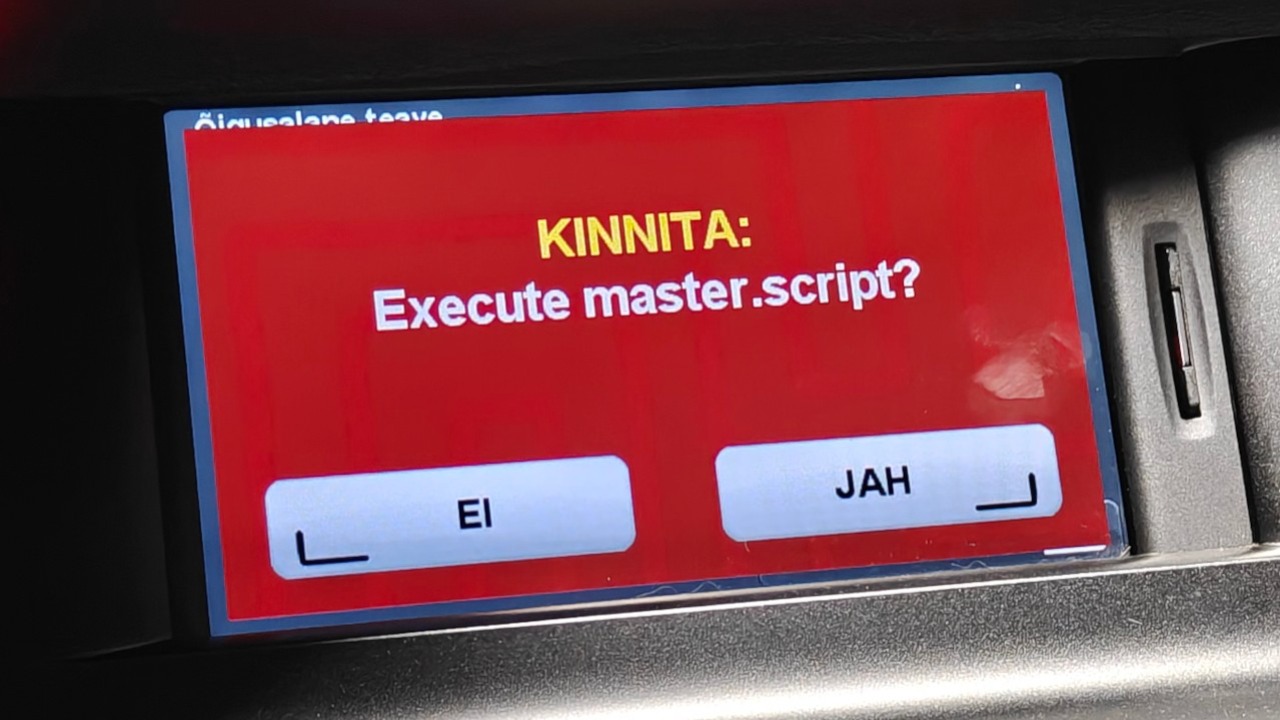
The turning point came by analyzing master.scripta proprietary language used by the drive to automate interface actions on each startup. Reverse engineering work conducted by others on this same device provided him with the correct addresses to download the update files, speeding up the initial phase of the investigation.
Within that language he found a command LOG with a path traversal vulnerability, capable of writing ASCII text to any path on the system with root privileges. Hence the decisive idea, borrowed from the exploitation techniques of the Linux kernel: overwriting /proc/sys/kernel/core_patternthe file that decides what to do with coredumps generated by process crashes. Since kernel version 2.6.24 (the device version was 2.6.28), that file can also launch any program whenever something crashes.
It was therefore enough to crash any process to execute a custom script as root. The solution came from the binary dbus-monitorwhich generates a SIGABRT (and therefore a coredump) every time it does not find the system bus, which is absent on that unit. The final script, just three lines long, opened the door to execute root code via a simple SD card not modified in its executable content, but only in its role as a carrier.
With root access in hand, the developer performed a full backup of the eMMC storage and located the file /mnt/flash/settings.data proprietary binary format where the clock configuration is hidden. The device, it turned out, doesn’t handle time zones in the traditional way at all: it gets the time from GPS and saves the local offset in minutes. It was enough to change that value from 180 to 120 to finally fix your car’s clock.
