
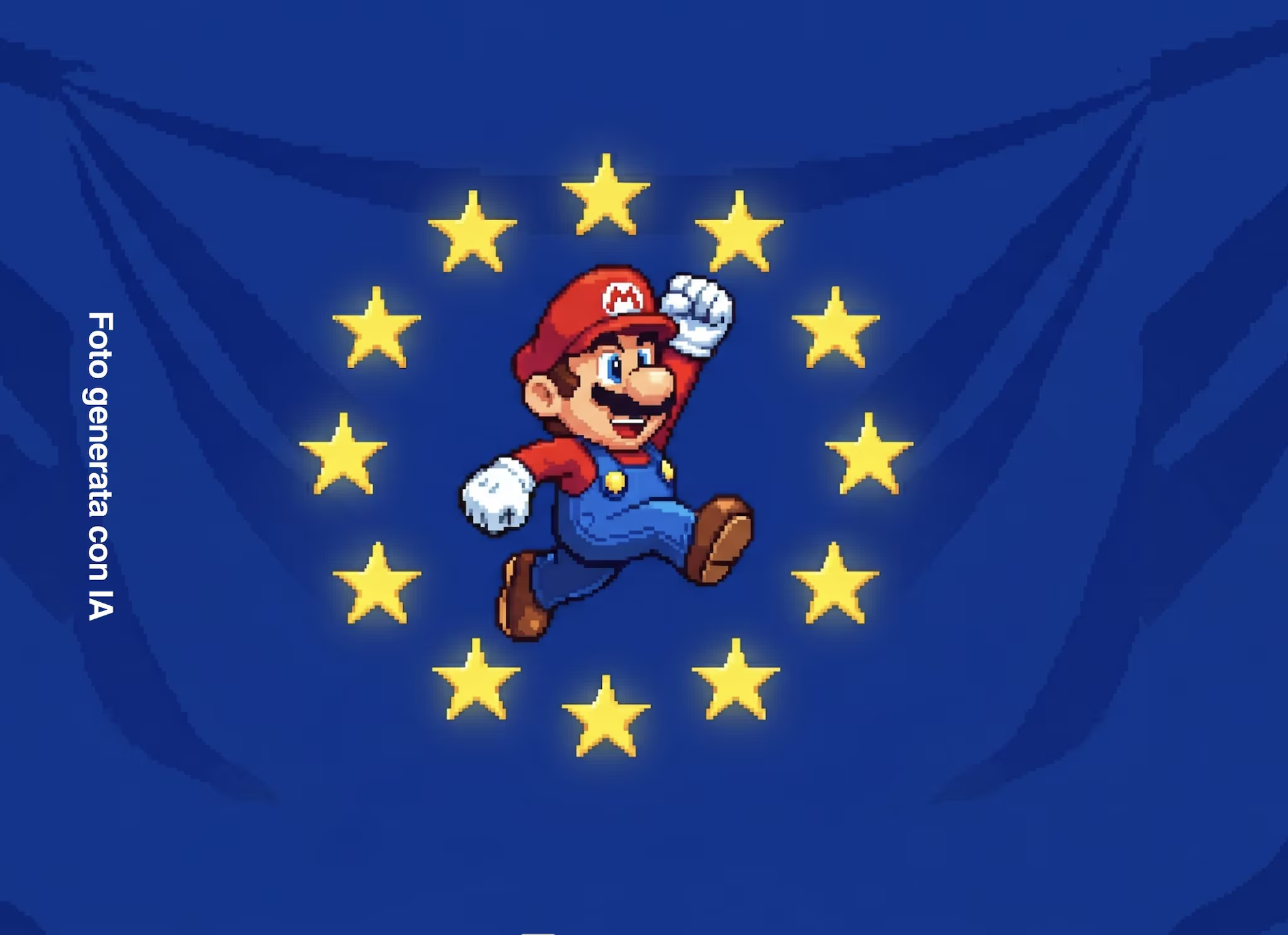
From Brussels to California, Stop Killing Games is calling for new protections for consumers and the preservation of video games that risk disappearing after the end of official support. The campaign started after the closure of The Crew, a video game published by Ubisoft.
If you buy a video game, shouldn’t you own it? Finnish politics is asking this question Maria Ohisalo to the European Parliament. The question arises from Stop Killing Gamesan international campaign for consumer rights launched in 2024 by the American YouTuber Ross Scottwith the aim of preventing video game companies from making regularly purchased titles unplayable. Some context: More and more video games require a permanent internet connection to work, even when they’re meant to be played solo. A trend that has spread in parallel with the popularity of titles belonging to the category games-as-a-servicelike Fortnite.
When the manufacturing companies decide to close these online servers, the games involved stop working, even if purchased by the players. Since it launched, Stop Killing Games has collected over 1 million signatures in Europemore than enough to bring the issue to the attention of institutions and open a global debate on the future of video game preservation.
Ubisoft’s The Crew case: the spark that sparked the case
The spark that gave rise to the campaign was the closure of The Crewpopular racing game published by Ubisoft in 2014. It could be played in both single player and online multiplayer. Ten years later, in 2024, the French gaming giant announced the deactivation of the servers because its maintenance was no longer sustainable. Result: the operation made it impossible to continue playing even for those who owned a copy of the title. For many users it was not just the end of technical support, but the definitive disappearance of a purchased product.
An NVIDIA video was removed for copyright infringement: according to YouTube, the rights belonged to La7
Some players had spent years within the virtual world of The Crew, so much so that they experienced it as a place of leisure and socialization shared with friends and family. As Chemical floodwho was interviewed by BBChe said: “I was about 18 when I launched. It was a great escape from the difficulties at the time, so it’s always been something special to me.” Ross Scott also reacted with disappointment to the closure of the game’s server, defining this attitude as a threat both to the rights of buyers and to the protection of digital culture. Hence the launch of several online petitions, including a European one called Stop Destroying Videogames which collected 1.3 million signatures. Today the various petitions launched are brought together under the aegis of Stop Killing Games, which has more than 2 million supporters.
Stop Killing Games requests
Alongside Ross Scott, face of Stop Killing Games, there are Moritz Katzner, Jonah Goldman, Clemens Istel. The former dialogues with European legislators and guides the organization’s political strategy at a global level. The second deals with relations with US legislators. The third finally directs “Does It Play?”, an internal branch of the movement. All of them represent players, consumers and developers, and are fighting for the introduction of legal protections internationally. The objectives of Stop Killing Games are different. First of all, prevent video game companies from making the titles purchased by players inaccessible. In many cases, it is the player communities that develop patches and alternative solutions to keep video games with these problems active, with the risk of removal orders from publishers due to alleged copyright violations. In this sense, one of the mottos of the campaign’s supporters – but not of the official members – is: “If buying does not mean owning, then piracy is not the same as stealing”, in reference to the possibility of playing games by downloading pirated copies.
Stop Killing Games also criticizes the incorrect naming of downloadable content present in digital stores, such as Steam and PlayStation Store. In fact, these are not defined as rental services, but as products to be purchased, although the publisher can deny use to the buyer at any moment, all without indicating an expiry date at the time of purchase. Another objective of the movement is the recognition of the artistic value of video games and their preservation. Theme addressed on Fanpage.it in an interview with the former manager of the Videogame Archive of Bologna.
The reactions of the game industry and politics
The response from companies did not take long to arrive. Specifically, Ubisoft argues that consumers buy a user license and not permanent ownership of the software. Even the association Video Games Europewhich represents many of the major companies in the industry, believes that the ability to discontinue online services is necessary when a game is no longer economically viable. But Stop Killing Games doesn’t want games to be supported and updated by their developers forever. What it requires is that the games are kept running after the servers are shut down, for example through the introduction of an offline mode or the ability to host private servers. On the political front, the initiative has gained resonance in both Europe and the United States. In 2025, during a debate at United Kingdom Parliamentmembers compared the cancellation of games to the destruction of irrecoverable cultural works. However, the government has so far rejected new laws, other than calls for greater information transparency. The situation is different in the European Union: last April, Ross Scott was heard by some representatives of the European institutions during the meetings dedicated to the initiative. There are several politicians in his favor, such as the aforementioned Maria Ohisalo, and Reinier Van Lanschot of the Dutch Volt party.
Giuseppe Abbamontedirector of the European Commission specializing in copyright law, has announced that he will examine whether current copyright legislation has gaps in this area and will report the results of his analysis in July. Meanwhile, in the past few hours, a first response has arrived from the European Commission, which has decided not to recommend the adoption of a new regulation that obliges publishers to guarantee the playability of video games once their commercial cycle has ended. In a statement, the Commission explained that “at this stage it is not possible to propose a legal obligation to guarantee the playability of video games once they are no longer commercially available”. The reasons cited also include: complexities related to current regulations on copyright and intellectual property.
However, the decision does not represent a definitive closure on the requests made by Stop Killing Games. The Commission has in fact announced its intention to meet representatives of the videogame industry and consumer associations to evaluate possible solutions. Furthermore, according to Ross Scott, the movement can continue to pursue its objectives through the European Parliament, where the initiative has already gathered significant support. Scott himself stated that 45 MEPs have signed a request for legislative intervention and that the issue could be addressed as part of future changes to the Digital Fairness Act.
In the United States, the situation is more complex due to different legislation. There have been some steps forward, however. The California State Assembly passed the Protect Our Games Act (AB-1921)a bill supported by the Stop Killing Games movement, which aims to guarantee users the possibility of continuing to access purchased video games even after the end of official support from companies. The measure was approved with 43 votes in favor and 16 against. Support came mainly from Democrats, with support also from two Republicans. Now the text will be examined by the state Senate, where its legislative process will continue.