
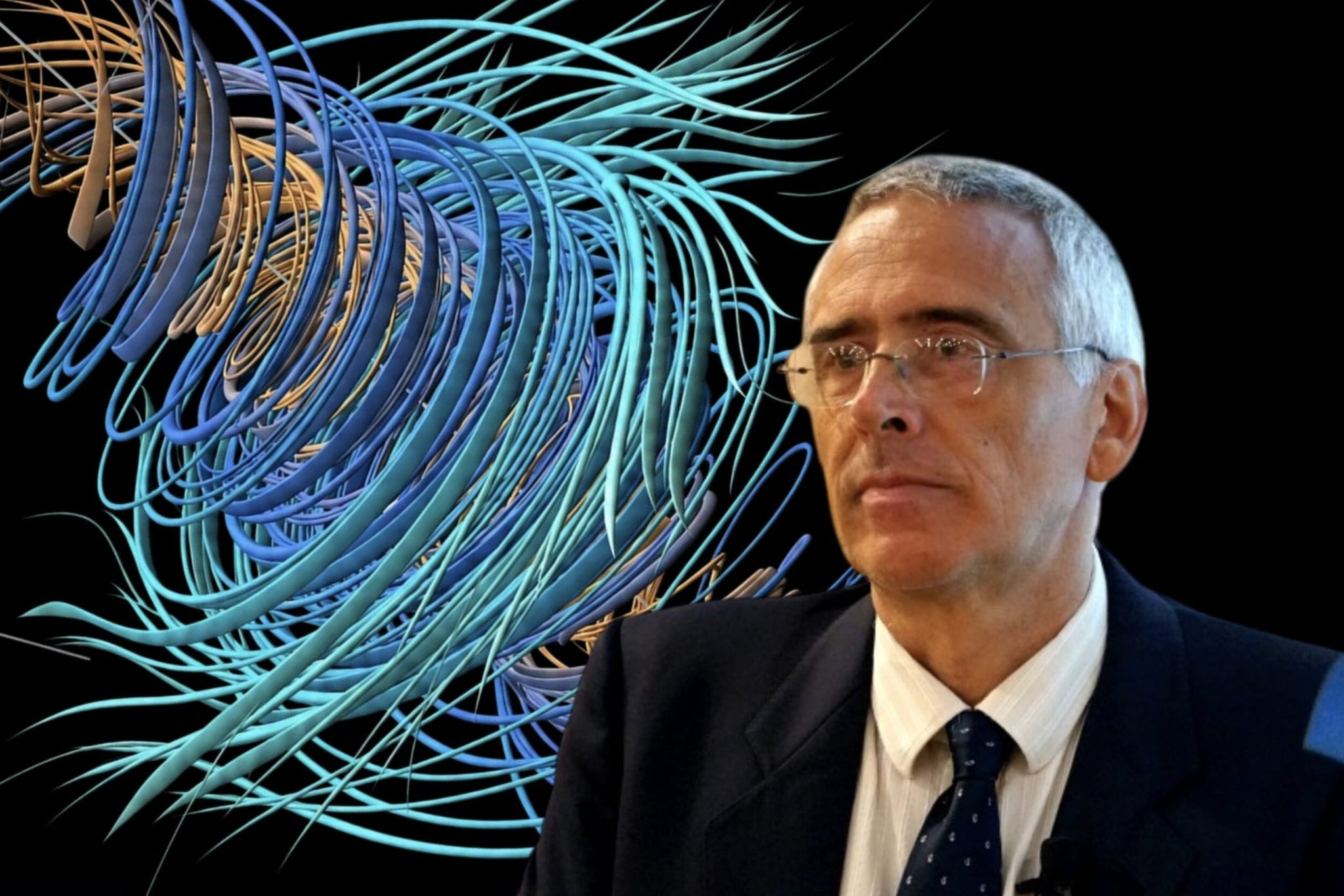
OpenAI announced that it has solved the Navier–Stokes equation, one of the most complex mathematics problems studied in this discipline, thanks to artificial intelligence. We talked about it with Filippo Gazzola, mathematician and professor of Mathematical Analysis at the Polytechnic of Milan.
Interview with Filippo Gazzola
Full professor of Mathematical Analysis at the Polytechnic of Milan
On September 8, OpenAI published an article on its blog. Title: On the Navier–Stokes Millennium Prize Problem. Contents: the solution to a complex mathematical problemwhich crosses the notes and of the mathematics students from almost 100 years. OpenAI is the company that allowed the world to learn with ChatGPT artificial intelligence as we use it today, not just a science fiction entity but a tool that has entered everything we touch. Recently also in washing machines. After revealing its skills in assembling data to give us an answer or in composing pixels to generate an image from a text, OpenAI now wants to demonstrate that even complex mathematical problems can be easily solved with the intervention of a team of agentic artificial intelligences. THE’Navier–Stokes equation it’s not exactly a compulsory school subject, to better understand the weight of this article we interviewed Filippo Gazzolafull professor of Mathematical Analysis of the Polytechnic of Milan.
OpenAI announced that it has solved the Navier-Stokes equation, calling it the mathematical problem of the millennium. Can we explain to non-mathematicians what it is?
First of all, it is one of the mathematical problems of the millennium, not the only one. The Navier-Stokes equations describe the dynamics of fluids, therefore the behavior of air, water, but also oil, gas and lava. A practical application that we all know concerns weather forecasts: in the long term they are not entirely reliable precisely because there is no uniqueness in the solutions of these equations, discovered just a few years ago. In mathematics, complex equations are often not “solved” in the classical sense of the term: the aim is to understand the behavior of their solutions. In the case of the Navier-Stokes equations, for example, it is interesting to understand whether vortices can be generated in the fluids they describe.
Is the solution proposed by OpenAI credible?
Let’s take a step back. To frame the question, we need to look at early computer-aided proofs, such as the four-color problem. Computers are exceptional for doing calculations in just a few minutes that would take us a lifetime, such as finding one hundred thousand decimal places of the root of 2. Today, however, the situation has gotten a little out of hand. The document produced by OpenAI is very long and clearly written by a machine: a mathematician would use a different language. It is absolutely not trivial to establish whether the result is correct. It will take time to understand.
Former Anthropic researcher fears AI will kill us all within 10 years: ‘It’s racing towards the endgame’
So not even the scientific community can say if OpenAI is right?
Exact. There are at most a hundred people in the world capable of evaluating and validating work of this level, and it will take time and effort to decipher.
What could be the practical applications of the answers provided by OpenAI on the Navier-Stokes equations?
These equations were written to describe the behavior of fluids and it has been an open problem since 1935. An important implication could be hidden in turbulence. Vortices (tornstorms) and atmospheric disturbances release gigantic energy on our planet. If we could fully understand their behavior in the future, in a world that requires more and more energy, we could find ways to capture that energy for use. At the moment it seems impossible to me.
Mathematician Terence Tao compares solving mathematical problems at this level to lifting weights: delegating everything to artificial intelligence leads to results, but prevents us from training the mind and understanding the processes. Like letting a robot do the weights instead of us doing them. Do you agree?
Completely. Even the world mathematical society, through leading figures such as Ulrike Tillmann and Peter Scholze, has underlined that mathematics serves first of all to develop human thinking. My concern is aimed at the new generations. Tao and Scholze are mathematicians who have worked hard to understand the discipline and today know how to govern AI from the height of their expertise. Today’s students use it as a shortcut and will not know how to handle it in the future. It’s like the fable of the Three Little Pigs: those who try to avoid fatigue are saved today only thanks to the wise little pig, but in twenty years, when they find themselves alone in front of the “bad wolf”, they will not have the tools to defend themselves.
In your work with university students, do you notice this abuse of artificial intelligence for basic tasks?
Yes, and it’s a disaster. Many students today delegate the search for answers to AI. The main aim seems to be just to pass the exams quickly, graduate and then get a job, without any real interest in the scientific problems themselves. I obviously exclude the 5% of human excellence that continues to give me hope. However, the invention itself is not enough: the atomic bomb is a scientifically extraordinary invention for the energy it releases, but we must always look at the use humanity makes of it.
Should we start treating artificial intelligence with the same care with which we spoke about the atomic bomb?
In addition to the atomic bomb, I would use the comparison with morphine: a great invention that takes away the suffering of terminally ill patients, but we know well what disasters its abuse has created. To stop this drift, the first move is to intervene right from primary school to prevent children from getting used to using artificial intelligence as a shortcut. Furthermore, collective solidarity would be needed: if each of us gave up 2% of our daily technological laziness, we could start to govern this phenomenon.