
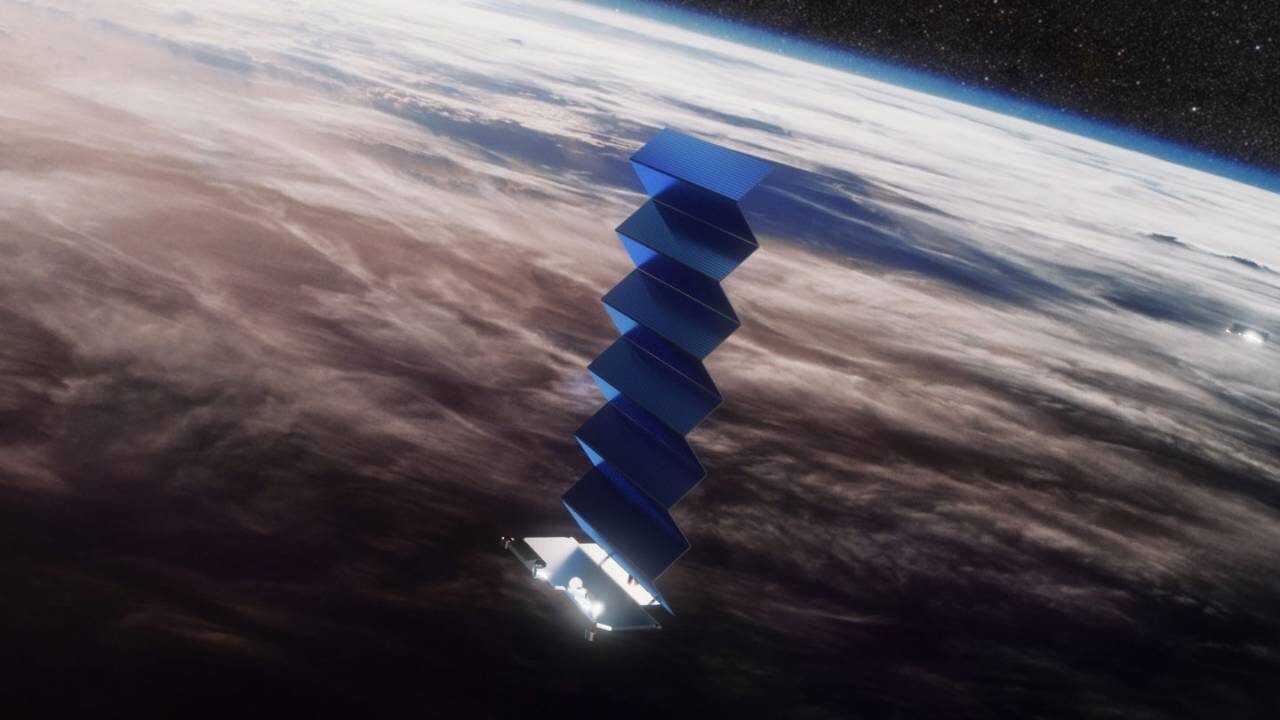
Solar activity reduces the useful life of Starlink satellites. According to a new NASA study, it is accelerating their return to Earth: thus increasing the risk of spatial debris in free fall.
The intensification of solar activity is a problem for low orbit satellites, primarily for the Starlink constellation. According to NASA new studies, the geomagnetic storms generated by solar eruptions are reducing the useful life of these satellites. Second Denny OliveiraNASA’s Goddard Space Flight Center researcher, during the geomagnetic storms “The satellites fall on earth earlier than expected”.
Not only that, solar peaks risk reducing the operational life of a satellite of approx 10 days compared to the standard. A significant fact if we consider that there are currently in orbit there are beyond 7,000 Satellites Starlink and that the goal is to get to 30,000 in the coming years.
The sun follows a cycle of activity of about 11 years. The last sunny peak was recorded at the End of 2024 and in fact in the last months of the year the solar eruptions and the geomagnetic storms.
What happened to Elon Musk?
Free fall satellites
From 2020 to 2024, they were traced 523 atmospheric return of Starlink satellites: everyone is completely burned on their return to Earth. Second Sean Elvidge of the University of Birmingham, the phenomenon could have a positive aspect. “This acceleration helps to remove obsolete satellites faster, reducing the risk of space debris”. However, Elvidge always warns about Difficulty in managing satellites at shares lower than 400 kilometerswhich could become unsustainable if the returns become too quick.
A risk for security when returning to the ground
Not only that. There is also a security problem. If satellites fall too quickly, they may not completely burn in the atmosphere. In August 2024, a piece of a Starlink satellite from the weight of 2.5 kilograms was found intact on a farm of Saskatchewanin Canada. It is the first well -known case in which a fragment of Starlink has reached the ground.
Second Samantha Lawler of the University of Regina, who lives in Saskatchewan, is likely that other debris fell elsewhere, without being noticed. “This is the easiest place in the world to find pieces of Starlink. If we found one here, how many have we lost elsewhere?”.
With the approach of the solar peak and the continuous launch of new satellites, these questions become increasingly urgent. Solar eruptions do not They only threaten spatial communications: they also place practical and environmental challenges, both in space and earth.