
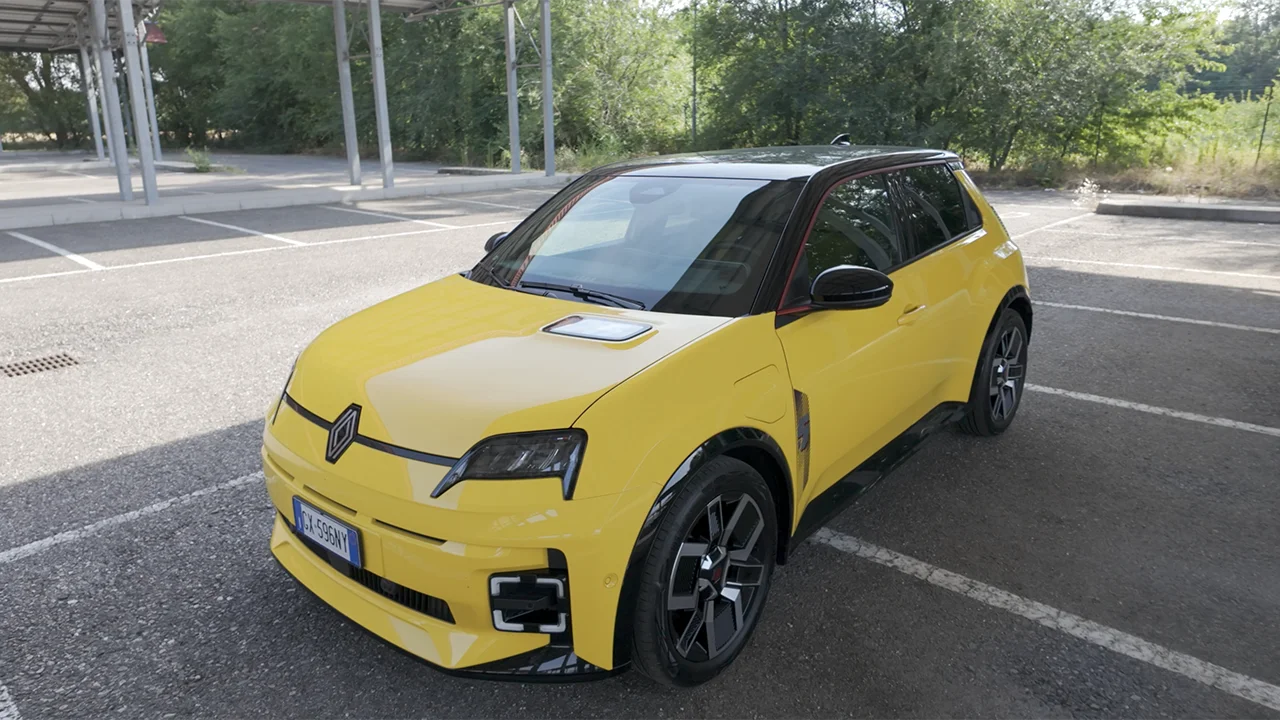
After the first contact we had on the occasion of the international launch (here you can find the video shot on that occasion), we returned to get our hands on the Renault 5 E-Tech Electricthis time for an extended test over several days, using it as a real everyday car. If in the first test the car was green, this time we tested it yellowa truly iconic color for this model: it was precisely in this shade that the Renault 5 was presented right from the prototype, and the combination with the contrasting black – lower skirt, roof and full-length red thread – is particularly successful.
Here you will therefore read not only a summary of the technical specifications, but also considerations arising from prolonged usejust to go a little beyond the simple impressions obtained after the international test drive. Obviously you can find everything summarized in our dedicated video:
Design: a project of guaranteed success
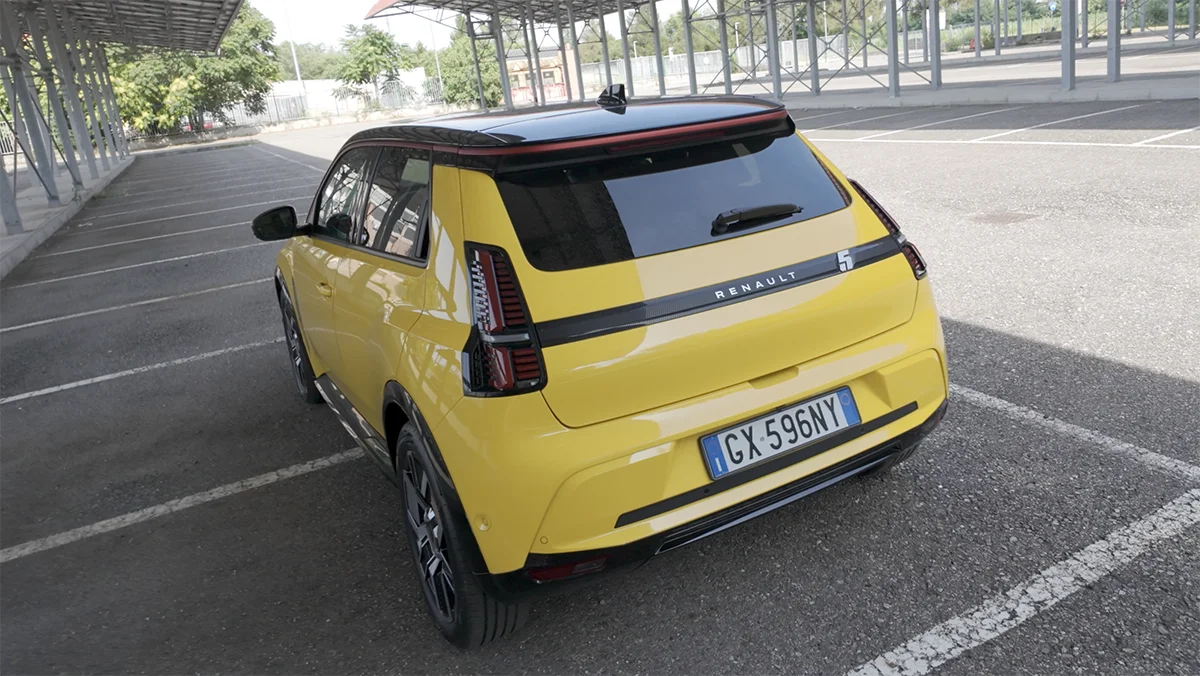
It is no coincidence that the Renault 5 E-Tech Electric has conquered the title of Car of the Year: This is one of the most convincing designs of recent years. On the back the lettering of the brand and the “5” glued stand out, as do the headlights with visible three-dimensional elementswithout external cover.
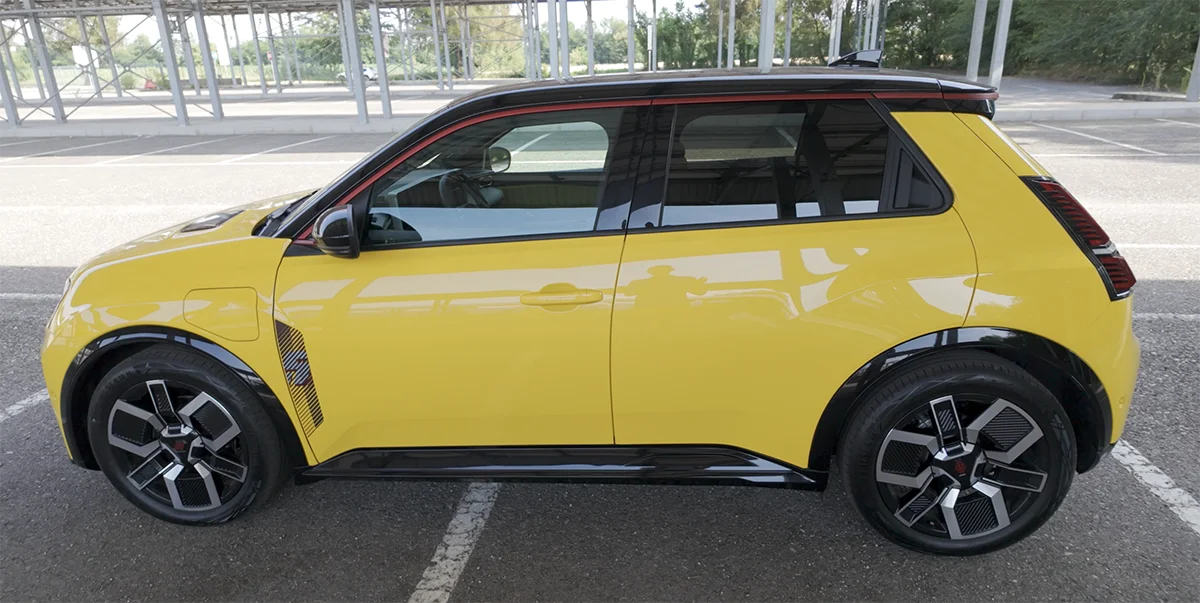
Laterally, compactness is one of the strong points: with only 3.92 m longthe car is very agile in the city, without sacrificing interior space, as we will see later. The charging port is positioned on the front left side and hides a Combo CCS socket capable of charging in direct current up to 100 kW.
A scenographic detail concerns the front “air intake” which recalls the historic R5: today it is a display which progressively lights up during charging, showing the battery level even from the outside.
During the test days, we encountered specimens of every color, confirming the commercial success of the model, which is particularly strong in France. A recurring doubt must also be clarified: Renault engineers have confirmed that the proportions of the car, both external and internal, are only possible thanks to the AmpR electric platform and they do not include any thermal variant.
The AmpR Small platform and 52 kWh battery
At the base of the Renault 5 E-Tech Electric is architecture AmpR Smallevolution of the CMF-B EV platform developed by Ampere, the Renault division dedicated to electric vehicles, and which debuted with this model before being shared with Renault 4 E-Tech Electricwith which it shares approximately 68% of the components. This is an architecture designed from the outset for electric propulsion, which takes up the front part of the CMF platform (the same as the Clio) up to the A pillar, and then adopts completely new components at the rear, with McPherson strut suspension at the front and a multilink layout at the rear.
On the battery front, both available versions adopt a NMC chemistry (nickel-manganese-cobalt), a more traditional technology than LFP cells, chosen by Renault to ensure good energy density in a compact and relatively cheap to produce package. The construction peculiarity concerns the organization in large modules, a solution that is close to the cell-to-pack concept and which reduces the number of components: the 40 kWh battery uses 3 modules, while the 52 kWh one integrates 4, for a total weight of the pack of approximately 297 kg compared to 237 kg for the smaller version. The battery pack is housed under the floor, in a low configuration that allows for maintenance a seat only slightly raised compared to a traditional city car, while still contributing to lowering the overall center of gravity of the car and improving its driving stability.
Interior: quality of materials and some small inconsistencies
On board we find the usual dual display Renault, with Apple CarPlay (or Android Auto) that connects automatically. The instrument panel behind the steering wheel offers different configurations: from the almost full-screen map, to the ADAS summary, up to the speed-focused display.
The driving modes (Eco, Comfort, Sport) also change the color of the ambient lights of the passenger compartment – emerald green for Eco, yellow for Comfort, red for Sport – a refined and well-executed detail.
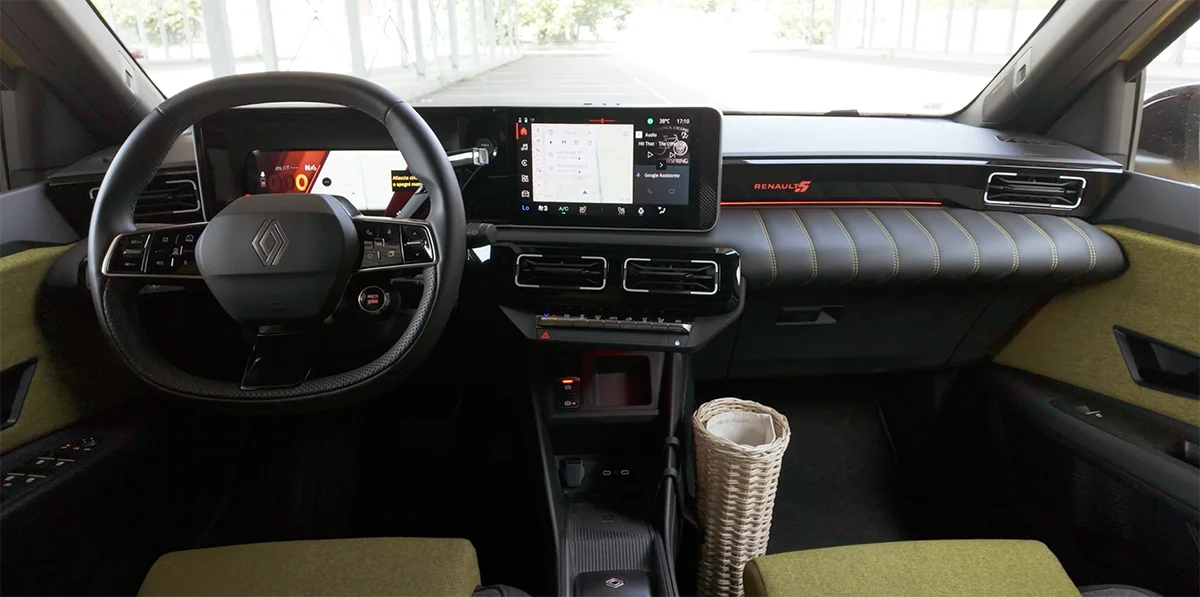
The materials convince: extensive use of denim style fabricsyellow and gray with the “5” logo on the backrests, combined with imitation leather on the seat sides. The fabric is particularly comfortable on extremely hot days, avoiding the “sticky” effect typical of leather.
Some reservations instead concern the (perhaps excessive) wealth of levers on the steering wheel: in addition to the gear lever, conveniently integrated into the column, there remains a separate lever for multimedia control which appears superfluous and rather dated in concept.
Among the available accessories, we found a nice (and very French) baguette basket on board.
Habitability and trunk
Despite its compact size, The rear seats proved surprisingly livable even for a 1.90 m tall passenger sitting behind a driver of the same height — a combination that is not to be taken for granted. Legroom is limited but sufficient, and feet are comfortably placed under the front seat. Let’s understand, this is not a car to be used comfortably for several hours in these conditions (in that case the Renault 4 would be better), but for short trips with multiple occupants there are no problems.
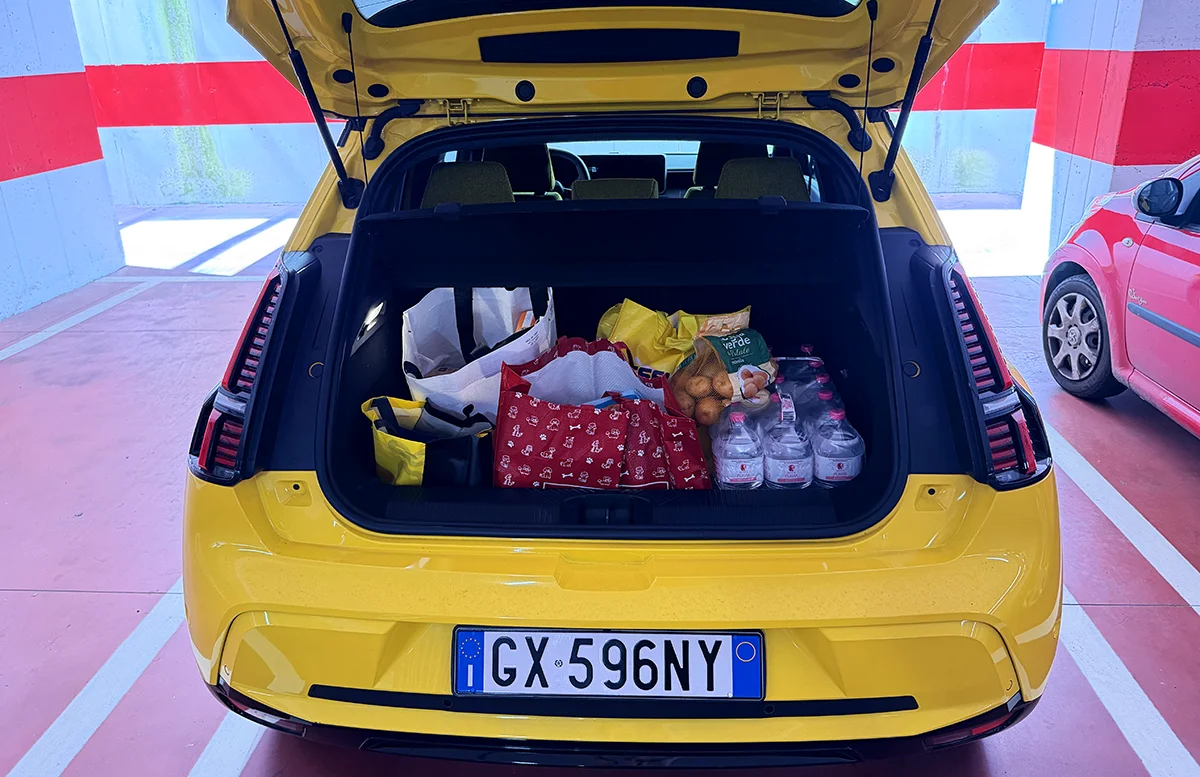
The trunk claims 326 liters of capacitywith a regular and well-usable load compartment. The rear seats fold down with a 40/60 pattern using convenient cords, making the car also suitable for transport of bulky objectsas tested by the editorial team during the transport of bulky boxes. The Renault 5 was also put to the test with the classic family shopping, revealing a load compartment that was more than sufficient for ordinary tasks.
On the road: driving pleasure and real consumption
The tested version is the one with 150 HP engine and 52 kWh batterythe most balanced combination compared to the basic 40 kWh variant. The weight of the car is around 1450 kg, low for an electric one, also thanks to the general compactness.
Always driving in Sport mode, without any particular changes in driving style, the average consumption recorded was around 16 kWh/100 kmin a mix of urban, extra-urban and motorway routes. This translates into a realistic autonomy of approximately 350 km in mixed useThat can exceed 400 km in predominantly urban contexts.
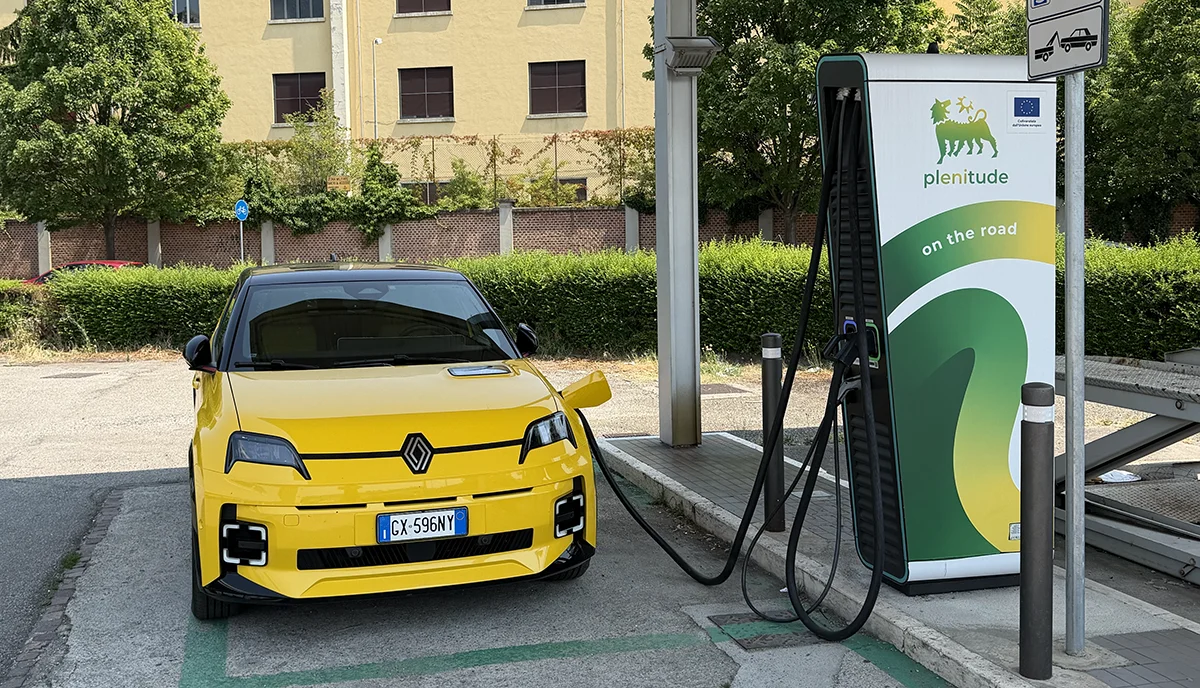
Fast charging at 100 kW allows you to go from 20 to 80% in around 15-20 minutes, while a full charge from a flat battery takes just over half an hour.
From a dynamic point of view, the low center of gravity conferred by the battery guarantees excellent road holdingsuperior – according to the comparison of our experience – to that of the Renault 4 with the same technical base, and closer to the behavior of the new Twingo E-Tech Electric. The sprint from 0 to 100 km/h is completed in approximately 8 seconds, with a maximum speed automatically limited to 150 km/h; more significant, for daily use, the brilliant idea and intermediate shots.
Regenerative braking, without adjustable paddles on the steering wheel on this version (coming with a future update), is however present well calibrated using “B” modewith a natural and progressive slowdown.
Even on the motorway, always in Sport mode and at code speed, the car proved to be sufficiently silent and free of problems with the ADAS systems, with an estimated autonomy of around 300 km in these conditions.
The V2L function: energy even outside the car
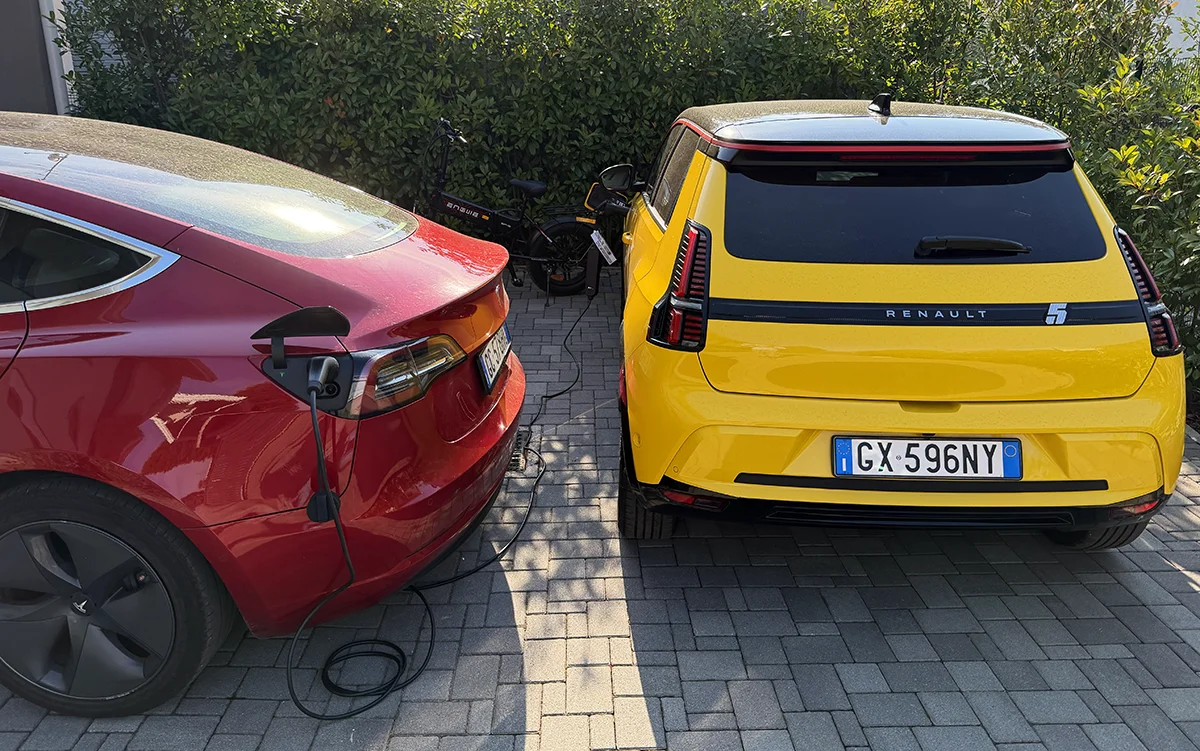
Among the most interesting features is: the Vehicle-to-Load (V2L) functionwhich using a dedicated adapter transforms the car battery into a portable energy source, useful for powering small appliances when camping or, as demonstrated during the test, for charging an e-bike or even another electric car in case of emergency (at a low power of approximately 2 kW).
This function, although now present in many electric cars on the market, has not yet fully entered the common imagination, and it is difficult to understand its innovation. In reality it can be useful in different contexts, such as excursions, camping, construction site activities, or even simply to exchange energy between two owned cars, in the event that only one of the two has been recharged at a charging station, and you don’t want to burden the home system.
In conclusion, our long-term test not only confirmed the first impressions of several months ago, but further strengthened them. The appreciation for the style that Renault chose for this car was not just the result of initial amazement, but after a long time the design does not tire and continues to be pleasant.
At the same time, the proportions made possible by the electric platform allow a compact car but usable in many contexts, without too many sacrifices. On the technical side, the French company has put all its know-how, and in particular with regards to the battery, it demonstrates that a small car does not necessarily mean a small battery. Our final opinion is that the award won as Car of The Year is not just the result of “politics” in the automotive world, but actually arises from the solidity of a project born well, and developed even better.