

The digital cameras could change radically thanks to a new technology developed by researchers at Nagoya University. The group created a transparent optical sensor based on nanolayers of gallium-doped zinc oxide (GZO)capable of directly acquiring color information red, green and blue (RGB) within the same pixel. The research results were published in the scientific journal ACS Nano.
The proposed approach differs from the architecture adopted today by almost all photographic sensors. Most modern sensors employ the Bayer filteran array of color filters in which each photosite records only one chromatic componentaccording to a scheme with double green density (50% green, 25% red, 25% blue) which follows the sensitivity of the human eye to luminance. Since each photosite captures only one channel, the complete color image is reconstructed by demosaicinginterpolating missing values from adjacent photosites and, consequently, with an inevitable loss of effective detail and the appearance of artefacts such as moiré and false colours.
A single pixel captures all RGB information
The solution developed by the team led by the professor Minoru Osada eliminate this limit thanks to transparent GZO nanosheetswhich allow multiple light-sensitive layers to be superimposed. Each level responds to different wavelengths of the visible spectrum, thus allowing a single pixel to directly record all RGB information.
According to the researchers, this architecture it could reduce the overall number of pixels needed by up to 75% for the same final resolution. The result could result in more compact sensors, photography modules for smartphones thinner and high definition image acquisition systems also intended for other sectors.
One of the initial obstacles involved the limited response of zinc oxide nanosheets to visible light. The introduction of gallium it allowed the creation of specific electronic states capable of converting visible light into an electrical signal without compromising the transparency of the material.
Much higher sensitivity than traditional sensors
The sensor is built to do something that seems counterintuitive: absorb very little light. Each of its layers lets it pass through 99.995% and retains a minimal fraction (0.005%). This quasi-transparency is fundamental, because it allows the layers to be stacked on top of each other, each dedicated to a color, so that a single pixel can record red, green and blue together, in a structure that the authors define as “Bayer-style” but vertical, without the need for the classic filter matrix and related interpolation.
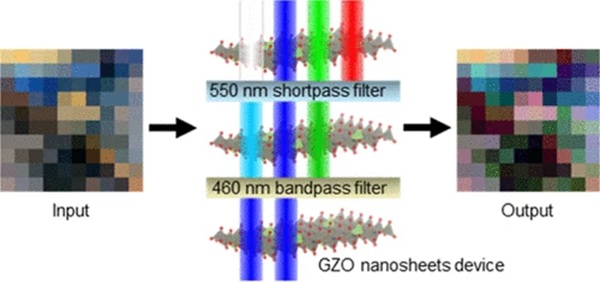
At this point the natural question arises: if each layer retains such a small fraction of light, how can it be sensitive? The answer lies in gallium added to zinc oxide, which triggers internal amplification in the material: every small amount of light collected is translated into an electrical signal that is much larger than you would expect. This is how the two things coexist: the sensor retains little light, but what it collects is amplified enormously. The result is a declared sensitivity up to 800 amps per watta very high value for a photodetector, especially when compared with i approximately 10 A/W of commercial sensors.
As often happens, however, all that glitters is not gold: such strong amplification tends to be accompanied by a slower responseand speed is just what a camera needs to take sharp photos or shoot smooth videos. The study does not publish the response times, so on this point there remains an unknown: the enormous sensitivity is useful for revealing minimal quantities of light, but it is not enough in itself to demonstrate that the device works well as a real photographic sensor.
According to laboratory tests, however, the prototype reproduces color images with fewer errors than traditional sensorsallowing to obtain a result consistent with the starting idea: if each pixel directly measures the three colors instead of reconstructing them by approximation, many of the typical defects of interpolation disappear. For now, however, it remains a proof of principle on a prototype.
Simplified production and use in numerous sectors
The research also highlights possible advantages from a production point of view. Transparent sensors can be made through a process in solution at room temperaturewithout several complex steps required by the production of traditional semiconductors. This method could simplify manufacturing and help reduce industrial costs.

The prototype also demonstrated stable operation up to 400°Cas well as maintaining reliable performance in vacuum conditions and in environments characterized by high humidity. These properties open the way to possible applications in smartphonesin medical endoscopesin the autonomous vehiclesin systems industrial vision and even in hardware intended for space missions, where robustness and reliability are fundamental.
According to Professor Osada, director of the research, the operation of the new sensor resembles that of the human eyeas it separates color information in a retina-like manner before reconstructing the complete image.
The technology still remains in the experimental phase and will have to demonstrate its competitiveness in terms of large-scale production, costs and commercial reliability. However, the results obtained outline an interesting perspective for the planning of future ones digital cameraswith smaller, lighter sensors capable of offering superior image quality.