
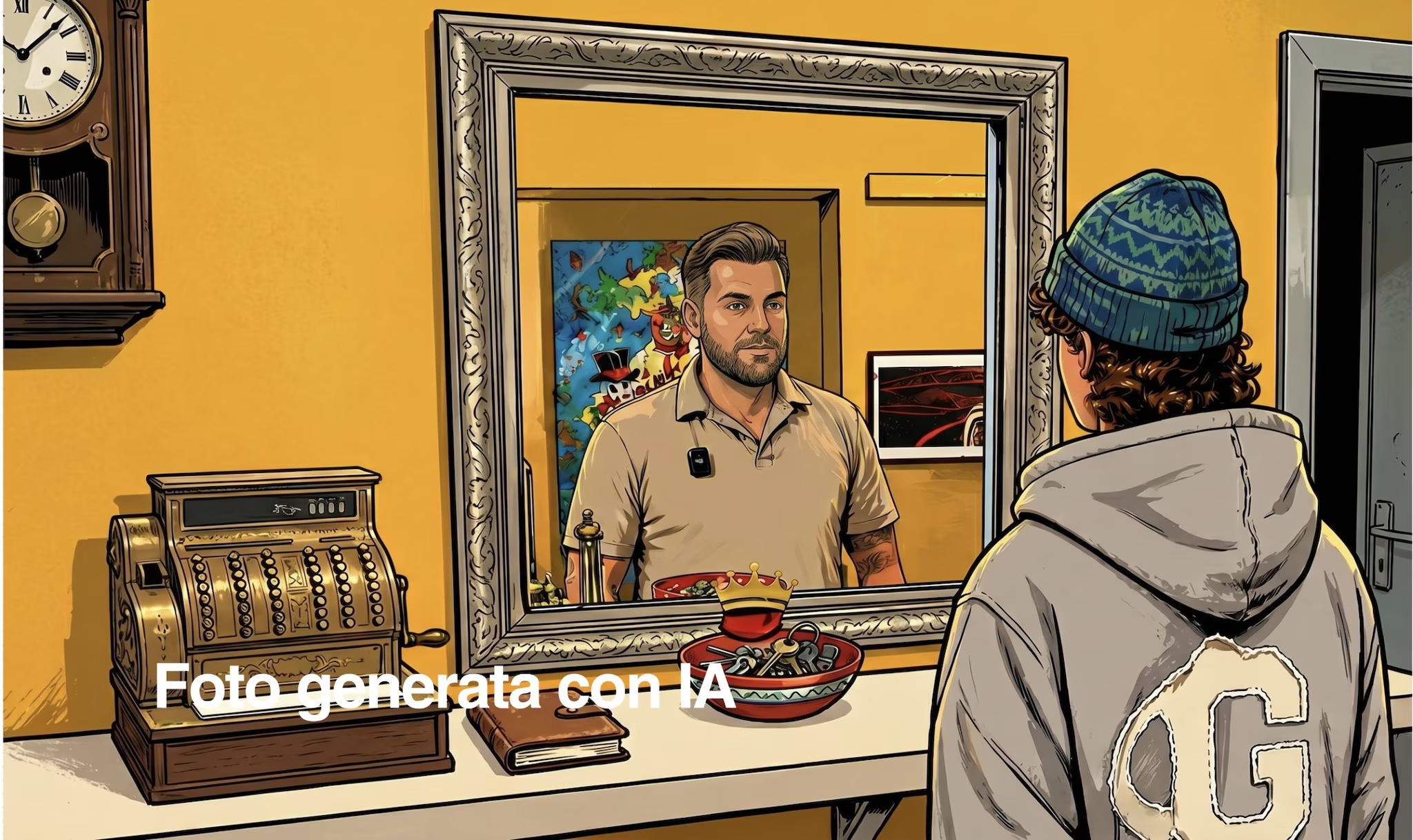
It is now marketing. The latest video chosen by the TikTok algorithm for my feed is set in a I buy gold. Two people. The owner of the shop, known on social media for having already told the story various commercial activities. Is called Michele Migliaccior, he has 168,000 followers on Instagram and nearly a million on TikTok. The other is a customer. A boy shot from behind. The boy shows up with a fair amount of gold: 125.83 grams. The dealer prices it around 12,000 eurosabout 90 euros per gram.
The guy says he just needs to 3,000 euros because he has to pay debts to people. At this point one begins negligible paternal about how it is a wrong gesture: in the end the shopkeeper calls the boy’s mother to ask her to come to the shop. As is quite clear in the comments, suspicions that the video is acted are very strong. Scrolling through the profile we see that this video is not an isolated case, but is the result of a marketing strategy.
Each video tells a story little storybased on current issues. Once there was a boy defined as “maranza” who was wearing a stolen necklace. Another a couple of girls he wants finance a business on OnlyFans. And then again. Stories of donations to the elderly, young people who run away from Italy. Of course, we cannot certify that every video is fake. And we can also take into consideration that these videos are reconstructions of similar cases. But by scrolling more through social media we understood that the video with the customer is truly one marketing strategy.
The scam with the face of Fabio Caressa: his deepfake image to sponsor an illegal site
A widespread technique: the cases of Mr. Oro and Dan Ink
Another profile uses a very similar strategy. This time it’s called Mr. Golden Goldha 436,000 followers on TikTok and 235,000 on Instagram. The similarities are many. Videos with customers, where only the owner is framed. Cartoon style covers. Every customer is different, every story is complex. Customers don’t just sell gold but they tell their stories stories, in the end it is halfway between a sale and a psychotherapy session. We learn from social media that Mr. Oro D’Oro now also has a program on DMax.
We repeat it. All the videos we saw seemed acted but we cannot guarantee that they are. Yet the stories seem tailor-made for smartphones. But this technique goes beyond the social screen. The same strategy is also used by Dan Ink, 76,000 followers on Instagram and 469,000 followers on TikTok. Here we talk about tattoos. The customer arrives, often with bizarre proposals, and the tattoo artist listens to everything and understands how much to ask.
Here too the requests go always out of the ordinary: a customer who wants to tattoo his whole body, a drunk guy who wants to tattoo three bottles to remember the evening’s table, another who wants to cover a tattoo without paying. Here too the matter is the same: they are certainly scenes that can happen in the life of a tattoo artist, but the final effect of the video is always a little acted.
Story, surprise ending and money: the points that work
There were social media before dozens of programs TV based exactly on this genre. The Bank of Punches which made the stories of the employees of theAmerican Jewelry and Loan of Detroit, United States. Here we are in the world of pawn shops. Customers come, try to sell or buy something. They tell their story and the story of the object they have with them to sell.
The strengths of these narratives there are at least three: each story is a different chapter. A micronarration which starts and ends within a few minutes. There is thewaiting for the finale. Does the deal close? What will be the outcome of the interview? And then there are the money. All these cases revolve around figures that can be more or less high. Seeing the final drop point is the reason to watch the whole story.