
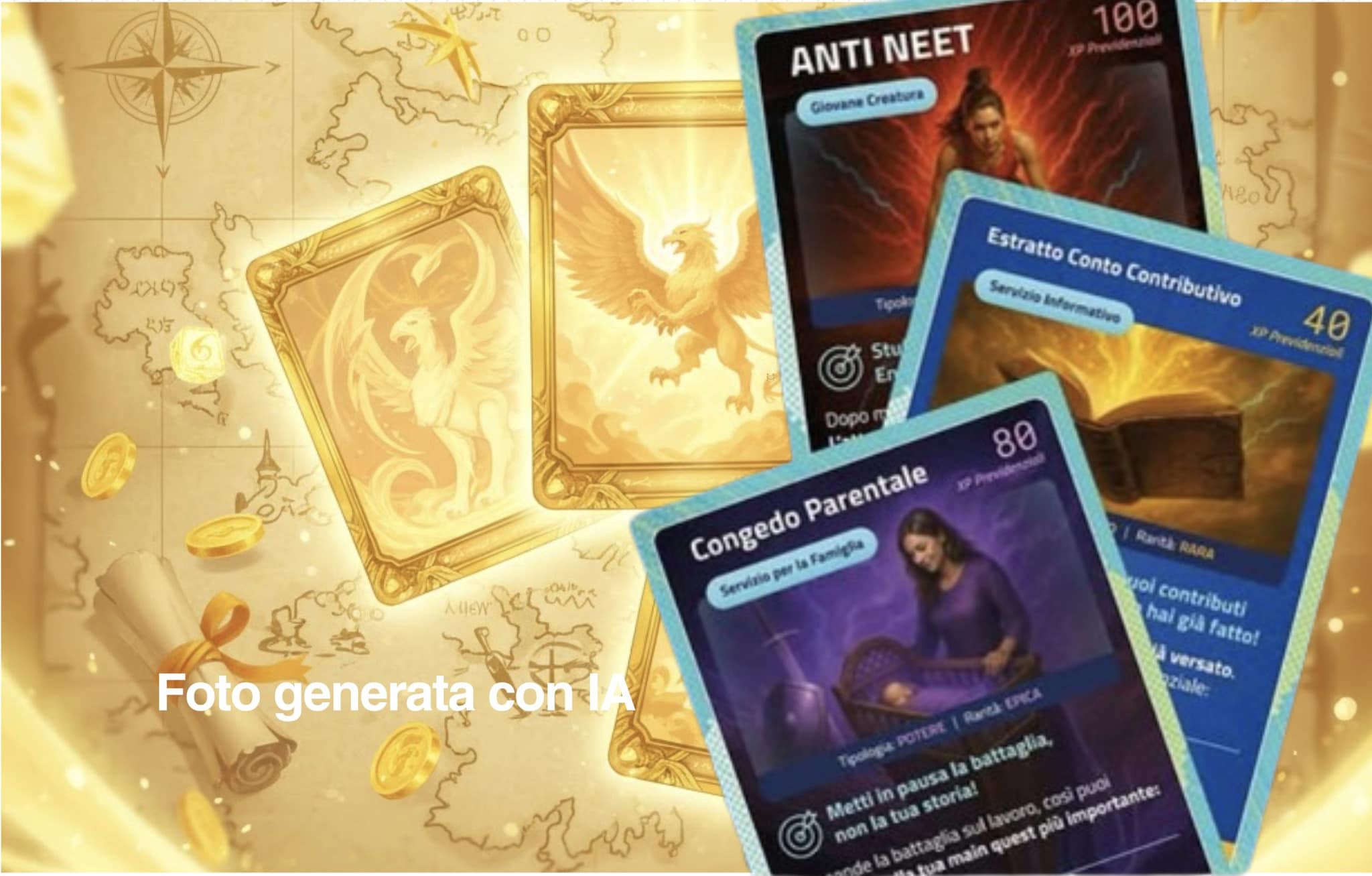
The trading card market works well. He understood it too the INPSalso present this year among the stands of Lucca Comics&Games. The National Institute of Social Security distributed it free of charge at its stand Magic or Pokémon style cards to bring visitors to the fair closer to topics such as welfare. Instead of new Pokémon or old spells, they could be found in the cards NASpia move Anti Neetor the move Parental Leave.
Curious idea, sure. The aim of the communication campaign, however, was quite linear: to explain the bureaucracy for young people. There has been some criticism. Some illustrations look like built with artificial intelligence. However, the cards ended up in the visitors’ registers. You never know they gain value.
Trading card hysteria
The set is inspired by the most popular collectible card games such as Magic: The Gathering and Pokémon. It is no coincidence that some nerd culture sites have renamed the initiative INPS TGC, Trading Card Game. Beyond the memes, the operation promoted by the Institute testifies to the enormous success of card games among enthusiasts. A real crazewhich drives millennials as well as the zeta and alpha generations crazy.
The Pokémon card sold for 4 million dollars: what makes it so valuable
Not to mention the economic implication. Last September, a Pikachu Pokémon card was sold at auction for $4 million. A figure that surpasses the 2 million dollars paid by the American rapper Post Malone to buy the Last Ring, a unique piece of Magic inspired by JRR Tolkien’s Lord of the Rings. Beyond exceptional cases, there has long been a frantic race to obtain the most prestigious cards from new sets. The case of the pre-launch of Magic x Final Fantasy is emblematic, with price surges, shortages of units and canceled pre-orders.
The high value of the cards, to which is added the collecting fever, has caused in recent years an increase in trading card thefts around the worldItaly included. The most recent case dates back to October 9th, when two thirty-year-olds from the Padua area stole the Pokémon cards of a Roman collector. A stolen item worth 24 thousand euros. In the end the thieves were tracked down by the local police and the loot returned to its rightful owner. This does not mean that theft, scams and robberies to obtain rare cards are on the increase, especially in Japan. The robbery of Pokémon cards which took place last July at a specialized shop in Kasamatsu involving cards with a total value of 13.7 million yen (around 94,000 dollars) is emblematic. It’s not the only case.
The trading card market
According to various industry analyses, the global collectible card game market is now worth between 7 and 13 billion dollars. Constant growth, driven by reprints, cross-media collaborations and the thriving market of second online collectibles. Platforms like eBay, Cardmarket or Whatnot they have become exchanges where prices fluctuate based on demand, rarity and state of conservation, not unlike what happens in the world of art or stocks. In Japan and the United States, some investors have even started to consider playing cards as alternative assets, i.e capable of guaranteeing long-term returns.
A phenomenon that translates into a parallel economy made up of trade shows, auctions, appraisals, unboxing videos and professional grading and authentication servicesuseful for establishing the real value of a card. Between nostalgia, speculation and passion, collecting confirms itself as one of the most long-lived subcultures of pop contemporaneity, capable of renewing itself with each generation without losing the original charm of the “rare piece”. And who knows, one day even the INPS cards, distributed for fun in Lucca, will in turn become collector’s items. At the moment there is no evidence of a secondary market, but the interest aroused during the fair suggests that the line between promotional initiative and nerd cult is thinner than it seems. After all, in the world of collectors, everything can acquire value. All it takes is for someone to want it bad enough.