
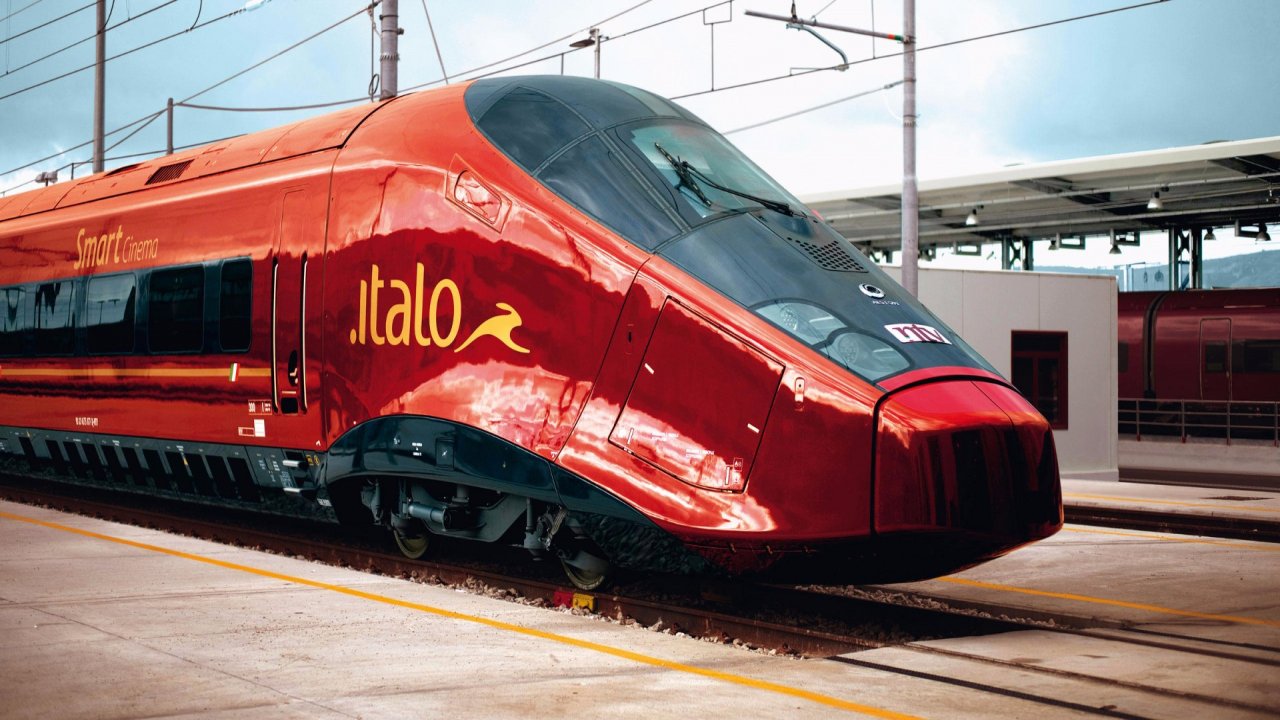
Italo turned on Starlink on board high-speed trains, and the first numbers arrive from the testing on the Bologna-Milan line: the satellite connection reaches peaks of 192Mbps downloaded when the train was launched, after starting at just 11.2 Mbps in the underground station of Bologna, where the concrete above the tracks cuts out the signal from the SpaceX satellites. The numbers were published by IlSole24Ore, which tested the new technology.
Ten minutes outside the tunnel are enough to understand the difference. Once out of the station, the download rises to 137 Mbps, the latency drops from 90 to 69 milliseconds and the upload settles at 8.7 Mbps, before reaching the peak of 192 Mbps recorded during the journey to Milan.
However, these numbers are far from the numbers above 400Mbps touched during almost a year of experimentation at 300 km/h, with a minimum latency dropped to 25 milliseconds. The satisfaction of the passengers involved in the tests is also clear: the85% declared themselves fully satisfied, and over half gave the maximum score. Numbers which, according to the company, represent only the first step of a broader project of on-board multimedia services.
A fleet that grows month after month
Today there are 19 equipped trains. By the end of September 2026 they will become 27, exceeding half of the fleet, with the new trains that will be born already equipped from the factory, without the need for a subsequent retrofit.
The agreement with Starlink aims to close an entirely Italian paradox: very fast trains supported by on-board Wi-Fi that rarely keeps pace, with Italo’s CEO La Rocca speaking to IlSole24Ore of an investment of just over 10 million euros for installations on trains alone, to which a few million euros per year are added for service management and maintenance of the equipment.
The connection will remain free for passengers. The objective, according to the company, is not to generate direct revenues but to raise the perceived quality of the service to attract above all business customers and international tourists, the profiles most sensitive to a network capable of supporting video calls and streaming without interruptions for the entire duration of the trip.
The doubt is how the satellite coverage will behave in sections with longer tunnels or in particularly dense areas of infrastructure, where the signal towards satellites in low orbit may encounter more obstacles than an open route. It is there, rather than in the speed peaks, that Italo’s promise to leave the railway Wi-Fi lottery behind will truly be measured.