
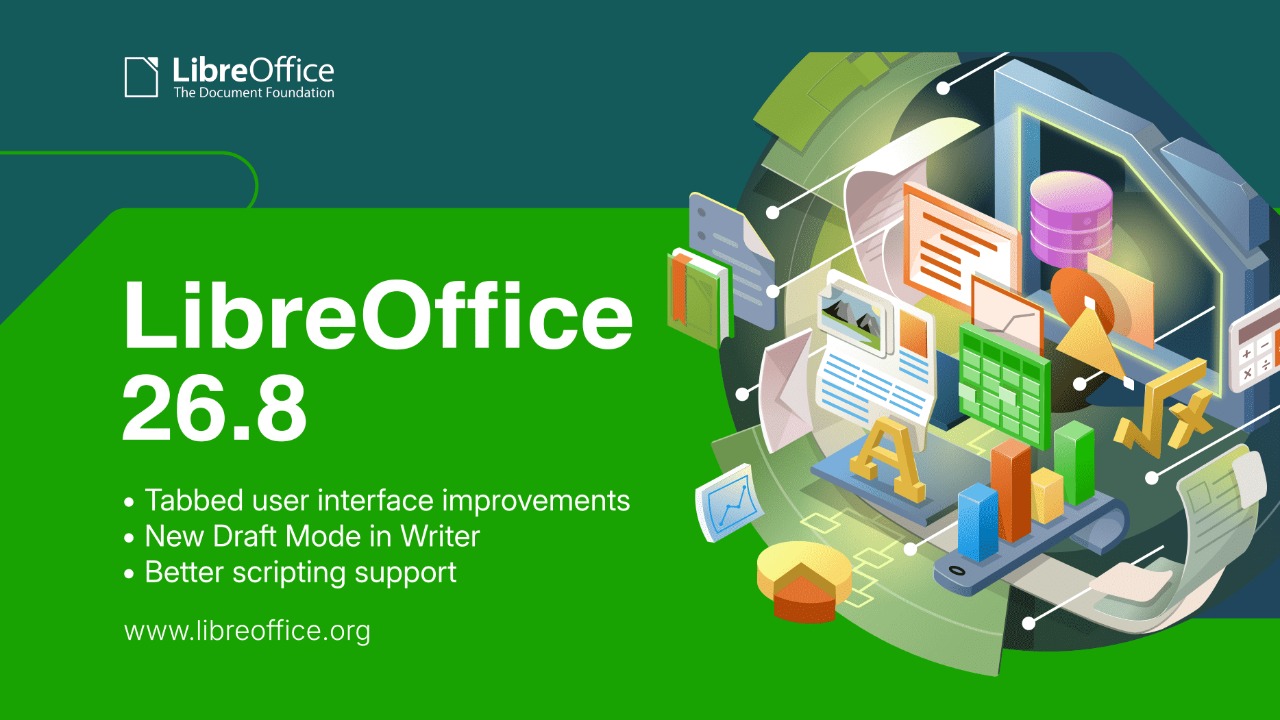
This has never happened before: LibreOffice 26.8 has exceeded quota 1,031,162 downloads in the first seven days of its release on August 26th. He made it known The Document Foundation in a report published on its blog, defining it as the highest number ever achieved by a release of the open source suite in the first week of availability.
The data, it should be noted, only concerns downloads made from the official project page and does not take into account those who updated via the Linux distribution repositories, the Snap and Flathub stores or the PPAs. The real number of installations, therefore, is probably much higher than that communicated.
Alongside the downloads, the foundation also shared the numbers linked to the communication of the release: 50.061 between views, shares and likes collected on social media (Mastodon, Bluesky, X and Facebook) from posts dedicated to the launch, and 20,918 views for the video “LibreOffice 26.8 – New Features”, subtitled in 32 languages thanks to the work of the international community of translators.
A choice of field: no cloud, no artificial intelligence
The download success comes at a time when LibreOffice 26.8 stands out for a precise editorial line. The suite remains a native application that runs entirely on the device of the user, without sending data to the cloud and without any integration of functions based on generative artificial intelligence, unlike what is done by other tools on the same base code, or by Microsoft on its own suite.
On the technical front, the release brings improvements to professional typography, deeper support for global writing systems (the suite is available in 120 languages), and more refined handling of paragraphs and formatting. There is no lack of attention to accessibility, with ARIA support designed for screen readers.
It also remains confirmed double soul of the interfacewith the classic toolbar mode that can be repositioned next to the Microsoft Office-style ribbon mode, in addition to the ability, already known in previous versions, to recover damaged Word, Excel and PowerPoint files often better than original Microsoft applications.
Numbers like these come in a context where the sensitivity towards privacy and independence from the cloud it is weighing more and more in the choices of companies and public administrations. The Document Foundation closed the report by thanking “the global community of volunteers and certified developers for all the work done on this release”, a recognition that weighs as much as the numbers themselves: behind one million downloads there is a development model that continues to hold its own against proprietary suites without a comparable euro of marketing budget.