
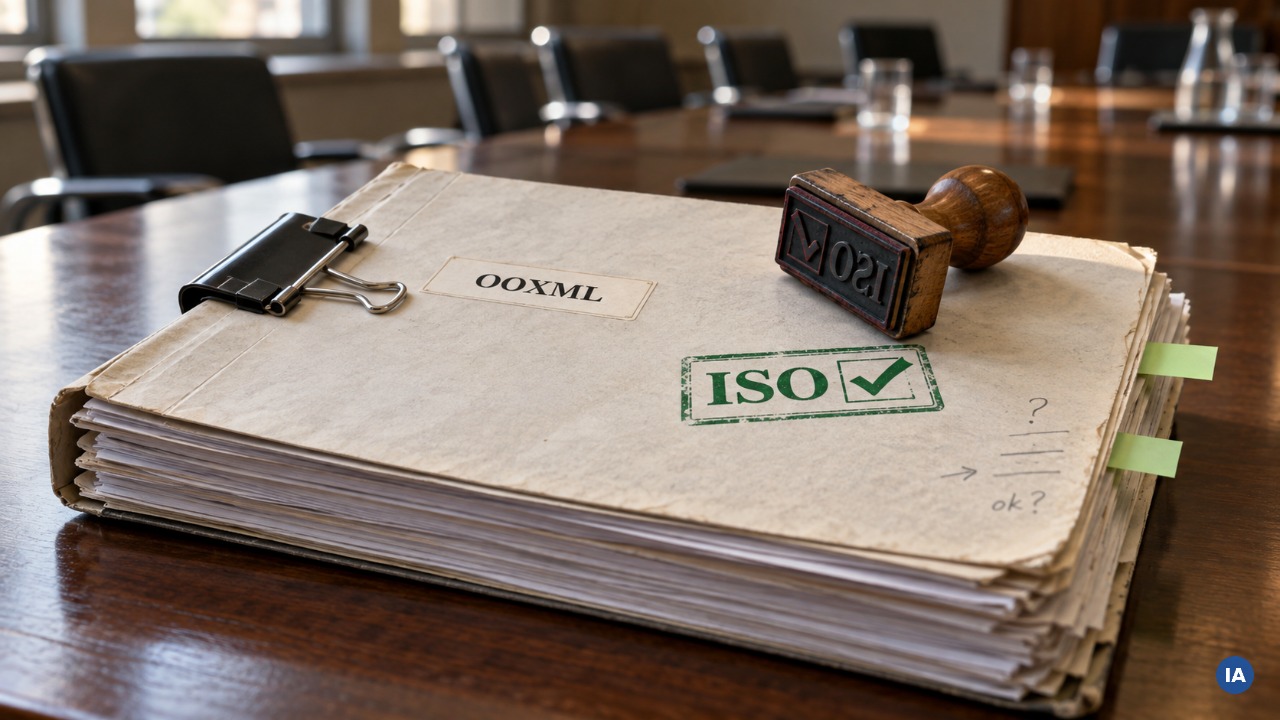
The Document Foundationthe foundation that supports LibreOffice, accused Microsoft of having bent the OOXML standardization path to its advantage. In a speech published on 23 October, Italo Vignoli reconstructed the protests against the process that led to the approval of the format as ISO/IEC 29500. The thesis concerns both the voting procedures and the distance between formal recognition and effective interoperability.
The point must be kept distinct: OOXML has achieved ISO standard status. The foundation disputes its substantial openness and attributes a decisive influence on the process to Microsoft. The text therefore constitutes a position statement of the LibreOffice project, with explicit accusations on the responsibilities of the company and the bodies involved.
In official reconstruction, one of the main problems is the use of the procedure fast-track. Ecma International submitted the specification to ISO/IEC JTC1 in December 2006, when the responsible technical committee, TC45, was chaired by two Microsoft employees. According to Vignoli, that accelerated path did not allow for an adequate examination of such extensive documentation.
The first vote, in September 2007did not lead to approval. The foundation recalls objections about date management, language support and compatibility with ODF. France proposed separating the core of the format from the functions necessary to maintain compatibility with previous systems, a distinction directly linked to the possibility of implementing it in different software.
Complaints to committees and the problem of interoperability
The heaviest accusations concern the composition of the national standardization bodies. TDF reports the entry of Microsoft commercial partners in Portugal and a strong expansion of the Italian committee, which would also include a law firm and a public relations agency linked to the company. The proposed interpretation is that these inputs have altered the balance of the discussion.
Another disputed passage is the Ballot Resolution Meeting in Genevain February 2008. Delegates had to deal with thousands of amendments in the space of a week, a time the foundation judges to be insufficient. The text also reports that several national bodies complained that they had not been able to examine the final version on which they were called upon to express their opinion.
OOXML gained approval inApril 2008. The appeals presented by various countries against alleged procedural irregularities did not stop the process. For TDF, the result demonstrates how the availability of personnel and resources can impact technical bodies, even when their rules provide for formally balanced participation.
The criticism then comes to the variations Strict and Transitional. The foundation accuses Microsoft of having favored Transitional, oriented towards compatibility with previous documents, rather than making Strict the concrete reference for users. The problem raised concerns the possibility, for independent applications, of reproducing the behavior of Microsoft programs without depending on their particularities.
Vignoli also attributes responsibility to competition between Microsoft and IBMwhich in his opinion took away attention from user interests and the shared development of ODF. The foundation’s final request concerns the guarantees of the process: greater participation of institutions, research and civil society, together with rules capable of preventing a single supplier from influencing decisions. For TDF, the open standard label must be reflected in the possibility of actually implementing it.