
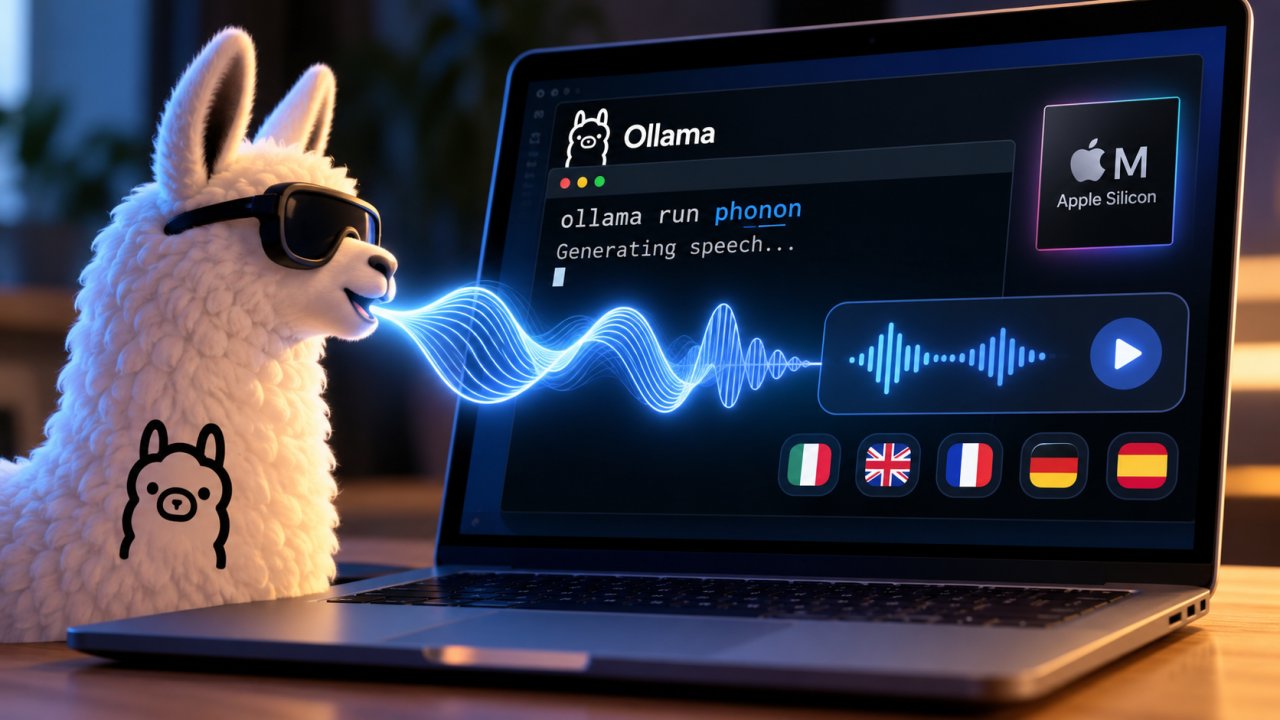
In recent days Ollama added the speech synthesis to the platform, and the first supported model is Phonona family of compact text-to-speech templates developed by Gradium. Voice model support is available on macOSwhile versions for Windows and Linux are announced as forthcoming. For now you therefore need a Mac with Apple Silicon e Ollama 0.40.11 or later.
The model can be downloaded with ollama pull phonon and the first synthesis is obtained with ollama run phonon “Hello from Ollama.”. The item is chosen with the option –voice (in the API the parameter is called voice), for example Hadley, and the complete list of voices, taken from the Gradium catalog, appears with ollama show phonon. Running the command without text opens a prompt where you can type sentences line by line, while redirecting the output to file produces a WAV.
The command can also be queued to a chat template. In Ollama’s example, ollama run gemma4 –hidethinking receives a request for a trivia about owls in two sentences and its output is piped to ollama run phonon. The text is read as it arrives, then the response begins to be spoken after the first sentence, without waiting for the end of generation.
Speed and precision on Apple Silicon
On the performance front, Ollama takes advantage MLXApple’s machine learning framework, and claims faster generation of 35% compared to the second comparison engine, the Gradium runtime called ptts. The test was conducted by Ollama on a MacBook Pro with M5 Maxgenerating 45 seconds of speech and taking the median of 10 performances. The metric is expressed in multiples of real time, i.e. how many times the synthesis is faster than the audio produced.
The two engines do not work with the same numerical precision. ptts uses 8-bit weights on the CPU, fp16 on the Neural Engine, and f32 on the GPU, while Ollama runs the model in bf16. It is therefore a measurement made by Ollama on a single machine, with different calculation configurations between the two engines.
On accuracy Ollama claims that his implementation equals the error rate on words (WER) of the reference implementation in Hugging Face Transformers. The test uses 200 sentences from the English Seed-TTS set, transcribed with Whisper large-v3, and a lower WER indicates a better result. The comparison therefore concerns sentences in English.
Languages, licenses and APIs
phonon is the English model, while the other languages have dedicated variants: phonon:40m-fr for French, phonon:40m-de for German, phonon:40m-es for Spanish e phonon:40m-pt for Portuguese. phonon:40m-multilingual brings together all five languages. The licenses also change: phonon is released with Apache 2.0while the 40M variants use CC BY-NC 4.0which limits its use to non-commercial purposes. For commercial use, among the Phonon models available on Ollama there is therefore only the English version.
Phonon responds to the endpoint /v1/audio/speechcompatible with the OpenAI API: code using the OpenAI SDK only requires a new base address pointing to the Ollama server. The response is streamed while the audio is generated and can start playing immediately, for example by forwarding it to ffplay. The audio is a 24kHz mono, returned in WAV by default or as raw 16-bit samples by setting response_format to pcm.
