
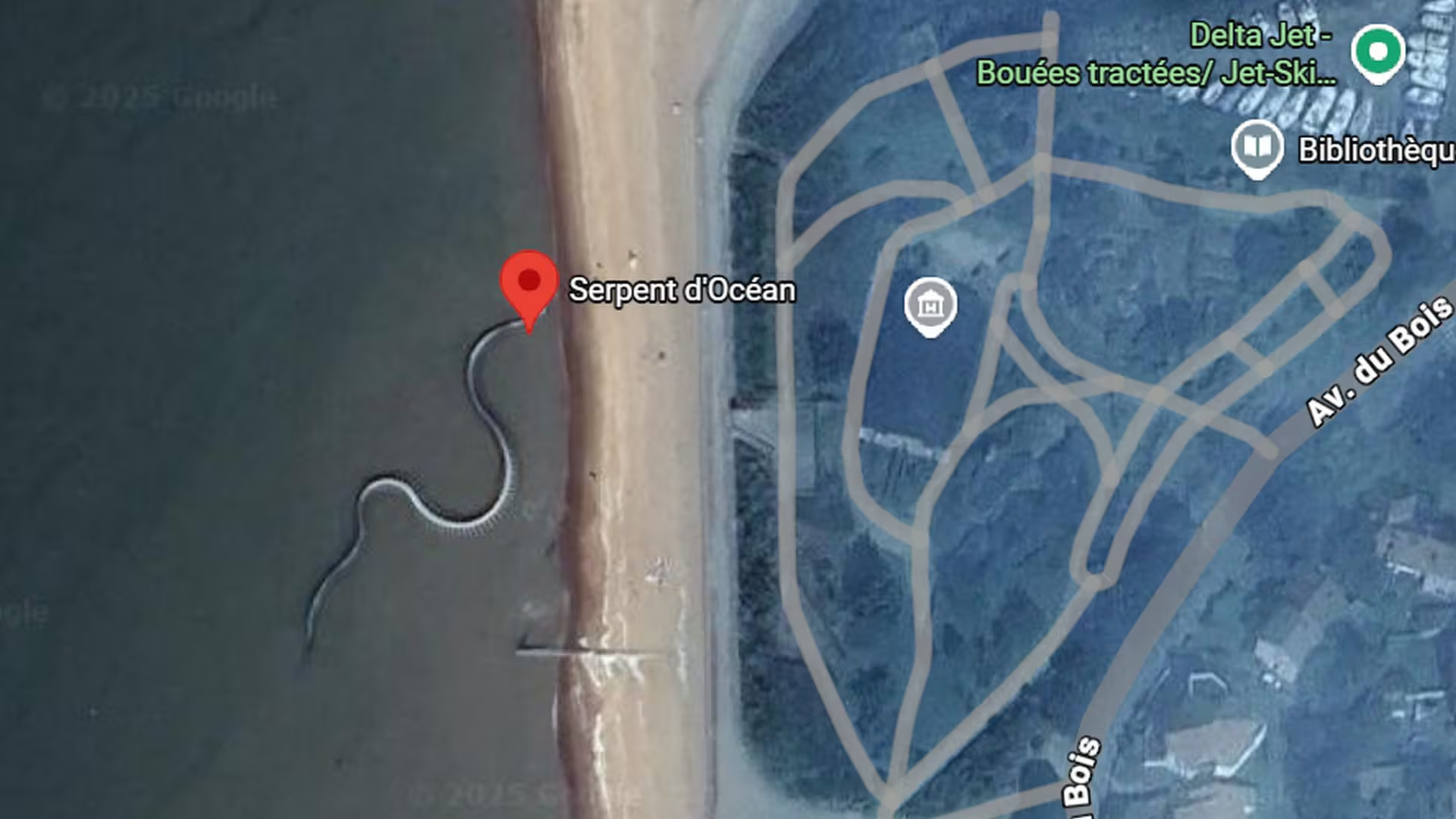
If you are looking for the following coordinates 47°16′04″N 2°10′15″W on Google Maps and set the satellite view, you will find yourself faced with something incredibly curious and fascinating: a gigantic And sinuous snake skeletonso large it can be seen from space. It is no coincidence that the Serpent d’Oceanas it is known, is long well 130 meters. This colossus is located exactly in the intertidal zone of the Loire estuary, the longest river in the France with its 1,006 kilometres. The serpent towers over a beach overlooking theAtlantic Ocean and is periodically submerged by the ocean, precisely due to the fact that it is located in a tidal zonewhere the water rises and falls several meters every day. It is no coincidence that the Ocean Serpent is the representation of a sea serpent with its jaws wide open, clearly imaginary given its gargantuan size. But what exactly is this snake?
Not unlike the famous Volvo Island in Illinois (United States), where an elegant Volvo S80 it has been parked for 13 years, the Serpent d’Océan is also classified as “tourist attraction” on Google Maps. In this case, however, it is not the work of an entrepreneur in search of publicity – who has managed to gain worldwide recognition without wanting to – but rather atrue work of art. The Ocean Serpent is indeed a bold one installation of the late French-Chinese artist Huang Yong Ping (born 1954), author of multiple experimental and provocative works.
The author decided to install the giant snake – completely in steel – in Mindin in the municipality of Saint-Brevin-les-Pins (Loire-Atlantique), directly on the tip of the sandy promontory known as “Nez-de-Chien”, due to its geographical appearance which resembles the muzzle of a dog. The work was inaugurated on June 20, 2012 and created as part of that year’s edition of the Estuaire festival, thanks to the financial support of the European Regional Development Fund of the European Union (EU).
There is also a “sunken” XC90 in front of Volvo Island and now we know how it ended up there
The snake emerges from the sand as if emerging from a large one archaeological excavation and its spine, as reported by the Estuaries website, seems to recall the Saint-Nazaire bridge. Even the way it is laid out is a reference to the “carrelets”, characteristic fishing boats that sail off the French Atlantic coast. The work was probably designed as a tribute to combine the Chinese mythology – in which dragons have great relevance – with the suggestive European landscapewith references tocultural hybridization determined by globalization. It is a recurring theme in the artist’s large sculptures.
The snake is also a symbol of candies And knowledge present in numerous of the works of Yong Ping, who passed away in 2019 due to illness. For example, in the opera Empires (2016) installed at the Grand Palais in Paris in the context of the series “Monument”, the sinuous skeleton of a gigantic serpent (over 240 meters) rises above beyond 300 containers and a huge forklift: it is a reflection on the global trade and on the economic power represented by the reptile. Even in Baton Serpent of 2003 and in sculpture Le Grand Vivant of 2016 the skeletons of giant snakes take center stage. Themes related to the environment and animals, together with those dedicated to the meeting of cultures and the destructive power of man, were particularly dear to Yong Ping. Its Serpent d’Océan has now become home to the creatures that populate the delicate ecosystem of the tidal areas.