
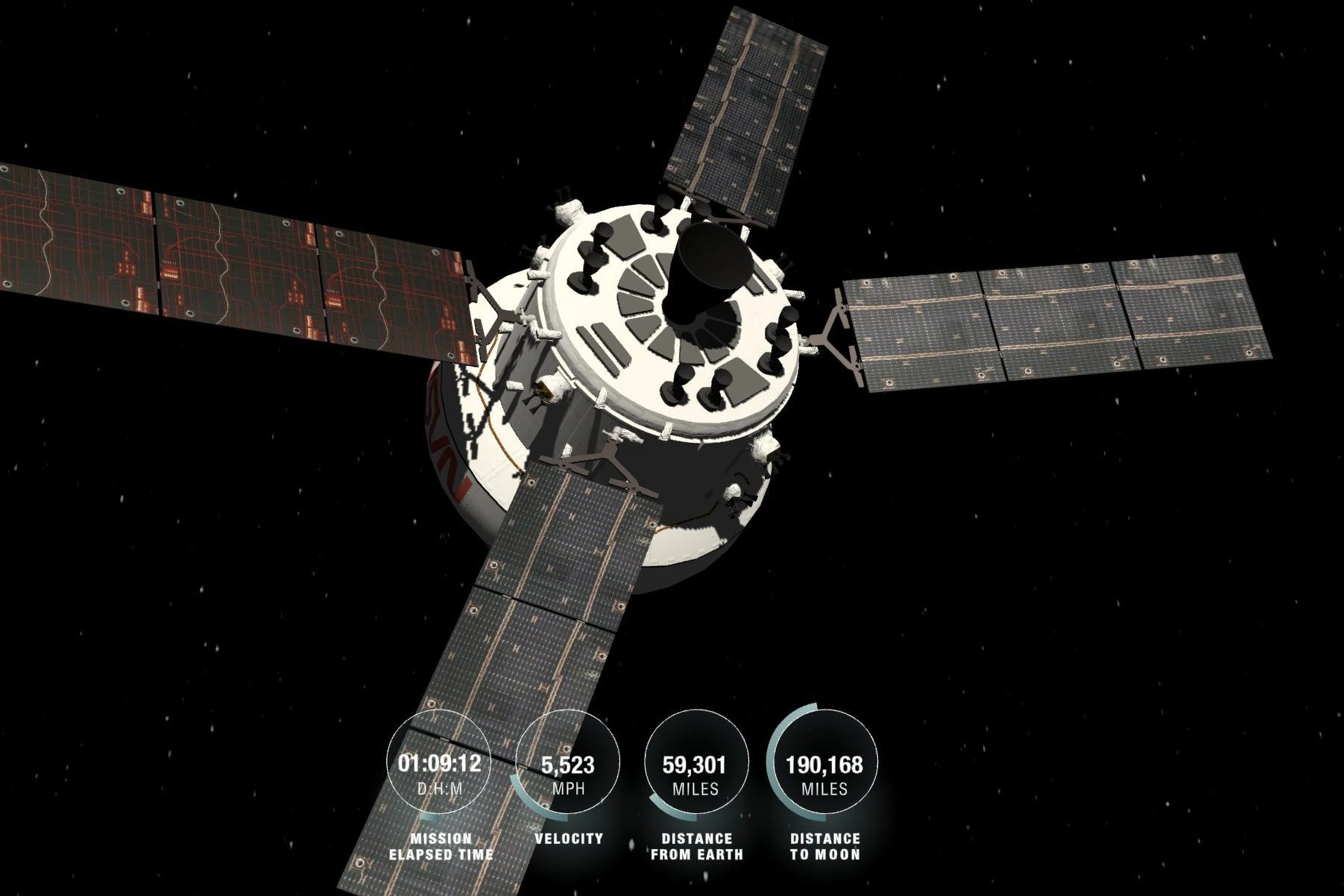
Start one new phase for the mission Artemis 2. According to the tracker made available by NASA, at this moment the Orion probe left theEarth orbit and it is moving towards the Moon. On board are the four members of its crew: the commander Gregory Reid Wiseman and then Victor Glover, Christina Koch And Jeremy Hansen. As we write the probe is traveling to 9,384 kilometers per hour. It is located at 87,147 kilometers from Earth and 311,961 kilometers from the Moon. In short, the journey is still long. The furthest point from Earth should be reached April 6 when Orion begins its orbit around our natural satellite. The astronauts should thus arrive at the furthest point from Earth ever reached by a Homo sapiens. Over 400,000 kilometers from our planet. If you want to recover the images of the launch, we leave you our news here.
In the last few hours Orion has completed its orbits the Eartha preparation trait to check that all of Orion’s controls are capable of functioning. No surprises. Or almost. In the first hours of the flight, a problem emerged with the bathroom, as explained by the NASA spokesperson Gary Jordan. If the most attentive fans of Big Bang Theory remember it, the engineering of a bathroom designed for space is not exactly easy to manage. In this case, however, the problem concerned the fan: a problem resolved quite quickly, however. To understand the importance of this mission we also leave you our interview with Umberto Guidoni, former Italian astronaut.
How to follow Orion’s journey: the tracker with which you check your position
NASA has released a long list of tools to stay on course. On the section AROW on the site dedicated to the mission you can watch Orion’s journey live. Here we find one 3D map in which both the Earth and the Moon are represented. We can follow the progress of the mission both from the satellite and from our planet. A useful starting point for understanding distances in perspective. We have all the data to check, from speed to distance travelled. And then by checking on the Moon we also see all the points where the Apollo missions landed. There is also an app to follow the entire journey from your smartphone.
Italy towards the Moon with Artemis, Leonardo’s 4 solar panels powering Orion are now active
Not only that. NASA has also started a series of conferences with all the daily updates on the mission which can be seen on the agency’s YouTube channel. The entire conference calendar has already been planned until April 9th. The mission is expected to end on April 10th with a ditching in thePacific Ocean. Here too a very critical phase: Orion should enter our atmosphere at approximately 40,000 km/ha maneuver that had never been attempted at this speed.
The program of conferences organized by NASA
- Friday 3 April | 9.30pm Italian time
- Saturday 4 April | 11.30pm Italian time
- Sunday 5 April | 9.30pm Italian time
- Monday 6 April | 19:00 Italian time | Here we should see the passage around the Moon
- Tuesday 7 April | 10pm Italian time
- Wednesday 8 April | 9.30pm Italian time
- Thursday 9 April | 9.30pm Italian time