
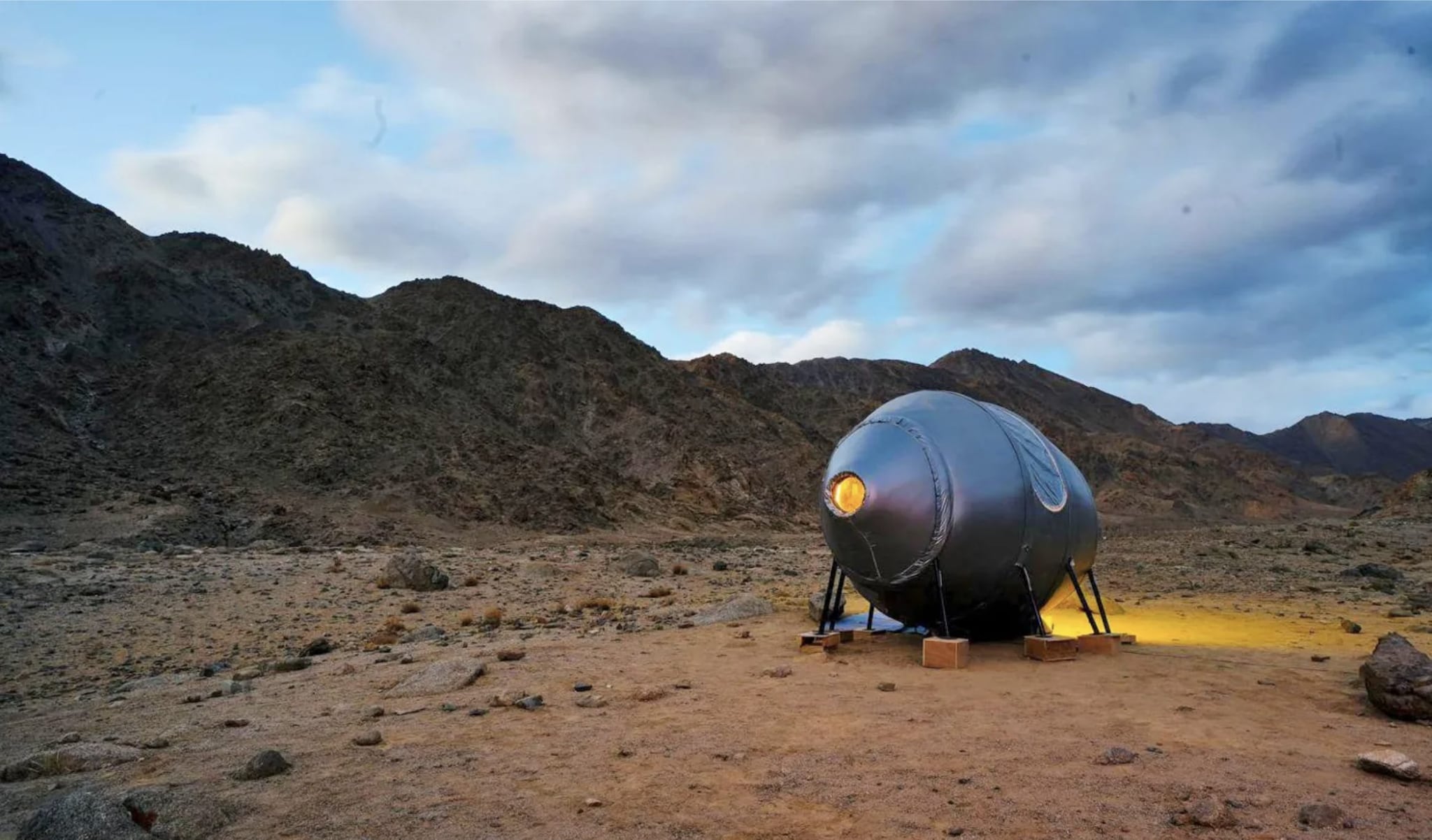
The space homes were placed in the Himalayan mountains of Ladakh, a place that features extreme weather conditions and thin air. The house is built entirely of Teflon and was designed by the Indian space agency Isro. Among the features there is also a system for disposing of waste independently.
Is called Hab-1. It has a bed, a compartment for emergency kits, a kitchenette for heating meals and a bathroom. It could be something very similar to future homes that we will build on another planet. The house made of Teflon, an insulating fabric, was tested between the Himalayan mountains of Ladakh for the Gaganyaan mission by the Indian space agency Isro. The objective of the test is prepare astronauts for future space missions.
“Hab-1 was designed keeping in mind that there will be a lot of space limited to the Moon or Mars“, he explained to the BBC Aastha Kacha-Jhalaspatial architect from Gujarat-based firm Aaka. Not only “there will be a shortage of water so we thought of designing a dry toilet and also a waste disposal system to prevent odors from remaining.”
An astronaut spent three weeks at the facility to test future space homes. Agencies around the world are trying to build bases to explore the Moon and Mars, both for research and training. Isro plans to place three astronauts in orbit low terrestrial at an altitude of 400 km for three days. If all goes according to plan, the mission will launch next year. India also plans to set up its first space station by 2035 and to send a man on the Moon by 2040.
Where astronauts will land on the Moon, NASA updates list of Artemis 3 moon landing sites
“Once we complete our simulation mission, we will no longer have to depend on foreign space agencies to train our astronauts,” says Professor Subrat Sharma, dean of research at the University of Ladakh, who collaborated on the project.
Because it was tested in Ladakh
Ladakh, explained Kacha-Jhala, was chosen as the location of the experiment because “it gives a geographical perspective, its rocky and arid landscape and its soil bear similarities to the material and rocks found on Mars and in some parts of lunar terrain, making it ideal for space research“. Not only is the Himalayan region on the border between India and China located at a height of 3,500 meters and extreme climatic conditions and rarefied air. The temperature over the course of a day here can vary from a maximum of 20°C to a minimum of -18°C. Not comparable to the Martian climate, where temperatures reach -153°C, or the lunar climate which can drop to -250°C.
As Sharma explains, “we can’t go into space to do tests every time, we need these areas where they can be created conditions similar to those in space“. Not only that, Ladakh is a region of India where the arid land extends for kilometers, “giving you the feeling of being alone on the planet”. And in fact according to scientists, one of the most important aspects of the mission is the simulation of the psychological factors to see how loneliness and extreme living in space might impact humans.