
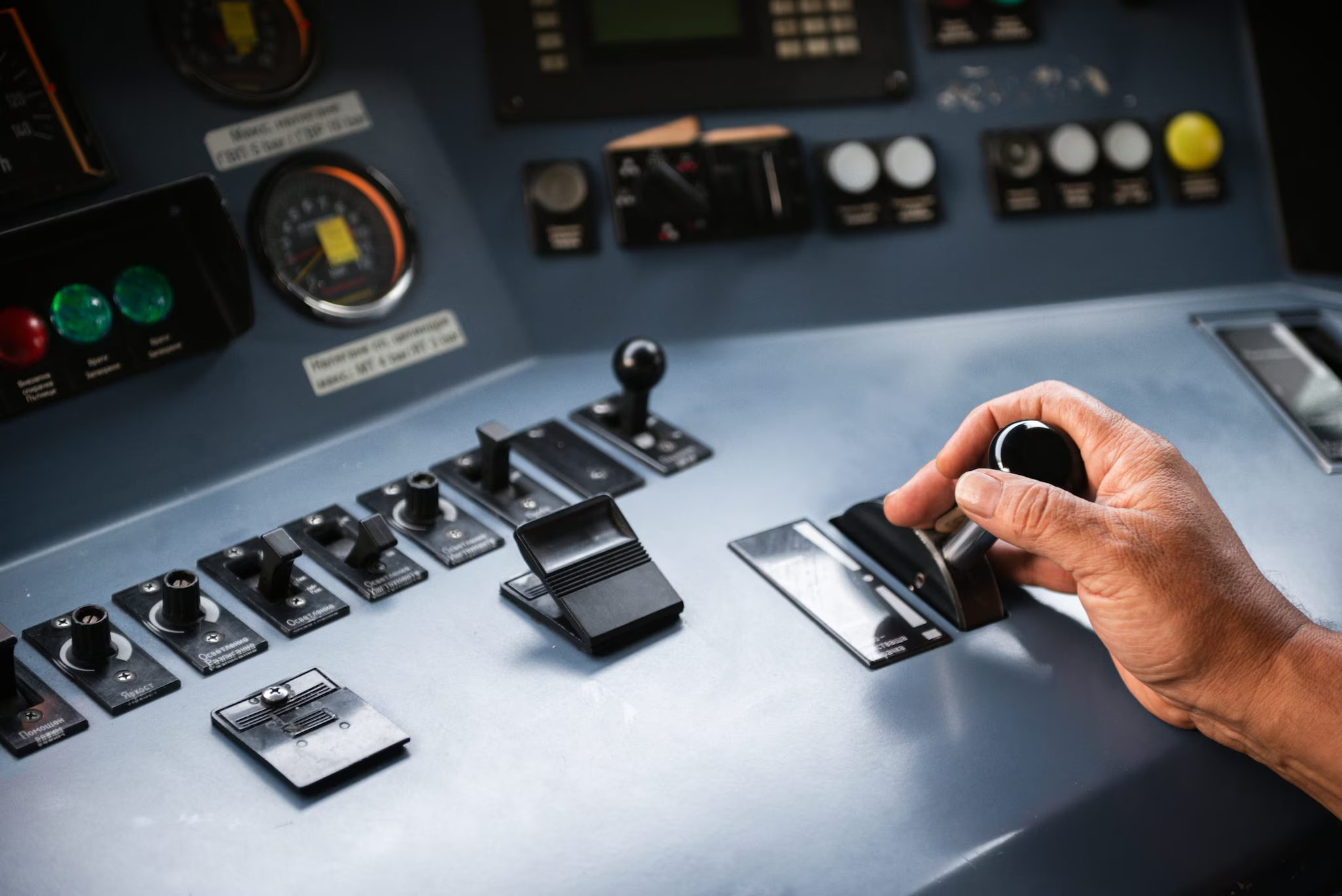
Since the dawn of transport public railway And tramwaythe designers understood the importance of introducing security systems proactive, able to stop machinery – operating i brakes – in the event that the operators were unable to carry out the checks. A illnessa serious one distractionit fainting and even there sudden death of a driver can represent an extreme safety risk; therefore it is not surprising that automated systems – which are activated in the absence of certain inputs – have been introduced for over a century. The first ones appeared on steam locomotives and electrical of the late 19th century and on the trains of New York subway at the beginning of the 1900s. The basic system that intervenes is called “dead man” switch (dead man’s switch) and its name refers precisely to the extreme case, in which the person in command of a vehicle, machinery or device dies, leaving it out of control and potentially capable of causing a disaster.
A potential malfunction of the dead man system is at the center of the investigation derailment of tram 9 in Milanwhich occurred shortly after 4pm on Friday 27 February along Viale Vittorio Veneto. The vehicle, while moving from Piazza Repubblica towards Porta Venezia, came off the tracks sharply speed – an estimated speed of around 50 kilometers per hour – and crashed into a Japanese restaurant on the corner of Via Lazzaretto. The outcome was tragic: two dead, the sixty-year-old Ferdinando Favia and the fifty-six year old Abdou Karim Toure (both on board the vehicle but thrown out), and over fifty injured. The driver of the vehicle, a 60-year-old expert tram driver who has been working at the company for thirty years ATMconfirmed to authorities that he had had a illness and therefore having lost control of the vehicle.
The tram, a latest generation model Tramlinkaccording to reconstructions he would have missed one stop and it wouldn’t fit into the exchange expected; this led to derailment and terrible crash which you can see in images taken from a car. The prosecutor Marcello Viola and the pm Elisa Calanducci have opened an investigation file for manslaughter and injuries; images of the cameras internal parts of the vehicle, the data recovered from black box and the driver’s smartphone, to check whether he was using it at the time of the accident (this is done as a matter of practice). The man, who is undergoing various clinical and toxicological tests, will be questioned in the next few days.
Why China banned retractable door handles on cars
Net of the results of the investigations, what doesn’t add up would be precisely there failure to activate of the dead man system on a brand new vehicle. “A deadman safety system – explains the robotics company Standard Bots – can turn off a car, stop a train or activate a signal emergency without anyone touching it. It is present in factories, vehicles and even email, and is one of the simplest yet essential security tools in automation.” “A ‘dead man’ safety switch – continues the company – is a safety mechanism, mechanical or electronicdesigned to activate when a human operator becomes incapacitated or unresponsive. It is typically used to prevent accidents or to trigger an alarm when the operator no longer has control of a device or system.”
There are various types: a button, lever And pedal. The latter is almost no longer used following accidents in which drivers, after an illness, collapsed on the pedal, preventing the safety system from being activated. Typically, in modern trains and trams, the deadman switch is directly integrated into the lever that gives traction. If this button is not pressed every 2-3 secondsin order to confirm your presence and the fact that you are alert, an acoustic alarm is activated which invites you to press it; if this does not happen for another 2-3 seconds, the automatic emergency braking system starts and stops the vehicle.
In more modern vehicles the deadman switch is integrated with other systems and sensorsa bit like those associated with automatic driving of modern carsnot only capable of maintaining a safe distance, checking for the presence of obstacles, braking when necessary and correcting the trajectory, but also of checking, via an internal camera and other sensors, whether the driver keeps his hands on the steering wheelif he is conscious or if he is at risk of a falling asleep. This integrated surveillance system emits acoustic signals of varying intensity before intervening directly on the vehicle control.
It seems that these systems did not work adequately on the tram 9 that crashed in Milan, in light of the dynamics of the accident. This will emerge from the analyzes currently underway. It cannot be ruled out that the tram driver, during the illness, kept his hand on the running and braking command (or traction throttle) where the deadman system is located, perhaps to support itself, or that the loss of control occurred so close to the switch that, after the derailment, it would no longer have been possible to stop the tram’s travel, even with the system active. Clearly this is just speculation. Additional, potential automated subsystems capable of intervening to prevent such a disaster must also be taken into account. All that remains is to wait for the results of the investigations to understand exactly what happened on that tragic afternoon in Milan.