
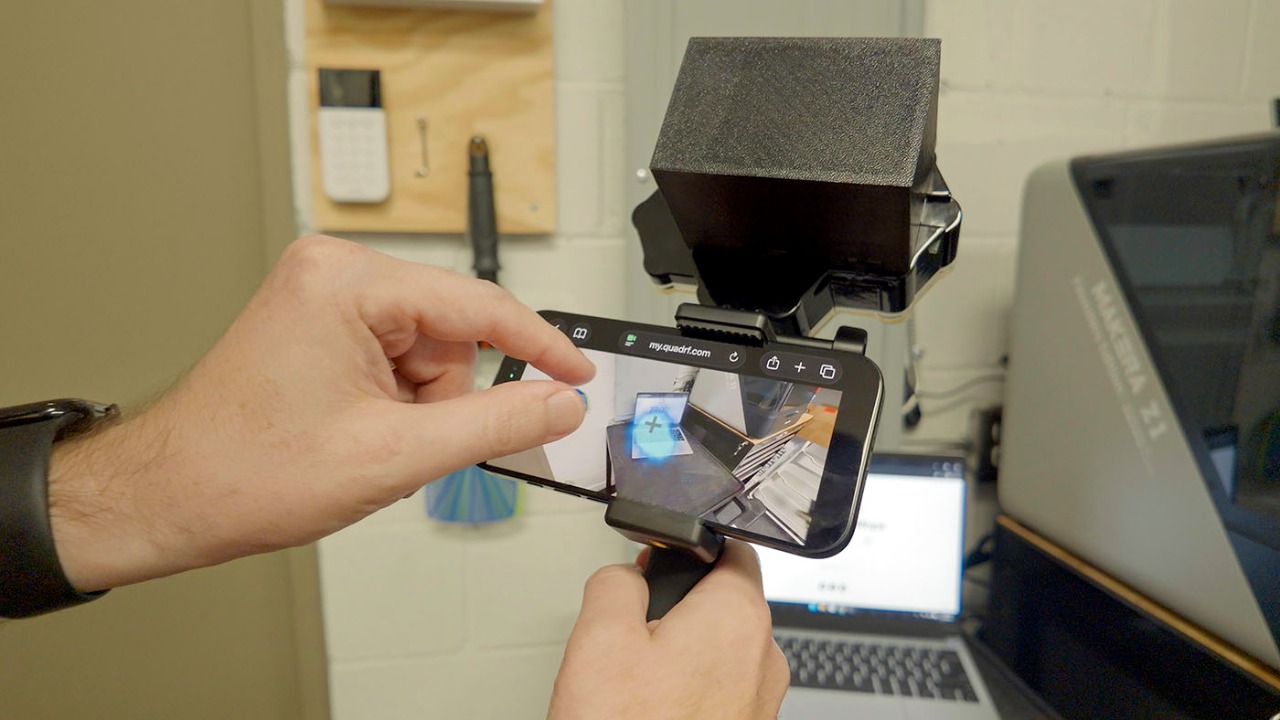
QuadRF It’s a phased-array radio featuring a Raspberry Pi 5 paired with a picosecond-level FPGA board. The result is a device capable of applying advanced beamforming to radio signals, identifying WiFi networks hidden behind walls and following drones in flight in real time. It is not a military laboratory prototype, but a kit that anyone can order online.
The operation uses four coherent antennas that measure differences in signal arrival times, returning a live RF overlay at 30 frames per second to a smartphone or laptop. WiFi devices, wireless cameras, drones and beacons thus become radio sources colored according to frequency, in an operating range between 4.9 and 6 GHz.
The basic kit costs money $499 on Crowd Supply and includes four interchangeable dual-polarization antennas, a pre-loaded 32GB microSD card, and a 27W power supply. A mobile expansion pack adds a battery and smartphone holder, so you can take your device with you and analyze the RF environment on the go.
Behind the project is the ambition of a radio array scalable to the Moon
To develop QuadRF is Martin McCormick, who previously worked at SpaceX in the team that created Dishy, the first Starlink terminal. The inspiration is clear: the declared objective of the project is to arrive at a lunar-scale antenna array for Earth-Moon-Earth radio experiments and radio astronomy, by concatenating multiple QuadRF modules until reaching a EIRP of 1.15 MW in the most extreme configuration with 240 antennas.
In its current form, however, QuadRF remains a handheld device designed for local SDR applications. I/Q data transmission between the RF card and the Raspberry Pi 5 goes through the camera and display MIPI connectors, normally used for video peripherals, leveraged here for over 5 Gbps of low latency bandwidth. The team had to independently decode the MIPI protocol of the Pi 5’s RP1 chip, leaving the PCIe connector free for storage or high-speed networking.
In practical tests, turning it on starts a WiFi hotspot to which you can connect to access a VNC interface via browser, from which GNU Radio, SDR software and an augmented reality viewer are launched. With the latter, a 5 GHz WiFi network on channel 100 appeared as a blue spot, while nearby networks appeared in red and green: the numerical scale of values, in this still immature version, is however not displayed on the screen.
The test with a drone DJI Mini Pro 4 flown behind the studio confirmed the tracking capability, although the lack of automatic gain control meant that sensitivity had to be manually adjusted as the aircraft receded. The crowdfunding campaign has already exceeded its goals, to the point that the team is moving from the 3D printed body to an injection mold for series production.
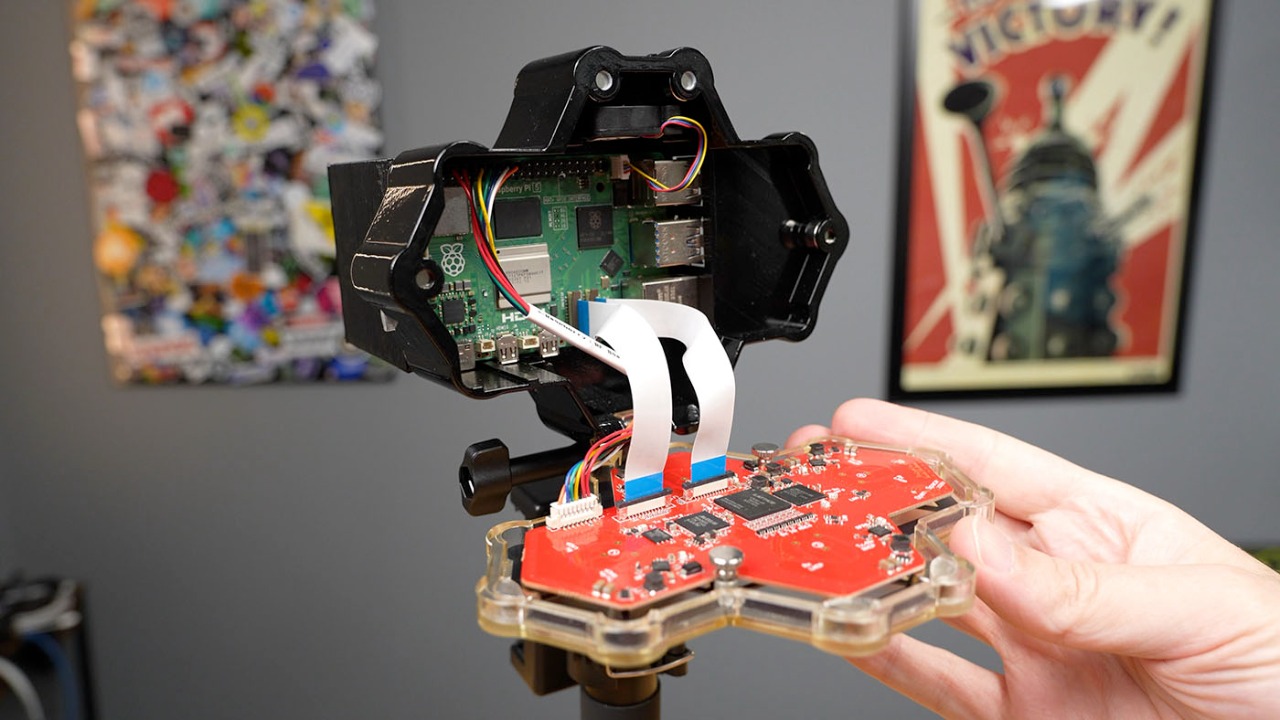
It must be said that this is still pre-production hardware: as with any crowdfunding campaign, the promised delivery times are not a guarantee that deadlines will be met.