
Níckolas de Aguiar Alvesphysicist at the Federal University of ABC, Brazil, has taken up one of the most cited scenes of Star Trek: The Next Generation and applied special relativity to it. The result overturns the meaning of the idea: what seemed like a narrative license from the screenwriters turns out to be more solid, on a physical level, than they themselves could have imagined.
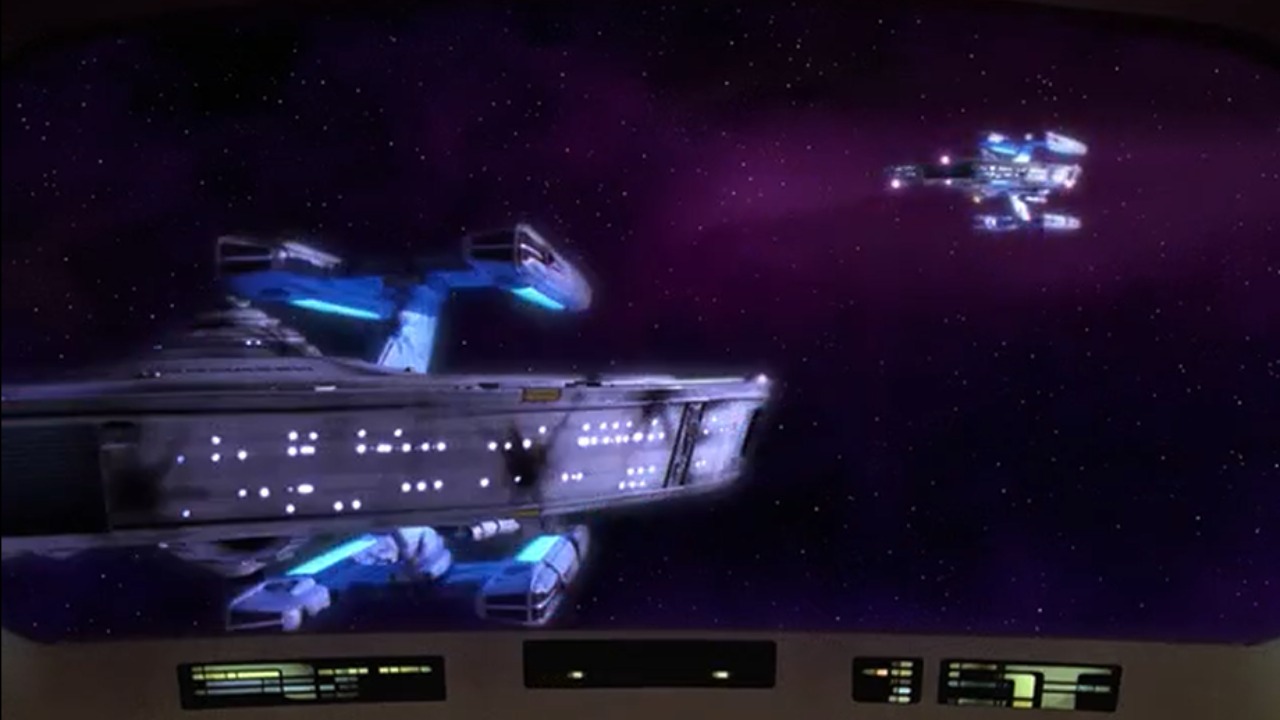
The scene comes from the episode “The Battle”, the first of the series, when a Ferengi leader reminds Picard of a battle he faced years earlier in command of the Stargazer. With shields down and under fire from an unseen enemy, Picard tries a desperate trick: he orders the ship to charge at warp speed, then to stop suddenly and open fire.
The idea is that by exceeding the speed of light, the Stargazer it would have generated two distinct images in the eyes of the enemythe one where it reached warp speed, and the one where it stopped. By shooting at the wrong image, the opponent would have missed the real target. Later in the episode, Riker says that the gimmick ended up in Starfleet manuals under the name of “Picard’s maneuver”.
From a youthful doubt to a scientific article
De Aguiar Alves had seen that episode as a master’s student, during the years in which he was taking a relativity course, and something in that scene had left him perplexed without being able to define what. The doubt remained there for years, until the physicist found himself working on a different problem, linked to the behavior of particles in a medium where light travels more slowly than in a vacuum.
To verify his calculations, he tried to reconstruct the situation with space-time diagrams, the same graphic tool used to teach relativity in university classrooms. Applying that method to the case of the Stargazer, he discovered that the double image hypothesized by the series was an approximation: an object that accelerates until it exceeds the speed of light, and then stops abruptly, generates multiple delayed time values and therefore not two but up to three images of the same ship.
The study, entitled “The unexpected effectiveness of the Picard maneuver: seeing three images of the same superluminal spaceship”, appeared on arXiv on August 22 and is being published inAmerican Journal of Physics. Four pages, four figures, “Popular Physics” category: more than a study designed to overturn theoretical physics, an educational exercise that uses science fiction to make accessible a little-known phenomenon of relativity, that of multiple images generated by an accelerating superluminal object.
It is understood that warp speed does not have no evidence in real physicsand no one is suggesting that the Federation was right about the warp drives. The work of de Aguiar Alves demonstrates that, given the science fiction assumptions of the series, Picard’s maneuver would have been even more effective than what was told on stagewith a third illusory target to further confuse the enemy. A rare case in which a detail born by mistake, or by narrative simplification, holds up better than expected when someone takes the trouble to deal with it.