
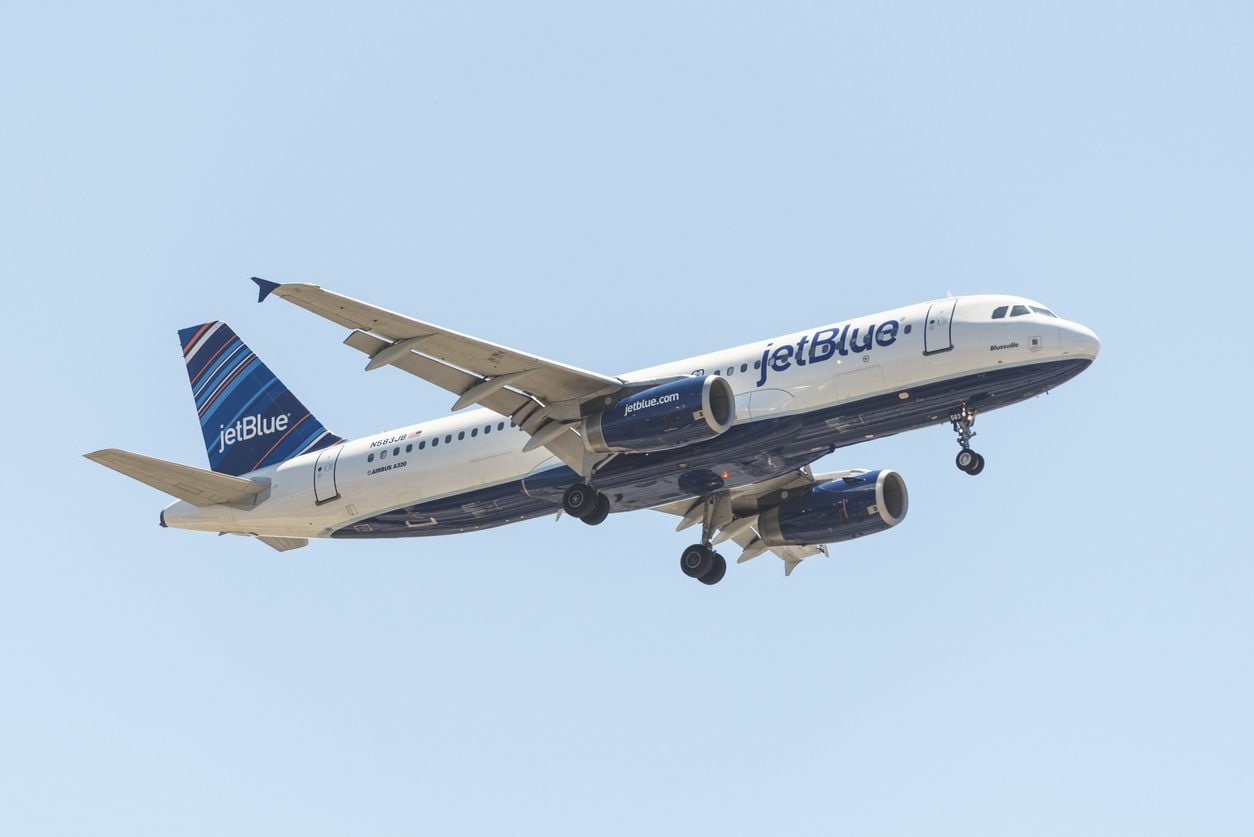
An Airbus A320 of the airline JetBlue
In a note published on Friday, November 28, 2025, the company Airbus communicated that the intense solar radiation could “damage data essential for the functioning of the flight controls” in the planes of the family A320based on what happened to an aircraft of the JetBlue airline flying from Cancún to Newark last October 30th (we’ll get back to that shortly), so a immediate recall and on a large scale affecting more than half of these aircraft worldwide. In light of what emerged, Airbus has ordered airlines to intervene immediately with precautionary measures, such as software updates and replacement of components to ensure flight safety. In simple words, the particles of solar radiation can interfere with i electronic data that one of the on-board computers called ELAC (Elevator Aileron Computer) uses for navigationcontrolling ailerons and elevators; this can lead to malfunctions and potentially very dangerous maneuvers, as happened on the aforementioned JetBlue flight. Following this event, theEASA (the European Aviation Safety Agency) and the FAA of the United States with the issuance of an emergency airworthiness directive (EAD) in order to mandatorily resolve the problem on the A320s.
Considering that the A320 family jets are among the most widespread globally, with over 11,200 examples distributed across 375 airlines, the impact on air traffic it is significant. It is no coincidence that we are faced with one of the largest recalls in the history of aviation, which is causing disruption in many countries. “Airbus recognizes that these recommendations will cause operational disruption for passengers and customers. We apologize for the inconvenience caused and will work closely with operators, keeping safety as an absolute priority,” the French company underlined in its statement. Fortunately, the software intervention to combat the problem requires an update couple of hourstherefore the related interruptions are and will be limited (in some cases everything has already been resolved); however, for some aircraft a hardware intervention is required (in short, the replacement of a part) and this could have an impact of weeks. The global recall, which hits during one of the busiest periods of the year as regards air traffic (especially in the USA), highlights the extensive and transversal consequences that solar flares can have on Earthhighlighting the importance of monitoring the space weather.
The event on JetBlue flight 1230
Last October 30, as reported by Business Traveler, an A320 of the airline JetBlue Airways en route from Cancún to Newark, “suddenly banked downward without any intervention from the pilot.” The sudden maneuver resulted in the wounding of about fifteen passengers and the need for an emergency landing in Tampa, Florida. Subsequent analyzes of the aircraft revealed that the cause was a computer malfunction ELAC 2 of the aircraft, which as indicated is the component that controls the ailerons and elevators (therefore pitch And roll of the aircraft). Airlive.net reported the following statement from EASA: “If not corrected, this condition could, in the worst case scenario, lead to an uncommanded movement of the elevator which could exceed the structural capacity of the aircraft.” Reuters, which has seen an Airbus bulletin, indicates that the problem concerns the ELAC flight system “which sends commands from the pilot’s side-stick to the rear elevators. These in turn control the pitch or heading angle of the aircraft”. Reuters contacted the computer’s manufacturer, Thales, and received a response that “the computer complies with Airbus specifications and that the functionality in question is supported by software which is not the responsibility of Thales.”
Huge and threatening sunspot appeared on the Sun: it is so large that a NASA rover imaged it from Mars
The sharp downward tilt of the JetBlue A320 occurred in correspondence with a strong solar flare and inspectors came to the conclusion that the anomalous behavior of the aircraft was triggered by the radiation storm. After asolar flare are thrown into the space particles like protons and electrons at speeds close to that of light, which can hit the Earth a few minutes later (unlike the flows of plasma And magnetic fields – The solar wind – which can take up to a couple of days to arrive and trigger a geomagnetic storm). These particles are responsible for radio blackout (for example with disturbances to high frequency HF communications) which we often hear about after a strong flare, but they can also “parasitize” the electronic systems of satellites and aircraft, despite the redundant and protection systems introduced precisely to prevent problems.
It is possible, but not confirmed, that the stream of particles ejected from the Sun on October 30 has corrupted the data which the ELAC 2 computer continuously processes for the navigation of the Airbus A320s, pushing the aircraft into the dangerous pitch down (the lowering of the nose) without any intervention by the pilots. A maneuver of this kind, automatic and unexpected, can have dramatic consequences in the most delicate phases of a flight such as those preparatory to landing; hence the need to intervene with software updates and where necessary hardware replacements – which should concern over 1,000 aircraft – to guarantee the absolute safety of flights. The software update, as reported by Reuters, mainly consists of “restore the previous software”, but it is unclear how this is linked to reducing the risk of radiation storms.
In a post on Reddit where pilots and other avionics experts write, a user underlined that the dangers of solar radiation are known and it is surprising that there is not enough redundancy to avoid critical issues like the one that happened to the JetBlue aircraft. The response from user mmalluck is quite interesting: “It depends on how valid your ‘voting’ is (a mechanism that compares data from redundant NDR systems in avionics) between the different data sets arriving from the sensors, and also from the ‘voting’ between the commands determined by the redundant IT systems. Many times these ‘voting’ and monitoring systems have both a threshold and a persistence component before the data is discarded. For example, an airspeed discrepancy might have to exceed 5 knots for more than 1 second (totally made up numbers, by the way). This means that for that second, the erroneous data will still have an effect on the aircraft. The analysis is done to demonstrate that, although undesirable, the one-second transient will not result in hazardous conditions in all critical phases of flight. I’m not sure of the story behind the Airbus problem, but I would be really interested in more details on the cause”.
Net of the actual causes, what is certain is that over 6,000 aircraft of the A320 family (which also includes A318, A319, A320 and A321, of different series such as NEO and CEO) are involved in this major recall, which is affecting many airlines. Suffice it to say that American Airlines has almost 500 A320 series planes in its fleet, while Delta has over 300. Air France has grounded 41 of its planes. THE scoreboards of the airports are reporting a series of delays And cancellations with inconvenience for thousands and thousands of travelers around the world.