
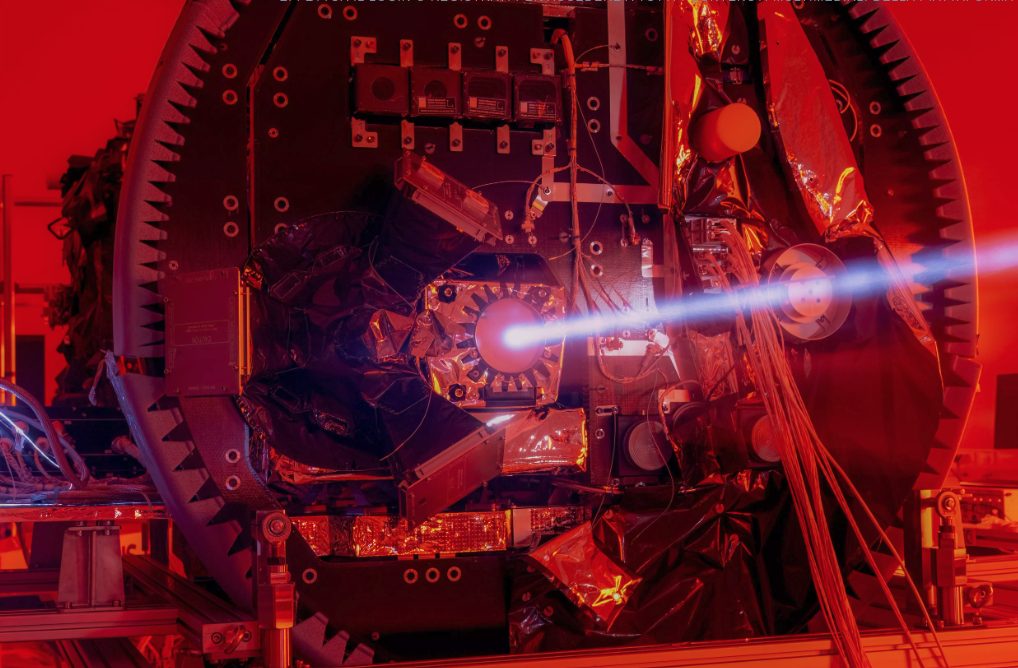
The goal of the Proba-3 mission is to study the solar wind and understand how the corona reaches high temperatures. According to the European Space Agency, the mission will be a revolution for solar physics.
ESA | The Occulter Spacecraft and Coronagraph Spacecraft satellites
“Imagine standing at the end of a football field and with one toss hitting a penny coin at the other end, that would be easier than what they’re doing here,” he explained. Daniel SeatonProba-3 researcher and solar physicist at the Southwest Research Institute. It’s not easy to create”eclipse on request“, but after decades of testing the Proba-3 team may have found a solution.
In India at the beginning of December, two satellites capable of temporarily obscuring the Sun were launched. Through a precise flight formation they will in fact create a six hour window to allow scientists to study the external atmosphere of the sun. According to theEuropean Space Agency it’s one revolution for solar physics.
“On Earth, scientists have to travel around the world and find a place to position themselves so that they can get a brief glimpse of the Sun’s corona, as the total solar eclipses they only last a few minutes,” the European Space Agency explained in a press release. “Now satellites Occulter Spacecraft and Coronagraph Spacecraftwill allow scientists to create solar eclipses on demand.”
Sun and solar storms, new data from Aditya-L1 tell us precisely when CMEs occur
Satellites capable of obscuring the Sun
The satellites were launched into space attached and separated from their upper stage about 18 minutes after launch. They will move along an elliptical orbit to reach a maximum distance from the Earth’s surface of 60,500 kilometers. The Occulter will align itself with the Sun and use a disk to cast a shadow onto the Cornographwhich will be approximately 152 kilometers away. The two satellites will have to be perfectly aligned to prevent sunlight from infiltrating ruining the observation. “One day, this technology could be extended to pairs of larger satellites to block starlight and allow scientists to hunt for planets,” Selton explained.
What Proba-3 scientists will study
The objective of the Proba-3 mission is to study the solar wind and understand how the corona reaches high temperatures, “at the moment it is impossible to observe these elements with the technologies we have”, explained Selton. So far scientists have used the coronagraphthe instrument dates back almost a hundred years and was invented by the French astronomer Bernard Lyot.
“The solar corona is an important element of our solar system, larger than the Sun itself, and the source of space weather and the solar wind,” he explained Andrei Zhukov from the Royal Observatory of Belgium, principal investigator of the Proba-3 ASPIICS (Association of Spacecraft for Polarimetry and Imaging Investigation of the Corona of the Sun) coronagraph.
“We can currently image the Sun in the extreme ultraviolet to image the solar disk and low corona, while using Earth-based and space-based coronagraphs to monitor the high corona. This leaves a significant observation gap, from about 3 solar radii up to 1.1 solar rays, that Proba-3 will be able to fill. This will make it possible, for example, to follow the evolution of colossal solar explosions called coronal mass ejections as they rise from the solar surface and the outward acceleration of the solar wind.”
Second Amir Caspiastrophysicist at the Southwest Research Institute (external to the Proba-3 mission): “For those who love studying the sun, every new mission is exciting, but this type of new mission in particular will open up new roadsmaking observations that were simply not possible before this mission,” he explained to the Washington Post.