
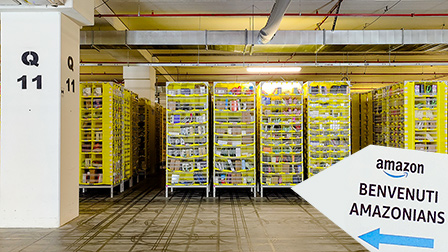
What is the journey of an Amazon package from when we click on ‘Buy’ to when we receive it at home? It is a very complex journey and a visit to the Amazon distribution center in Novara MXP6 allowed us to get to know a little piece of it better and to see the technological innovations at work that are studied every day byInnovation Lab.
Come with us inside the Amazon distribution center in Novara MXP6
MXP6: Amazon just outside Novara
There Amazon logistics structure it is quite complex, but to simplify it it leverages some crucial issues, including i distribution centers. They are huge warehouses where the products we find available online are stored and their work is crucial for the smooth functioning of the entire supply chain.
In Italy we find 10, including the one we visited. Amazon logistics then provides 3 sorting centers And 37 sorting depotsplus a whole series of hubs that allow you to serve particular needs, such as those of fresh products or those of large dimensions.
MXP6 is one of Amazon’s most recent investments in Italy, for the construction of a 60,000 square meter warehouse on the outskirts of Novara, a stone’s throw from the Novara Ovest motorway exit and very close to the railway line, which will see a new station dedicated to serving the warehouse with public transport.
There are several centers defined as MXP and the reason is simple: Amazon sites are usually named after the closest reference airport, in this case Milan Malpensa. If you remember, at the end of 2022 I visited BOS27, the Amazon Robotics research and development center near Boston, which took its name from the acronym of the US city’s airport.
For MXP6, Amazon has planned to reach approximately 900 employees with permanent contracts in three years and today, just over a year and a half after the inauguration (September 2021), there are already more than 850 people employed on permanent contracts.
Being a state-of-the-art distribution center, MXP6 uses some of the latest automation technologies fielded by Amazon Robotics and fromInnovation Lab. The latter is a research and development center, located within the Amazon site in Vercelli, which deals with the integration of third-party technologies, already present on the market, within Amazon logistics. The one in Vercelli is the only Innovation Lab in Europe and serves all the sites on the continents in terms of technological innovations.
MXP6 was an important benchmark for the European team Advanced Technology of the European Innovation Lab in Vercelli and the innovations developed at the Novara site were then introduced in 70 other sites across Europe.
Receiving, storing, shipping: this is the journey of an Amazon product
During the visit to the MXP6 distribution center we had the opportunity to speak both with the site manager, Alessandro Alberici, and with Gianpiero Negri, Principal Manager – Amazon Global Robotics – Mechatronics, who was traveling to Novara for the occasion.
The MXP6 distribution center is arranged over four floors: al ground floor we find the logistics of incoming and outgoing productswhile in the three floors above the inventory is stored. The new Amazon technologies are active on all floors and we have been able to see them at work in a pervasive way.
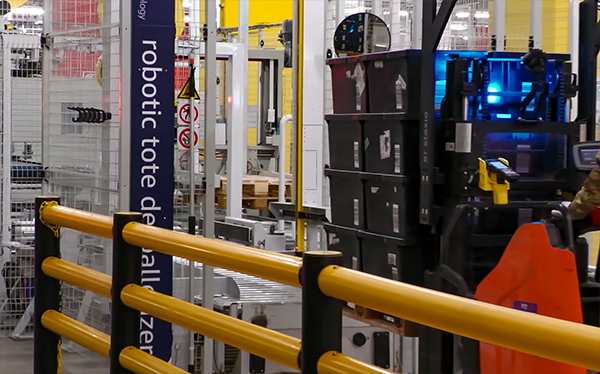
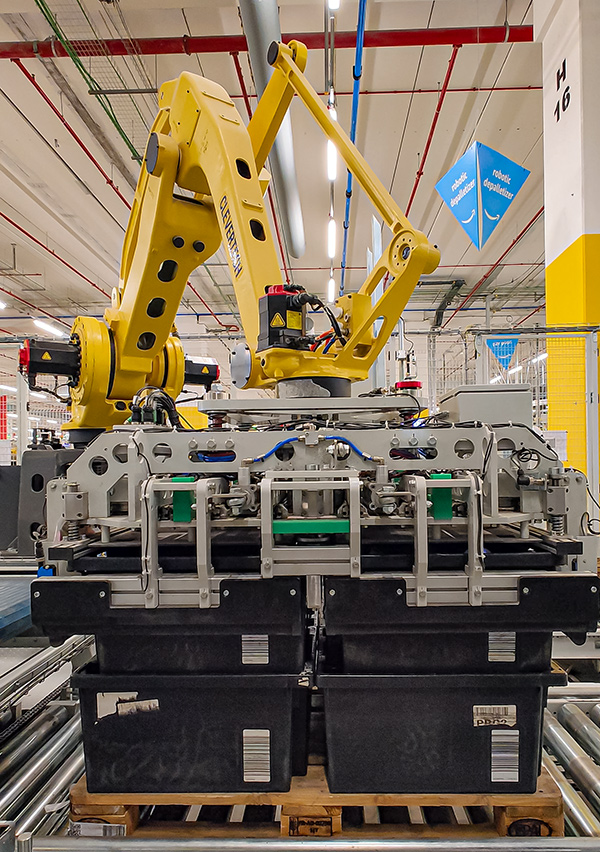
Robotics and automation are used to free people from the most demanding and repetitive tasks: both can be exhausting in the long run. We find a robot capable of automatically dismantling an arriving pallet and on the other side of the factory one capable of autonomously ‘palletising’ a group of boxes for shipping the products.
Very interesting is the storage method inside the warehouse, defined as ‘Random Store‘. Each object is stored in one of the mobile shelves based on size and not by product category. The tracking system and the self-propelled shelf-moving robots then take care of finding the right object at the moment of the customer’s click to prepare the package.
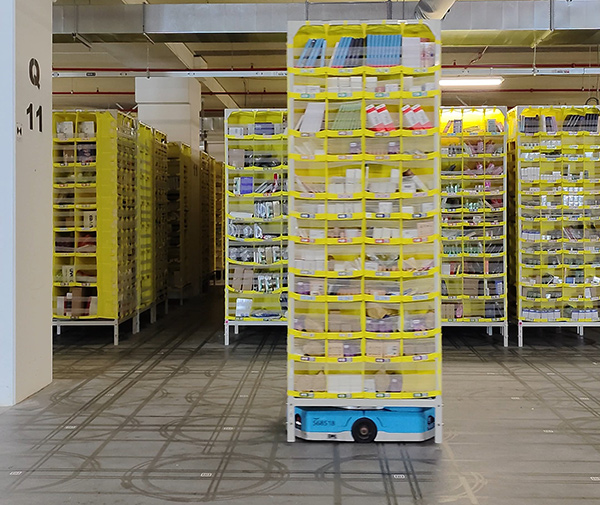
A ‘moving shelf’
Storing by size and not by category allows Amazon to optimize space and shelf occupancy and it also brings with it some benefits that make sending products to customers more error-proof. Let’s take a typical case for example: a customer orders only one book from a series; if in front of the operator there was a shelf with all the books of the series in series, the possibility of error could be high; if instead the robot brings him a shelf in whose indicated pocket there is only the right book, perhaps together with a USB charger, a handbag and a toothbrush, the possibility of error is practically nil. Similar argument for other types of products: distinguishing between salted caramel bars and peanut ones, even visually from a chromatic point of view, could be difficult and waste the operator’s time: if they are stored in different places at the time of the choice, the operator goes quickly without fail.
The warehouse floor is a comings and goings of shelves moved by robots and everything within the robotic area is automated. If someone or something crosses the border (virtual and physical) that separates this area from the one where the operators move, an alarm is triggered and the floor (i.e. the movement of the robots) stops completely for safety reasons. However, it happens that human intervention is necessary within the robotic area, for example for maintenance or simply to collect some objects that have fallen from the shelves during the transport phase.
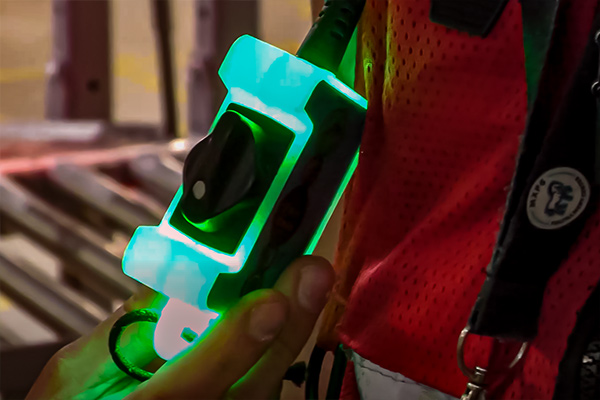
The safety antenna worn by operators
It would be impossible to block the entire plan every time. For this purpose there is a team of specialized operators with particular devices that allow you to enter the robotic area while it is operating in complete safety. The operators wear a radio device that allows their precise localization within the floor and are equipped with a tablet on which they establish the route they will take to reach the fallen object or the appliance that requires maintenance. At this point, when they enter the floor with the security systems activated, the robots know of their presence and automatically slow down when near the operatorsthe. However, the robots also have an integrated safety system whereby they are able to detect the presence of people on their path with immediate stopping, but the operator localization device ensures that this last safety does not come into play, with less abrupt stops of the shelves and the possibility of following alternative routes.
An interesting detail is the fact that no robot is allowed to occupy the path of the human operator: in the event of an emergency, in fact, he must be able to retrace his steps exactly without finding obstacles in the path.
It is interesting to note how, despite the high automation of the site, many people work at MXP6, with advanced job profiles. The large presence of robots and automation systems leads to the site having various figures active in surveillance and maintenance.
Ergonomics and safety are two of the watchwords of MXP6, with also a group of people dedicated to collecting suggestions and advice from employees to create shared solutions and good practices: the Safety Action Team.
Keywords: safety, ergonomics and care of workers
This might sound strange to some union between Amazon and the words safety, ergonomics and care of workersbut it’s not strange: in a highly efficient system like that of Amazon warehouses, accidents, injuries or sick days are a living cost and minimizing their impact benefits the production process and, ultimately, the turnover. Whether it is philanthropy or pure capitalist interest, the fact remains that the working conditions within a site like MXP6 are probably among the best that can be found in Italy.
Even the climate itself inside the warehouse, with team building sessions and good practices typical of techno-optimism of the west coast of the United States (very rooted in Silicon Valley, but which permeates the entire American entrepreneurial culture), is functional to business, but has undoubted positive effects on the daily lives of workers.
The Safety Action Team is a clear example of this: not only can the suggestions given by workers be useful for creating small or large solutions, perhaps to be exported to other sites, but it gives the workers themselves that sense of agency (the subjective feeling of controlling one’s actions and the surrounding environment) which – again – can be very functional for maximizing the performance of human resources.
After this tour inside one of the most recent Amazon distribution centers we hope to have given you an idea of what happens to your products from the click to the ringing of the courier’s bell, if you have come this far without having seen the video we invite you to do so, as you can see some of the things we have told you about in action. Naturally, below in the comments there is space for your discussion on the various topics we have touched on in this article.