
According to initial estimates by Facile.it, Italians will spend an average of 1,144 euros on gas bills next winter. Nowadays, however, the list of heating methods that can be accessed in Italy is very long, from traditional radiators to baseboard heating. In this article we will see the most convenient systems together with suggestions on how to limit consumption and therefore the price of the household bill.
From the October 15th the heating can be turned on. The first plants were turned on in North and Central but in the next few days it will also be possible to turn them on in the rest of Italy. The last switch-ons are scheduled for December 1st. According to an analysis released by the Facile.it portal, this winter Italians will currently spend an average of 1,144 euros in gas bills. At the moment gas prices are set at approx €0.415/Smc.
The heating systems available in Italy there are many. They range from those with radiators to underfloor heating, through heat pump and infrared. It is also possible to install baseboard heating in your home. There are many types and prices of installation: there are more convenient systems in terms of savings and thermal efficiency and less convenient systems. There are also good habits to save on heating. In this article we will see some suggestions.
How to understand which heating system is better: the criteria
There are various criteria to understand which type of heating is best for our home, or in any case the home on which we want to install a system. Among the main ones are:
One and a half million jobs can come from renewable energy: data from WWF Italy
- Type of dwelling | Here the important thing to start from is the type of home. If we are talking about a detached house, the room for maneuver for the works is obviously wider than what we have in an apartment
- Power required | The power required to heat your home varies depending on the energy class. The scale varies across ten levels, four A levels (A1,A2, A3, A4) and then the rest of the levels (B, C, D, E, F, G).
- Thermal range | Obviously it is important to carefully evaluate thegeographical gold in which you are. Depending on the excursion ends with the surrounding environment you will also have to understand how important it will be to have a more or less powerful heating.
Radiators as a heating system: power supply and thermal efficiency
This is the most widespread heating system in Italy based on radiators. Also known as heaters or (more technical) radiators, radiators are used to spread the heat produced by a water heating system. Here the cost depends a lot on the system it is used for heat the water. Altroconsumo has carried out an overall analysis of these costs, also taking into consideration those for installation and those for distribution network. Installation costs are spread over 15 yearsthose for the distribution network on 30 years.
According to theAltroConsumo analysis for 2023 the most expensive method of heating heating remains the gas condensing boiler. In 2023 the estimate was 2,508 euros per year. However, it must be taken into account that the cost of installing the boiler is lower and in the event of system failure this element is also easy to replace. Other systems may be cheaper but have different installation costs. Still remaining with the estimates made by Altroconsumo for the winter of 2023 we find the biomass boilerwith an annual cost per home of 2,130 euros. Or even the solar thermal system: annual cost for the house 1,808 euros.
Pros and cons of central heating
If you do not live in a detached house but in an apartment, your heating is most likely it will be centralized. Here the advantage is above all economic. In short, central heating involves the use of a single boiler for the entire condominium. Here the advantage is first of all economic. Having only one common boiler, the cost of heating for individual condominiums is lowered. The problem becomes the management of independent heating: the management of heating is no longer the responsibility of individual condominiums but must follow the rules of the entire building. Central heating also has lower maintenance costs and better energy efficiency.
How electric underfloor heating works
The electric underfloor heating system is a heating, as is already clear in the name, which is radiated directly from the floor. Here the heat is generated by a series of electrical resistors: the objective is to propagate it uniformly by making it rise from bottom to top. Installation costs vary between 50 and 70 euros per square metereven if it is not mandatory to cover the entire flooring.
Infrared heating: what it is and how it works
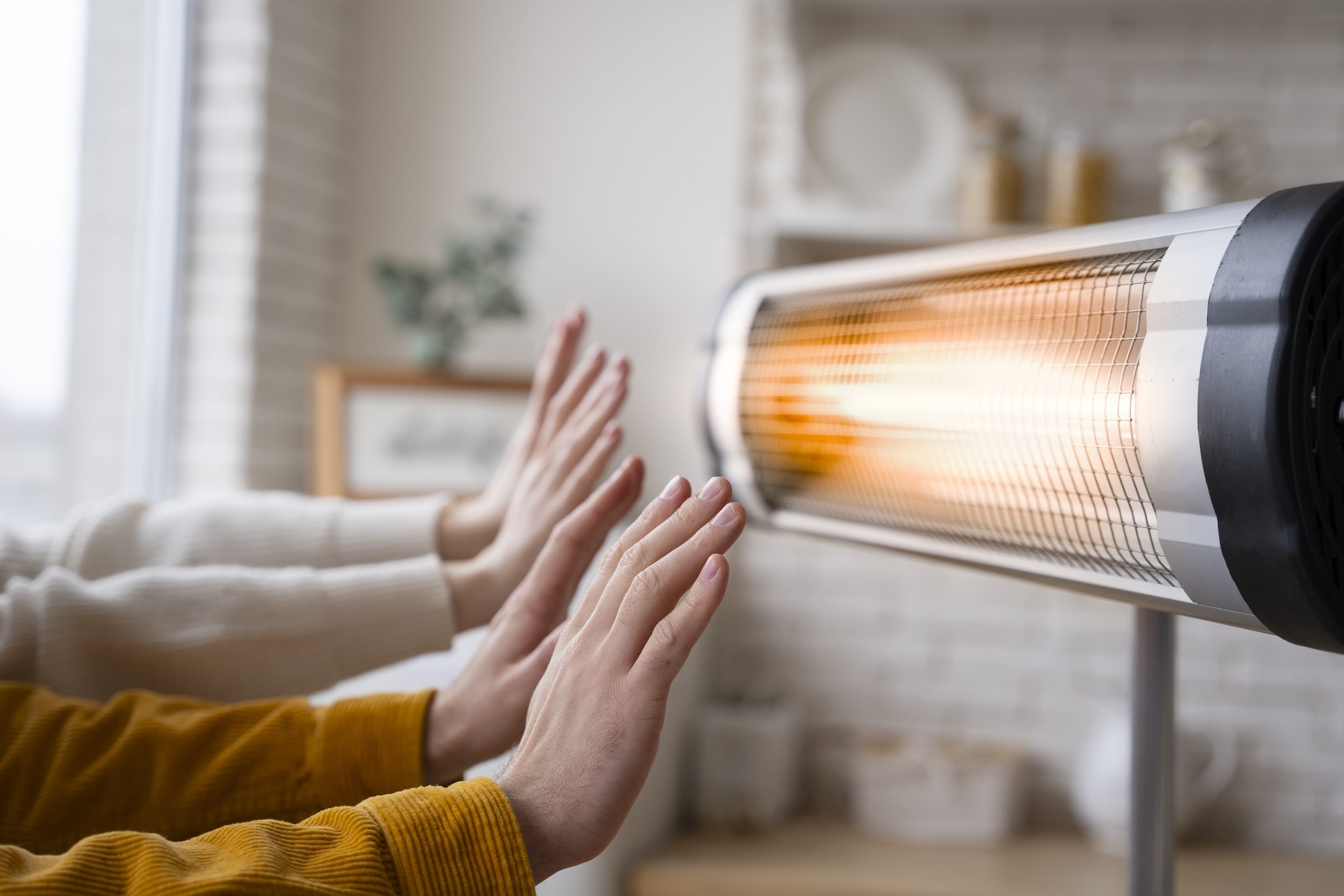
Of all the methods we have seen, the infrared one certainly has themore futuristic look. It is a heating system where i Irradiation panels spread infrared rays into the environment which heat the surfaces of the rooms in which they are installed. These surfaces also include our skin. They have no health risks and are obviously powered by electricity. Costs vary greatly from panels that you choose. Depending on the technology the panels can vary from 350 to 60 euros.
Why choose ceiling heating
In ceiling heating the heat is produced by upper part of the rooms and then pushed downwards. The heat source can be a plumbing system mounted on the ceiling, in this case we are talking about a network of pipes similar to the one installed for underfloor heating. The ceiling heating system can also be electric: in this case the heat is generated by radiant panels.
Among the advantages of ceiling heating there is certainly the ease of installation. Unlike underfloor heating, it is not necessary to lift the entire flooring to install it. Not only that. Ceiling heating is able to heat the room much faster than other systems. The cost is not insignificant: let’s talk about 100 euros per square meter.
The baseboard heating system: advantages and disadvantages
The system of baseboard heatingas we can imagine, uses the skirting boards to position the radiant tubes, i.e. the tubes from which the heat propagates to heat the house. The pipes can generate heat from hot water or electrical resistors. Baseboard heating can therefore be electric, water or even mixed.
Among the advantages there is certainly one energy saving. To heat a 100 square meter apartment they may even be enough 10 liters of water. Installing it, due to its position, is quite simple. And again, it’s quiet and above all well hidden. There are two disadvantages: it doesn’t work well for very large rooms and to make the hot air spread in the right way it is necessary that the furniture is spaced a few centimeters from the wall.
How convenient is heat pump heating?
Heat pumps are among the heating systems more convenient from an energy point of view. It takes more energy to start but maintaining the temperature can also be managed with 0.4 – 0.5 kW every hour. They can be of three types:
- Air – Air: when they regulate the heat exchange between the air inside a house and the air outside
- Air – Water: when the heat exchange arrives with the external air and in the meantime the water to be used in other types of systems is also heated
- Geothermal: in this case instead the heat source directly becomes the natural heat released by the ground
Saving on heating bills: good rules to follow
There are several rules to follow for save a little on heating bills. Of course, the first type of saving is that of invest in an efficient heating system and above all an insulated house: even just fixing the windows can become an excellent start to having a more efficient home. The advice then is to equip yourself with a smart heating system. Sometimes the systems are directly connected to a management app, in which case it is also possible to purchase one smart thermostat which allows us to regulate the entire heating level of the house directly from home.