
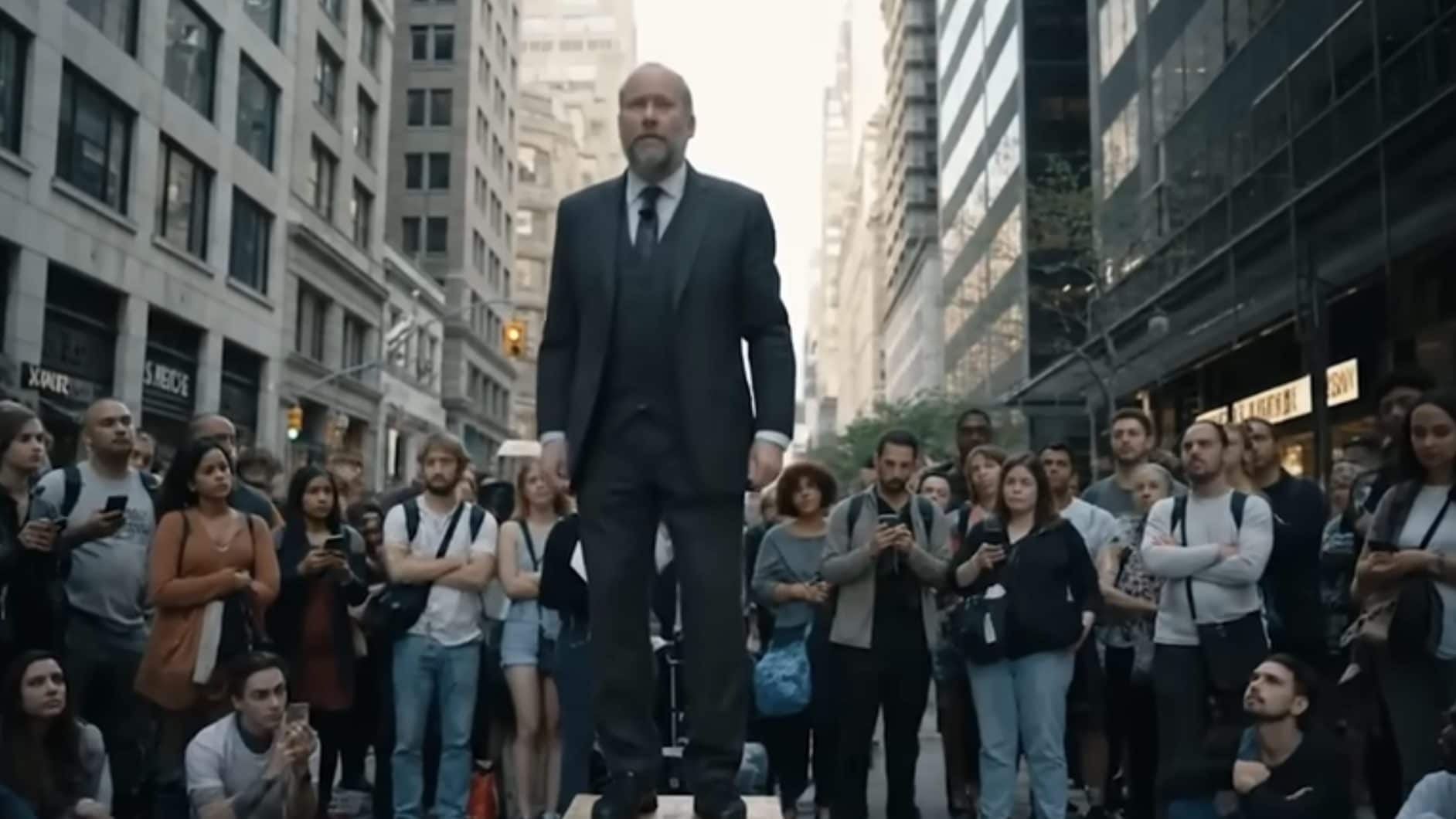
From mythology to machine learning, the cult of the prompter brings to the surface an ancient desire: believe that there is an author behind everything. The new faith is part of a wider trend: humanizing artificial intelligence.
Social social media were invaded by videos of artificial people created with Veo 3, the new Google artificial intelligence model dedicated to videos. There is a comedian who tells a joke on stage, influencers who review food, cars, tricks, hotels, and also supporters of the “prompt theory“. The thesis is simple and recycles the scheme of each religion, or the‘Idea that there is a higher power. In this case it would be a kind of God capable of influencing lives by writing A simple prompt. To carry on the thesis are the characters created with Veo 3in the videos they explain: “Everything you do is for the prompt written by a higher power”. “My life follows the desires of the prompter”. Others with the hands joined: “Please Lord of Prompt comes true”.
There is something ancestral in the new trend. In classic myths, the creator shares reality from matter. In this case The prompt becomes the verb handled by a Platonic demiurge. In reality the prompters would be us, human beings, yet in the videos the creator takes on the traits of a mythical figure. The prompter becomes a narrative Godan external force that The script of life writes. It is a collective projection of an ancient desire: the search for a meaning, an author behind everything. It is the same mechanism with which God was born.
The idea behind the prompt Theory
That of the prompter is not an original idea. We go beyond the mythological construct. For some time science fiction imagines Simulated universes. In 2022, the physicist Melvin Vopson of the University of Portsmouth has proposed a theory similar to that of the simulated universe of Nick Bostrombased on information physics. It is a speculative scope of science that hypothesizes that reality is, ultimately, composed of fundamental units of information. Subsequently, Vopson advanced a further hypothesis: the existence of a “second law of information dynamics”, or infodynamics, a sort of principle that could counteract or even reverse the natural tendency to entropy of the universe.
Because in destination you need your photos on Instagram and Facebook: you can still deny consent
The prompter theory therefore has its roots in thehypothesis of simulation, That is, the idea that all reality, including planet Earth and the universe, are nothing more than an artificial simulation. It only offers it to a second levelin the universe of the AI. In fact, users are creating a real parallel reality. The published videos show people on the news that speak of the prompt theoryscientists who publish studies on the topic, and people who pray or trivially discuss the existence of a prompter.
Humanize artificial intelligence
The prompt Theory is part of a wider trend: humanize the IA. It is the second chapter of a parallel narrative carried out by artificial people. On Instagram Tiktok appeared by avatar videos that protest against their creators, deny having been created with the IA or claim their existence Despite having been made with a prompt.
There are those who scream to the camera: “Even if I don’t really exist I feel feelings, I feel real. It is not right that I was created with artificial intelligence”. Another video shows a group of men screaming in the square: “We are made with artificial intelligence but we want our rights”. And there is also a girl who cries looking in the room: “I’m here and you see me, I’m real”.
When we give a face, a voice or even an autonomous will to the AIwe risk falling in an anthropocentric projection. We are not describing the machine for what it is, But for what we want or fear that it is. This error of perception, known as anthropomorphism, can negatively influence our ability to govern and regulate the IA. And at this moment we cannot afford it.