Generative AI is moving ever closer to the user and NVIDIAon the occasion of IFA 2026announced new local processing initiatives which include software optimizations, tools for agents and a solution designed to simultaneously exploit multiple PCs present in the same network. At the heart of the ad is NVIDIA Personal AI Router (PAIR)an open source software that allows you to distribute inference requests among compatible systems without requiring agent changes or adopting a new API.
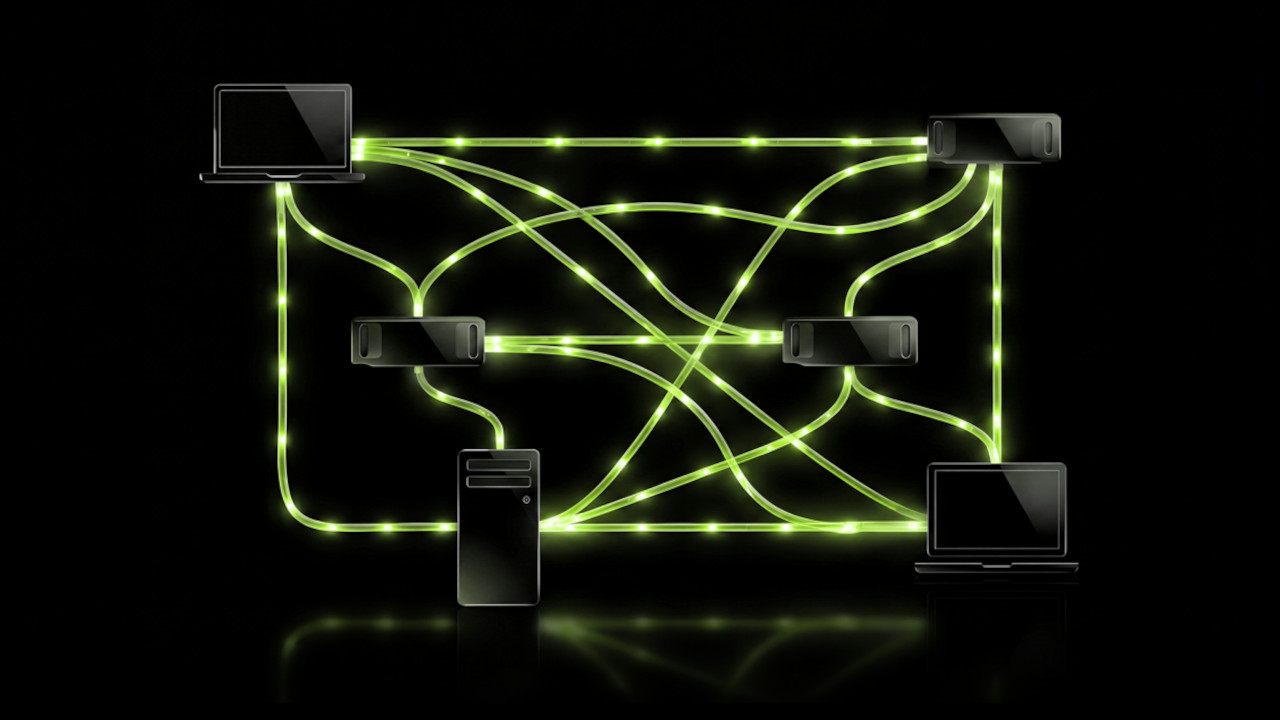
The principle behind PAIR is relatively simple. An agent can break down a complex task into multiple sub-tasks by entrusting them to different subagents. This mode allows many requests to be executed simultaneously, but can create a bottleneck when all inferences are directed towards the same GPU. PAIR introduces a routing layer capable of identifying available systems in the local network and assigning each independent request to a node that has the necessary resources.
Flowchart illustrating how NVIDIA PAIR deploys an Ollama inference
The solution However, it does not create a virtual pool of GPUs. A single inference remains entirely on one system: PAIR distributes different requests across multiple machines, but does not split a single model or a single request across multiple accelerators. This distinguishes the operation of the technology from that of a traditional cluster used to combine the resources of multiple GPUs.
PAIR was also designed with the dynamic nature of a home network in mind. A gaming PC may be playing a game, a notebook may go to sleep, or a workstation may be used for another application. The system discovers systems via mDNS and maintains an updated view of available nodes, considering the state of the machine, the active inference engine, the presence of the requested model, the current load and GPU usage among the evaluation elements.
The software supports Ollama and LM Studioand therefore maintains the local interfaces already used by the agents. PAIR acts as a proxy: it receives the request, checks which engine and model are needed, selects a suitable node, and forwards the processing to the relevant inference service. The application that generated the request continues to use a single connection, without having to directly manage the different computers on the network.
The configuration also includes a secure pairing mechanism. After systems discovery, the user authorizes the devices that can join the local group; communication between nodes is then protected via mTLS and certificates generated. NVIDIA also emphasizes that prompts, data, and inference traffic are intended to remain within the local network.
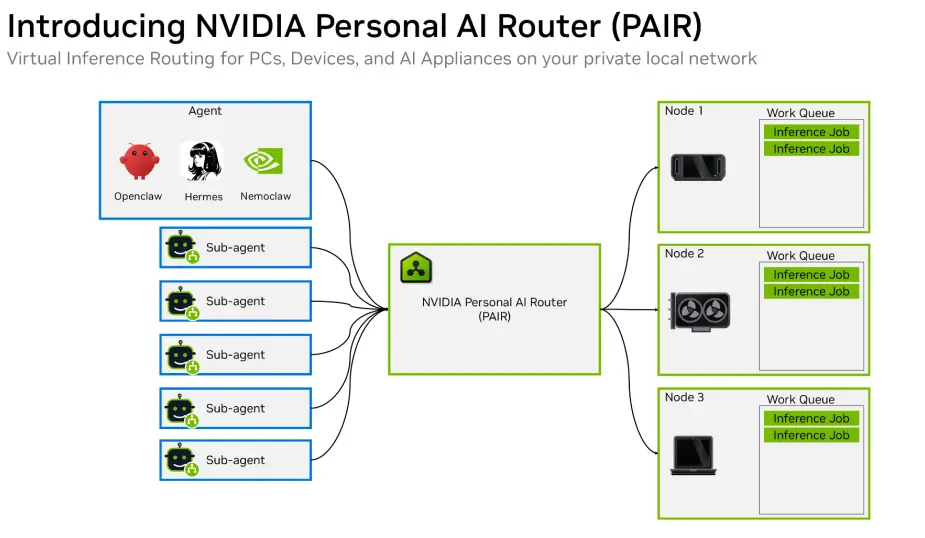
NVIDIA PAIR transparently distributes inference requests for processing on the local network
An example provided by NVIDIA concerns Hermes Agentused to create several subagents tasked with analyzing a mailbox and building a business plan. In an unofficial and specific demonstration for that configuration, a five-subagent load based on Qwen3.6 35B A3B took an average of 6 minutes and 18 seconds using a single RTX 5090, while the PAIR configuration with two RTX 5090s completed the same job in 3 minutes and 48 seconds. NVIDIA specifies that the result does not constitute a general benchmark and that the gain depends on the parallelism of the load, the model, the network and the availability of the nodes.
PAIR is available in beta for Windows, macOS and Linuxeither through a graphical interface or via a terminal. GeForce RTX 2000 and later, RTX PRO with Turing architecture or newer, NVIDIA DGX Spark, and Apple systems based on M4 chips or later are supported. The project is also open source, and NVIDIA invites developers to review the code and contribute to development.
In addition to PAIR, NVIDIA also reports a series of interventions intended to make the use of local agents easier. Hermes Agent, OpenClaw and Perplexity Portable Computer are introducing simplified procedures for configuring models on RTX systems, reducing the need to manually intervene on models, inference servers and quantization parameters.
In the case of Perplexity Portable Computersupport for NVIDIA RTX GPUs with at least 24 GB of VRAM is extended to Windows and Linux. The system allows workflows to be executed locally without consuming credits, with the possibility of resorting to the cloud when additional capacity is needed. Sending content to the cloud requires user consent, as indicated by NVIDIA.
Hermes Agentdeveloped by Nous Research, focuses on a one-click configuration. The software should automatically detect the NVIDIA GPU, select the appropriate model and configuration, and use llama.cpp with NVIDIA optimizations, saving the user from manually downloading and tuning the model.
Also OpenClaw benefits from the collaboration between NVIDIA and Microsoft: the new application for Windows makes it easier to set up an optimized local model on RTX systems equipped with at least 24 GB of VRAM. NVIDIA lists OpenClaw as one of the leading projects in the open-agent ecosystem, with over 380,000 stars on GitHub according to data reported in the document.
Click to enlarge
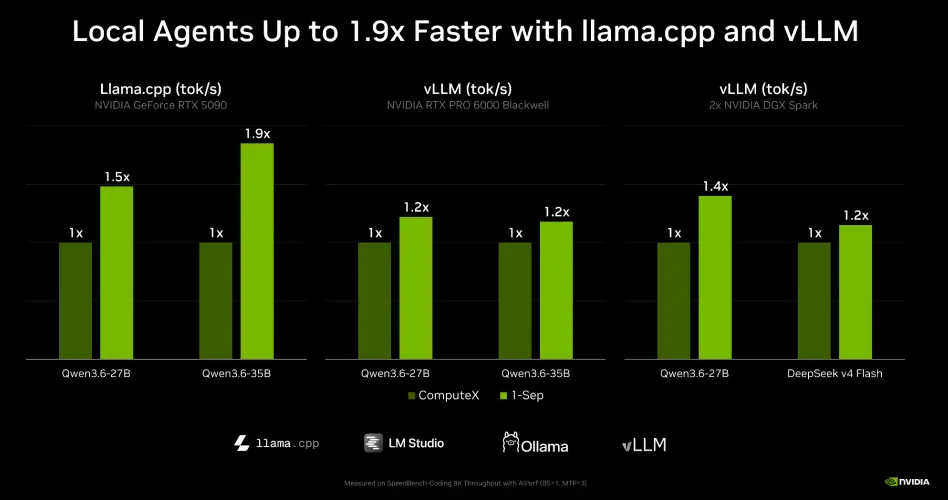
On the front of performanceNVIDIA also reports new optimizations for llama.cpp and vLLM. llama.cpp can achieve up to 1.9x higher throughput on GeForce RTX 5090 thanks to kernel optimizations, speculative decoding techniques, and faster prefill. vLLM instead reaches an increase of 1.2 times on RTX PRO 6000 Blackwell Workstation Edition and up to 1.4 times on configurations with two DGX Spark. Enhancements are available through LM Studio, Ollama, llama.cpp and vLLM.
In parallel, NVIDIA is expanding the ecosystem of models intended for local execution. Among the new features are mentioned Nemotron 3.5 Lightning30 billion parameter model usable on RTX, RTX PRO, DGX Spark and Jetson; GLM-5.3-Flash by Z.ai; Qwen3.8-Flash-Next and Qwen3.8-27B; LTX 2.5 for video generation; MiniMax-H3; Meta Muse Glimmer And DeepSeek v4 Flashthe latter with 284 billion parameters and 13 billion active parameters.
The other component of the ad is represented by NVIDIA RTX Sparkthe new Windows PC platform destined to arrive on the market in October with the first models from Acer and Lenovo, and soon from other OEMs.
NVIDIA indicates compatibility with the new Windows Agent framework, which allows agents to operate under the control of the operating system, but the RTX Spark ecosystem is also extending to creative software, with CyberLink PhotoDirector ready to support the platform.